
I am reading this in a cheap Spanish paperback edition, where it goes under the title Poirot in Egypt. In order that I do not miss too much in the translation, I am checking my understanding by reading in parallel the much more elegantly presented Folio Society edition.
One thing which has quite surprised me is that just like the lovingly illustrated Folio Society edition, my cheap Spanish paperback also features original illustrations – albeit line drawings which, therefore, do not require colour printing.
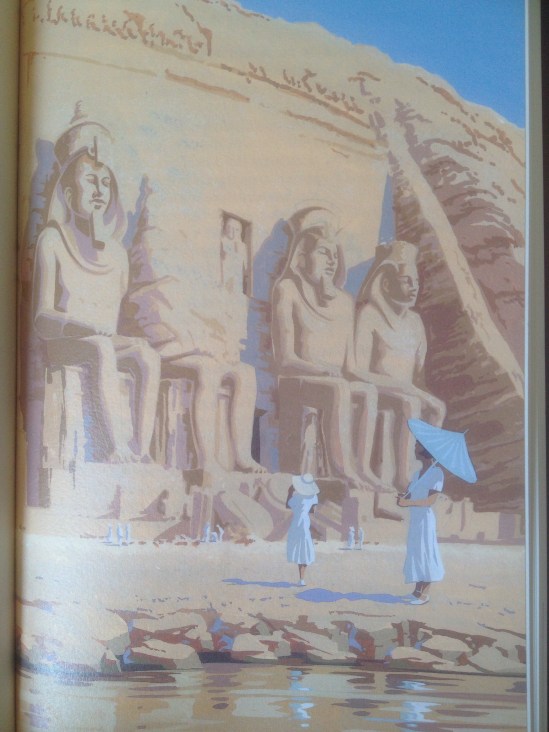
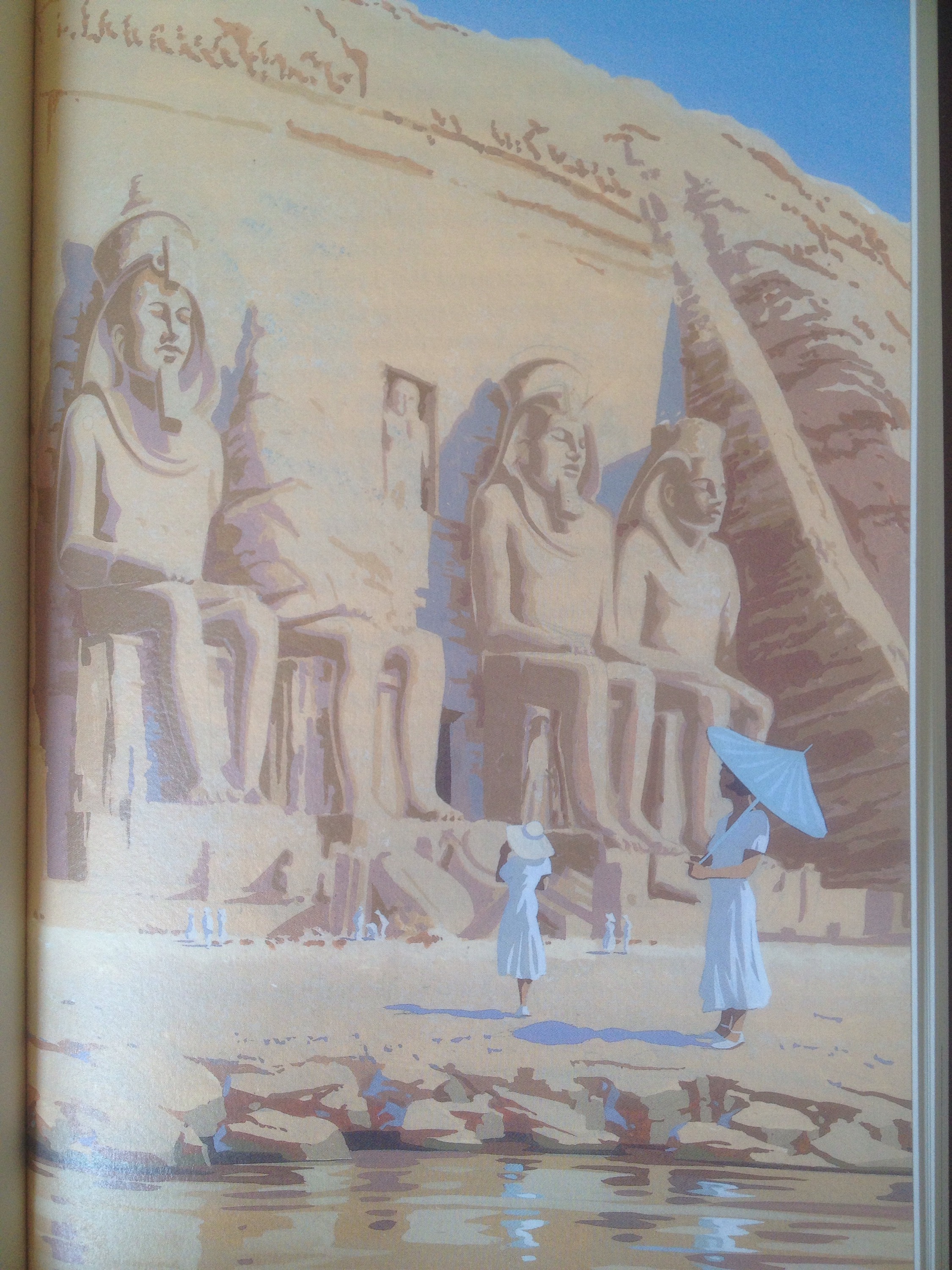
Interestingly, both editions select seven scenes from the novel to feature but only one scene is illustrated in both editions. This is when the Karnak on which the party is travelling along the Nile moors at the temple of Abu Simbel. This is such an iconic view which is, with the pyramids, a sight that absolutely captures the mysterious atmosphere of the ancient ruins of Egypt in the desert. It is therefore no surprise that both books should choose to use it.
Except they don’t quite.
The text from the novel reads: “The steamer was moored to the bank and a few hundred yards away, the morning sun just striking it, was a great temple carved out of the face of the rock. Four colossal figures, hewn out of the cliff, look out eternally over the Nile and face the rising sun.” And this is indeed what we see in the Folio Society edition illustration below.
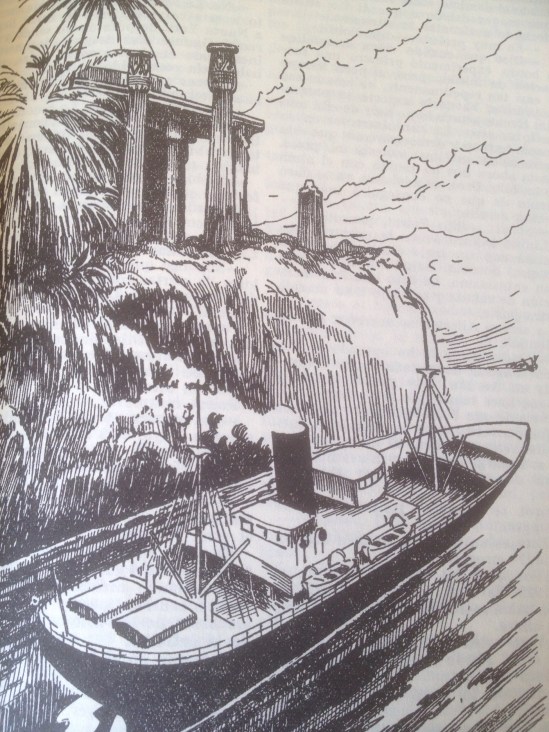
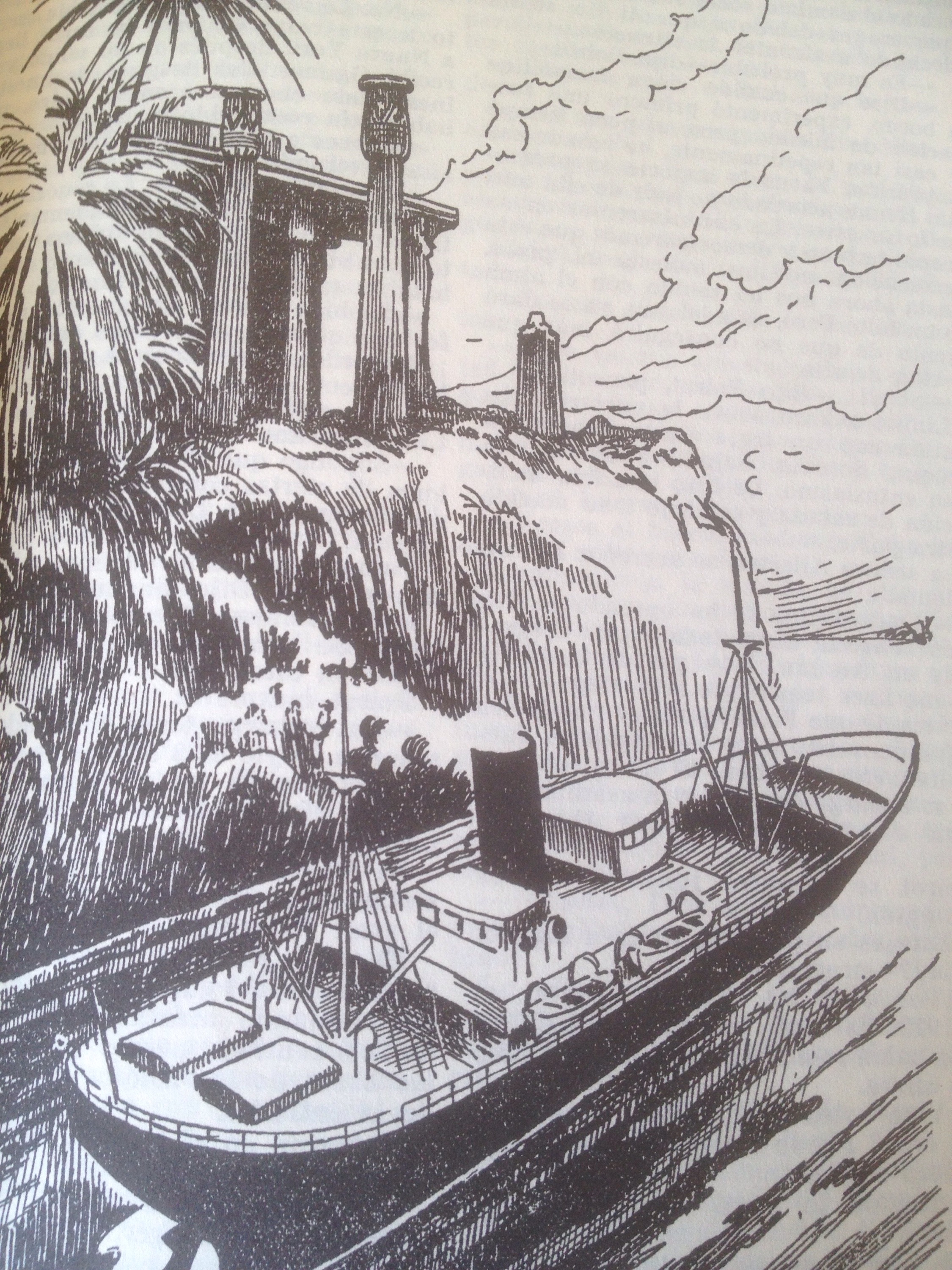
But in the Spanish translated version, the second sentence is omitted. The four figures are not mentioned. And the illustration, in consequence, drawn from the Spanish text, shows a wholly conventional free standing temple with columns such as might be seen at Luxor but not at Abu Simbel. Bizarrely, the temple at Abu Simbel does feature in the cover illustration of this version (see top image).
Indeed, one might speculate that the lower production values in the cheaper Spanish paperback meant that the illustrator was simply given a few lines from the novel and told to illustrate the caption. This may account for the layout of the Karnak in the picture which, of course, does not correspond to the deck plan included in both versions of the novel in a later chapter.
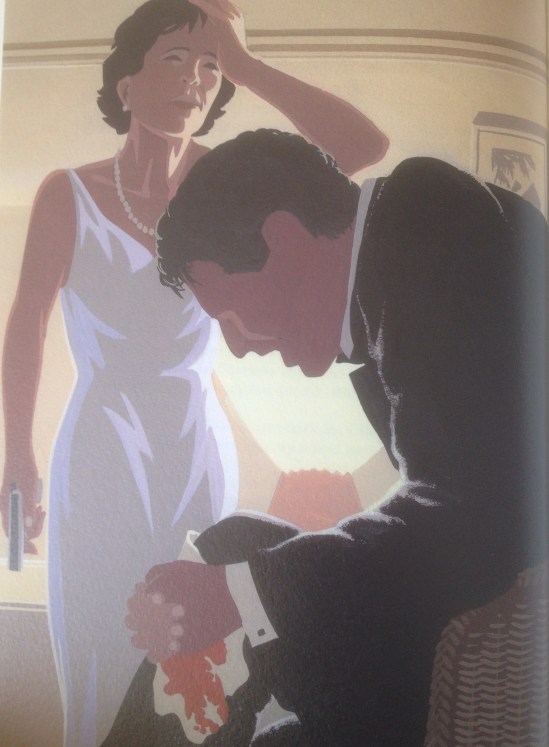
There are two other pairs of images which, although not depicting the same scenes, depict the same characters at critical moments in the plot. The Folio Society edition choses to show Jacqueline de Bellefort and Simon Doyle at the moment when he is clutching his leg after she has shot at him in a drunken rage.
The Spanish edition choses to show the two of them in the aftermath when Simon Doyle is recuperating in Dr Bessner’s cabin and Jacqueline de Bellefort in a moment of high melodrama begs for forgiveness. We also see here Hercules (note the different spelling) Poirot looking on. That moustache is certainly extra-ordinary but I think we have become so used to the tightly styled, trim, waxed moustache of David Suchet and Albert Finney that it does strike as odd when confronted for the first time.
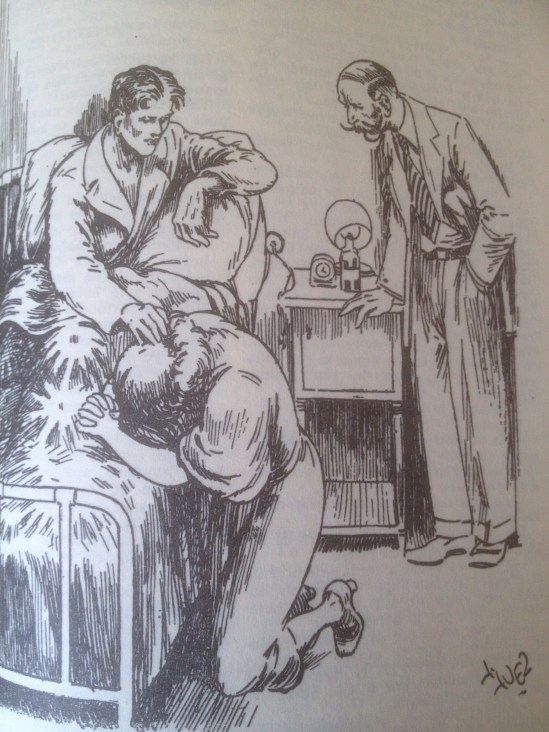
Indeed, Poirot appears a much slimmer character in the illustrations for the Spanish edition than we are used to seeing. There is no “embonpoint” for him to rejoice in, as we can see again in this illustration of the two detectives, Poirot and Colonel Race, examining the letter “J” scrawled on the wall of Linnet Doyle’s cabin in a blatant attempt to incriminate Jacquline de Bellefort. Indeed, Colonel Race is not how many English readers would imagine him in this illustration.

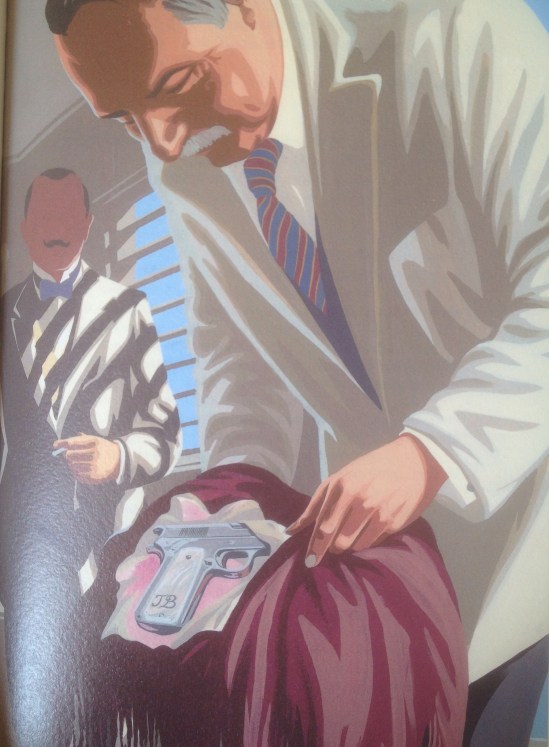
The Folio Society edition seems to represent Colonel Race more in line with English expectations (as indeed is Poirot) in this later scene when the two detectives find the murder weapon bearing Jacqueline’s de Bellefort’s initials.
I think it is fair to say that the illustrations in the two editions are in keeping with the expectations of their respective markets. The Folio Society hardback has beautifully reproduced colour images in muted pastel colours which ooze nostalgia and glamour in a way that will appeal to their more affluent readers; the cheap Spanish paperback – true to its pulp fiction aesthetics – focuses on the melodrama and, dare I say it, paints an altogether more black and white picture of the world.
Indeed, to avoid spoilers I have not shown here an illustration from the Spanish edition which depicts a murder with the murderer’s face showing an expression of such demonic fury and hatred that it would be worthy of the type of gurning that was shown in old silent movies accompanied by the captions like “No one calls me that and gets away with it. You’ll pay for that insult. I’ll get even with you if it’s the last thing I ever do.”
Mark





 The Bodies From The Library