
Continuing the analysis of Agatha Christie’s short stories to test whether the stereotypes hold true, I shall turn my attention to the Miss Marple stories. There are fewer of these than the Poirots; a mere twenty compared to more than fifty, but once again the analysis will go beyond the mere profiling of the murderer (though this is, of course, included) to examine the typical victim – if there is such a thing – and those crucial other factors: means and motive.
A crucial factor in the analysis is that out of these twenty stories, one is in fact a puzzle, which Miss Marple solves, in which there is no crime committed. Of the remainder fifteen are murders (there are no multiple murders) and four are other crimes: thefts or attempted swindles, including an attempt to frame someone for something they did not do. Since the thefts have multiple victims, these have been excluded from the analysis of the victims but, given the overwhelming majority of the crimes are murders, I have otherwise not distinguished between the murders and other crimes in the analysis.
Let us first consider the victim.
Here we find that the majority of the victims, more than two out of every three, are women.

When it comes to determining the age of the victim, Christie only explicitly states the age of the victim once or twice, although sometimes a broad age band is given – such as “over forty” – but where such definitive statements are is absent we are left looking for clues as to the victim’s age. One might infer, perhaps, that a couple are of a similar age unless a notable disparity is specifically mentioned. Or there are other clues, such as the fact that the victim has a child who is not yet adult, which implies perhaps that the person is in their thirties based on social customs of the inter-war period when the majority of these stories were written.
From these clues, the age range of the victims is perhaps younger than might be expected with more than one third being in their thirties and nearly a quarter in their forties. Barely a quarter of the victims appear to be over age fifty.

The stereotype would have it that Christie’s stories are set in a middle class milieu and so the victims might be expected to be middle class. For the purposes of the analysis, I have therefore tried to differentiate between the finely nuanced gradations of class in English society between the wars. The middle class could be broken down into upper-middle (usually richer, posher, living in the country rather than the town, often with private incomes rather than working for a living); middle-class (genteel and might still have a maid but not a “household” of servants, may be in one of the professions such as law or medicine) – Miss Marple herself falls within this category; lower-middle (working for a living but not in a manual type of job).
These categorisations are by no means hard and fast though there was probably less fluidity between them than there is now. Indeed, a working class boy (and it would almost certainly have been a boy in this period) who passed his eleven plus and managed to attend a grammar school and did well there so that he might become a solicitor’s clerk might by dint of these efforts find himself in the lower-middle class but could never hope to pass himself off as one of the truly middle-middle class. His voice and accent would betray him; and probably his taste and the choice of words for certain things – “tea” being a particular shibboleth. (A working class person, when referring to his “tea” ,would mean the main evening meal, eaten after returning home from work. A middle class person would mean the light meal – often comprising sandwiches and cakes – eaten in mid-afternoon.)
Even after making this gradation, however, the overwhelming majority of the victims fall into that middle class category that falls between the upper-middle and lower-middle classes.
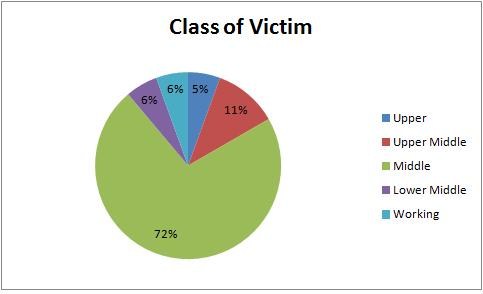
We can therefore build up a profile of the typical victim in one of the Miss Marple short stories. She will be a middle class female in her 30s. Inevitably only two of the sixteen individual victims actually fit this profile perfectly but six others fit at least two of the criteria (so half the victims exactly fit or at least closely fit the “typical” profile).
Turning to the perpetrators, we find that there is a marginally greater likelihood that the perpetrator will be a woman, acting either alone, or with another person (who might herself be a woman). We see no example of two men acting in consort.

The age of the perpetrator tends to be older than that of the typical victim, with over two-thirds of the perpetrators being in their forties or fifties (again, much reliance has to be placed on interpretation of evidence of likely age rather than being able to rely on Christie absolutely stating their age). There are apparently no particularly young perpetrators.

There is, however, a wider class distribution of perpetrators than victims of crime. The myth that the working class in Christie’s stories are merely there to provide a little background colour and humour is exploded by the finding that even within an apparently middle-class dominated setting, they commit at least one-fifth of all the crimes.

This enables us to build a profile of the typical murderer (for the crime as we have seen is much more likely to be murder in a Miss Marple story than in a Poirot story). She will be female, middle class and in her forties. This profile is a precise fit for four of the cases which is a remarkably accurate criminal profile – correct between 20% and 25% of the time. If we allow for those cases where the profile is accurate in two out of three respects, then the perpetrator is a close fit in a further five cases. This makes the profile reasonably accurate in about half the cases.
If we look at the relationship between the perpetrator and the victim of the crime, we find that the most common relationship is spouse. In fact this is invariably the husband – which is perhaps unsurprising given the majority of victims are female, though of course a husband could not satisfy the “typical profile” of the female perpetrator. Other relatives add a further five cases, so over half the murders are committed within the family.
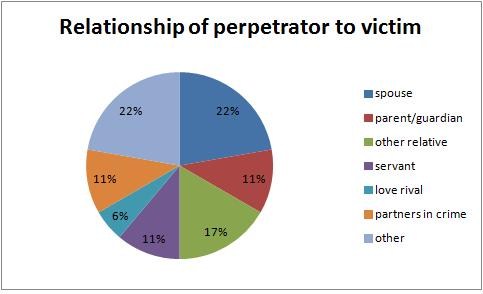
This domestic murder is perhaps to be expected in the Miss Marple stories. She is more likely to be involved in a purely domestic crime involving friends or neighbours than in other types of crime – though this rule might be stretched somewhat by the “story-telling” device which Christie uses for The Thirteen Problems/The Tuesday Night Club tales which are related by others including a senior police officer.
As might also be expected, given the preponderance of murders within the family, inheritance is the most common motive for the murder. However, given, as we have seen, that the typical perpetrator is older than the typical victim, this motive actually does not tend to feature in the cases where these profiles hold true. Inheritance is, therefore, likely to be a motive in cases where either the killer or victim does not fit the “typical” profile.

Frustrated love, as can be seen above, is the second most common motive, often with the killing of a person who is either a love rival or an obstacle to marriage with the “love interest” in the story.
It is often said that poison is a woman’s weapon. The lack of physical strength to carry out other types of murder is cited as the reason for this together with, in Christie’s case, her own background with training in a pharmacy during the First World War which gave her familiarity with poisons, how they worked and their effective doses so as to give her work a verisimilitude which others could only hope to emulate. It will come as no surprise, therefore, that poison is indeed the preferred method of dispatching the victim.
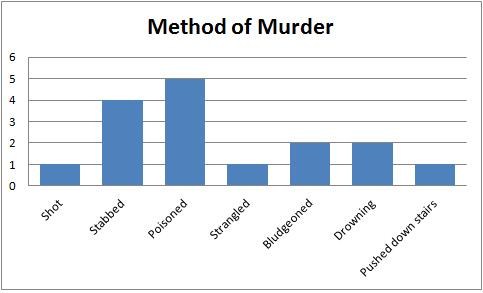
I should perhaps point out that one murder may be either a stabbing or a bludgeoning to death. This is never made clear but the solution depends on the perpetrator having got the blood of the victim on their clothing so it must be one or other of these two methods requiring the perpetrator to be close to the victim at the time they are done to death. It has been counted against both headings just to be on the safe side!
The other formula supposedly used by Christie is that of the country house murder. This seems to be supported by the evidence, with the majority of the crimes being committed in a country house setting or, failing that, in a rural village.
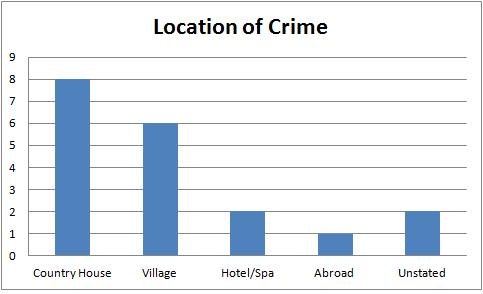
That is not to say that Miss Marple does not venture to the metropolis. One plot revolves around a plan she hatches to catch the criminals by a cunning use of “going up to town” shopping for linen to decoy them off the scent. And in another case, Miss Marple provides the solution for a murder done abroad without ever requiring a passport herself.
Nevertheless, that there should be no obvious urban setting for the Miss Marple stories is perhaps inevitable given that she is an elderly spinster living in a country village and mixing with people who live (and die) in similar locations. It would, in fact, be contrived of Christie to engineer many radically different settings for her Miss Marple short stories.
For the same reason, it is rare for Miss Marple to be involved other than after the fact. She then either correctly deduces who was the criminal or identifies the criminal enabling the authorities to catch them. In only three cases is she involved before the crime is attempted and in one of these she prevents it taking place, in another she enables the police to identify and apprehend the criminals. It is only in one case where she fails to prevent a murder and this she deeply laments though she observes that having put it off once she could not prevent the inevitable as the murderer could simply have waited until Miss Marple was no longer around before making a move. Would anyone take any notice of an old lady who says she knows a person has murder in their heart because she recognises the signs based on her experience of parallels in village life? Miss Marple thinks not, and I cannot disagree.
So, the analysis shows that Christie does conform to many of the stereotypes in her Miss Marple short stories with the middle class, country house settings for family or domestic crimes, that are often motivated by desire to inherit sooner rather than later after allowing time and nature to take its course. It is a measure of Christie’s abilities as a writer of detective fiction that she manages to weave so many fascinating and perplexing mysteries within the limited scope for variation she is constrained to accept with Miss Marple as her sleuth.

 The Bodies From The Library