The examination question used to be phrased along the lines: “compare and contrast…”
Having looked at each of Christie’s two greatest detectives in isolation, it is time to identify similarities and differences between them – or at least the short stories in which they appear.
If we consider the victims then we see that Poirot’s cases tend to have a bias towards male victims – they make up two-thirds of the victims – whereas Miss Marple’s cases almost exactly reverse this with slightly more than two-thirds of the victims being female.
A possible explanation for this is that Poirot, as a consulting private detective, is called in to investigate cases that are in the public domain whereas Miss Marple is more usually involved as an interested bystander in more domestic crimes. Since we are concerned with the period before the Second World War, the different spheres in which men and women moved are a significant factor. Generally, women at this time had a more domestic role than now. Married women tended not to go out to work but to stay at home and take responsibility for the household. Men, on the other hand, tended to go out to work as the main breadwinner of the family. Thus there would be a disproportionate number of men in any public setting and a proportionately greater number of women involved in a domestic scenario. Christie is therefore simply reflecting these differences in the proportion of each sex which falls victim to crime.
If we turn to the age profiles of the victims we find that there is again a discernible difference between the Poirot and the Miss Marple cases. The chart below shows the age of the victims – bear in mind that there are some 50 Poirot cases and only 20 Miss Marple cases so interpretation of the chart must take this imbalance into consideration.
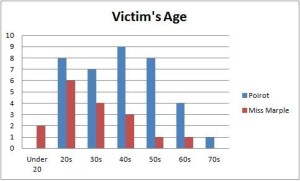
The ages of the victims in Miss Marple’s cases are decidedly skewed towards the younger end whereas there is a more even spread of victim’s ages in the Poirot cases with the most frequent age of the victims falling in their 40s.
This might again be attributable to the public nature of Poirot’s cases since the victims in this public arena would tend to require sufficient time to achieve whatever prominence in business or public life is required to precipitate their murder – or to enable them to acquire sufficient wealth to be worthwhile potential victims of some form of theft.
However, given the domestic nature of many of Miss Marple’s cases, and the tendency for inheritance to provide the motive for more of the crimes within the family (6 out of her 20 cases), it is perhaps surprising to find that the victims in the Miss Marple cases tend to be younger. It transpires that the inheritance motive tends to apply almost exclusively to the cases where the victim is at the older end of the range and that the young victims are more likely to be murdered for other reasons. Love (as in the removal of an inconvenient obstacle in the form of a current spouse, for example) is the second most common motive for murder in Miss Marple’s cases (4 out of the 20) and this is more naturally a greater concern to the younger age groups. So on deeper analysis we see a divide in Miss Marple’s cases between older victims killed for inheritance motives and younger victims killed for motives of (misplaced) love.


 The Bodies From The Library