If they are not to be accorded the regal status of the four Queens of Crime – and that does seem to be almost a surfeit already – then to what rank may we elevate Georgette Heyer and Josephine Tey? Perhaps they may be Grand Duchesses?
Neither, it must be said, concentrated exclusively on the Detective Fiction genre.
Heyer is probably better known for her historical romances, particularly those set in the Regency period. Indeed, she may be credited with inventing the sub-genre of Regency Romance, inspired by the subject matter and imitating the style (to a greater or lesser extent, depending on the practitioner’s skill) of the works of Jane Austen.
In this context, Heyer’s research was meticulous and she frequently included “explainers” in her works for the benefit of modern readers to which Austen, writing for a contemporary audience, never had need to resort. Whether or not these details were carried to excess and became obtrusive in her writing is a matter for debate but they were not found in her detective fiction which was set in the modern era.
In fact Heyer treated her detective fiction somewhat more casually than her historical fiction. The plots were frequently planned in outline by her husband and she wove the characters around them, bringing them to life with vivid dialogue and light humour. So cavalier was she that notoriously on one occasion she was said to have reached the denouement and had to ask her husband to remind her whodunnit and how before she could complete the novel.
Her two novels in the the Recommended Reading list for this year’s Bodies From The LIbrary Conference are Death in The Stocks and A Blunt Instrument. Both have a humourous tone – think of the Tommy and Tuppence adventure stories for an equivalent in the Christie canon. Both feature her series detective Superintendent Hannasyde and may be thought of as police procedurals though in both cases the procedure followed is somewhat unorthodox. In the former Hannasyde allows a relative of the deceased, who is also acting as legal advisor to more than one of the other family members who are prime suspects in the case, to have rather greater access to the investigation – accompanying the police to interview witnesses and/or suspects and allowing him to come and go to the Superintendent’s office in Scotland Yard – than might have been conventional even in those less strictly controlled times.
The light-hearted tone is maintained throughout the first novel by the almost callous disregard with which the family members treat the whole business of the murder and subsequent enquiry. If the dismissive one-liners lack the lightning quality of Noel Coward’s repartee, it is not for want of trying on Heyer’s part.
Much of the humour in the second book is also found in the dialogue – specifically the portentous religious pronouncements of a local constable who is involved in the case.
There is little doubt that Heyer saw both these works, and the remainder of her detective fiction, as pot-boilers, written solely to earn money. She managed to get herself into difficulties with the tax authorities and was frequently in sore need of money to pay the bills. She certainly held them in lower regard than her more serious historical fiction and in particular those which were based on real-life characters for which her capacity for research ensured an almost obsessive level of accuracy on even the most obscure details.
So while Christie too saw her writing principally as a means to earn a (very good) living, there is to my mind a seriousness in Christie’s approach to plotting and the production of her detective fiction which is absent from Heyer’s work.
Indeed, in the case of both the novels, I guessed whodunnit correctly fairly early in the books. The clues were a little too obvious and were played with too little sleight of hand to achieve Christie’s masterly level of misdirection. Ultimately this weakness may be why Heyer, in spite of her excelling in the historical romance genre, and in spite of her amusing and lively characters, and sparkling dialogue, falls short of the throne in the detective fiction genre.
The position of Josephine Tey is somewhat more complex. She was a successful playwright – her Richard of Bordeaux, written under the name Gordon Daviot that she also used originally to publish The Man In The Queue, which introduced her detective, Inspector Grant, was a West End phenomenon, running for more than a year.
She, however, seems to have taken a more serious approach to the detective fiction genre. Indeed two of her books, The Daughter of Time and The Franchise Affair appear in the top dozen works of mystery fiction selected by the Crime Writers’ Association in 1990. Neither of these is a conventional “whodunnit”. Tey’s work may, in fact, be characterised by a deliberate attempt to subvert the conventions of the detective fiction genre.
That said, The Man In The Queue, which is one of the recommended reads for the Bodies From The Library conference, actually harks back to the more traditional English thriller. It even includes a chase sequence across Highland scenery that would not have been out of place in The Thirty-Nine Steps. And, unlike both The Daughter of Time and The Franchise Affair, it may be seen as a fairly straightforward police procedural. Where it differs from the convention, perhaps, is that the detective spends much of his time investigating whether the prime suspect is in fact innocent.
A further twist on the conventions of the genre, though by no means unique to Tey – Dorothy L. Sayers did it in Whose Body? – is that there is also considerable time devoted to identifying the victim. This process is very different from how it might be if the story were set now. Instead of a multitude of means of identification that we all carry these days – credit cards, bank cards, work ID pass, mobile phone, driving licence, shop loyalty cards and so on (I counted 24 items in my own pockets, including my precious library card!) – the Inspector is at first flummoxed because the man has removed the laundry tags from his clothes. There can be few of us nowadays who even use a laundry service. (Again, my own experience of this is restricted to a couple of occasions on a long trip around south east Asia and I still have some shirts with small green threads attached to the labels which were the only markers used to identify my laundry. These would obviously not help detectives in discovering my identity.)
Instead Inspector Grant follows the lead offered by an unusually patterned tie which, in the days before it was possible to order clothes online, could be traced to a specific chain of shops and through them to the manufacturer who, using the dye colours, could indicate the batch in which the tie was produced and direct the police to the shop which received that batch for sale.
I would also mention at this point that the book contains an unpleasant reminder of the pervasive racism of British society of that time. The prime suspect is mentally pigeon-holed by Inspector Grant as “the dago” – firstly by the use of a knife in the murder which is not an English weapon of choice (a gun or bludgeon would be more manly) and then this is confirmed by his description by a witness of having a more tanned complexion than an Englishman might be expected to have. Grant then assumes that “the dago” – it is even used as a chapter title – will prefer to hide, “ratlike”, in the sewer/labyrinth of the city than to escape to the open air of the country. Later, a conversation is described in which mixed race marriage is held to be wrong and it is made clear that “I don’t mean black and white, but just different stocks of white”. It requires a substantial leap of imagination to inhabit a world where such views could not only be publicly espoused (not that I am attributing them to Tey, I should stress) by a protagonist in a novel but that this should be done without comment or without potential harm to sales from a resulting backlash of public opinion.
Brat Farrar, the second Josephine Tey novel on the recommended reading list, also works for the period when it was written when it would not if set in the modern era. The trope of the return of the heir to a fortune after a mysterious disappearance some years previously is possible in a pre-DNA testing era but no longer. The novel actually predates the discovery of DNA by only a couple of years, though of course forensic testing was still a long way in the future even after the discovery. Nowadays, any such person would be subject to simple tests which would establish whether he shared the same parents as his claimed siblings. Here though, cleverly, Tey’s novel is as much concerned with unraveling what happened at the time of the original disappearance as whether or not the eponymous Brat Farrar is, in fact, the heir to the estate he claims to be.
So, even though they depend to a greater or lesser extent on the state of detection being as it was back in “The Golden Age”, both The Man In The Queue and Brat Farrar do push at the boundaries of detective fiction, which is a hallmark of potential greatness. Why then is Tey not regarded as up there with Christie, Sayers, Allingham and Marsh?
I think part of the explanation lies in considering what makes a truly great Golden Age Detective Fiction novel.
Any great novel needs strong characterisation, good dialogue that sounds credible, suspense or other means of keeping the readers’ interest and making them want to read on, a distinctive writing style and a believable plot. It may even tell you more about the human spirit than you knew at the start and leave your life enriched and with a deeper understanding of the human condition.There are as many ways to achieve these as there are great novelists and a great novel may succeed where one or other of these “key features” is absent – usually because this absence is compensated for by an abundance the other qualities.
But for a novel to be a great detective fiction novel of the Golden Age, the genre demands a great puzzle and its solution. Thus a great novel, great in all the above respects, will fail to be a great detective fiction novel if at its heart the puzzle is mediocre. The puzzle becomes the glass ceiling to the status of the detective fiction novel. It may be a great novel but is mediocre as a piece of detective fiction. Conversely a great puzzle may elevate a mediocre novel within the detective fiction genre. A great puzzle may raise a mediocre book to the level of a good piece of detective fiction. Personally I would not attribute to the puzzle the power to raise a novel, mediocre in all other respects, to the status of a great detective fiction novel.
And I think it is in this respect that Josephine Tey (and Georgette Heyer too) falls short when compared with the likes of Christie and Sayers. The puzzles and solutions in the works of the Queens of Crime are more ingenious, the clues to the solution are more cunningly placed so as to give rise, after reading the denouement to that feeling of inevitability, the sense that “of course” it must have been so. This is true even where, as Sayers was prone to do, the solution doesn’t work (I can think of at least three ‘solutions’ where that is the case) or where, indeed, as in Berkeley’s The Poisoned Chocolates Case, the reader is presented with umpteen equally plausible solutions. The reader is carried along with the author’s flow.
In The Man In The Queue the eventual solution is delivered out of the blue and, unlike Christie where the detective – Poirot or Miss Marple – elucidates the reasons why that the reader has failed to spot in clues along the way, it is the murderer who fills in the gaps in the detective’s (and the reader’s) knowledge. Conversely, in Brat Farrar, like with the Heyer novels, I guessed the solution early, something that hardly ever happens to me in Christie or Sayers novels, because the clues were inadequately disguised.
So I am led to conclude that it is this falling short in the puzzle element – in setting it up or in its explication, which, in the final analysis, divides Tey from the Queens of Crime, though I have no hesitation in conferring on her the rank of Grand Duchess for her superb, playful messing with the conventions of the genre in each of her books I have read.


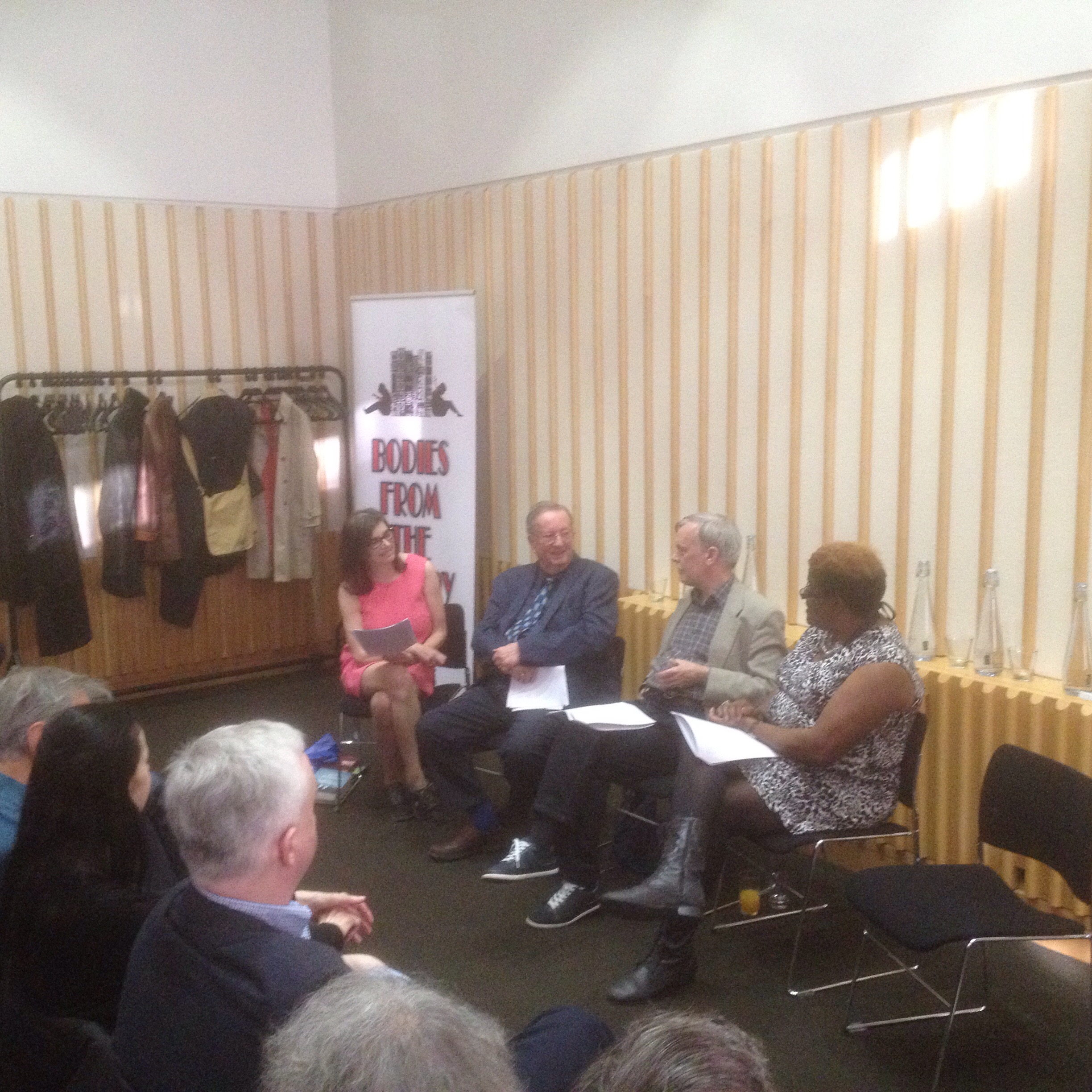


 The Bodies From The Library