Trends in Locked Room Mysteries (part 2/5)

Having considered the “big picture”, we can now turn to how the locked room mystery developed over time. What were the earliest preferred methods and did this change over time.

If we look at the fourteen earliest mysteries in our sample we see that in the era before the twentieth century, the murder from outside was already the favoured solution. However, perhaps more interesting is that some solutions, such as suicide rigged to look like a murder or the murder of a stunned victim by the first person into the locked room after the supposed murder has taken place, had yet to appear. We can therefore look to see when these innovations first appeared.
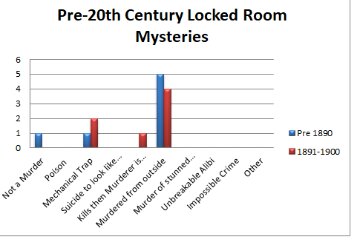
Clearly at this early stage in the evolution of the short story locked room mystery form, many of the types of solution have not yet been conceived so there is less variety in the types of solution – only three out of the seven types which Dickson Carr will later codify have appeared in the stories published before 1890.

As we move into the final decade of the nineteenth century there is still a concentration of the solutions with only three types represented. It is notable that already the mechanical trap has featured alongside murder from the outside in both the very early and the late nineteenth century solutions. It may be that such devices crossed over in appeal with the readership for the gothic thrillers which were also popular at that period. Wilkie Collins, for example, wrote in the gothic genre as well as in the crime/detection genre so there was perhaps a significant area of overlap between the two forms at that stage even though they have subsequently become quite distinct.

The last decade of the nineteenth century sees the first example of that complex timetable of events which sees a murderer’s entrances and exits from the room in which the murder takes place being apparently incompatible with their being involved in the perpetration of the crime. These kinds of intellectual puzzles are, therefore, already a feature from quite early in the genesis of the locked room mystery.
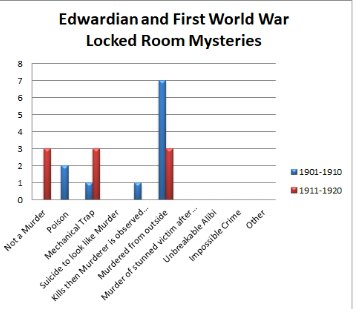
We see in the Edwardian era the first instances of poison appearing in the locked room genre. I think it important here to mention that this is not to say that poison was not a method used in earlier detective fiction but that this is when we first see it appearing as a part of a locked room solution.

We also see that during the second decade of the twentieth century – the era of the First World War – the prevalence of the murder from outside (which had been the favoured method hitherto and returned to its usual prominence afterward) is challenged.

In fact, the solution turning out to not be a murder at all is for the only time in the history of the genre, equally likely to be the case. Again, it is tempting to speculate on possible reasons for this. Perhaps, in an age which was seeing death on a massive scale through man-made wars, there was an impulse to find other causes for an unexplained death than just murder?

The range of causes does, however, remain more limited than it will later become. Indeed, there is less variety of method during the second decade then during the first decade of the century. Arguably this very lack of original new methods is an indicator of a pent up pressure which will build up and explode into the variety and ingenuity of the locked room mystery solutions in the Golden Age which followed on from this era.
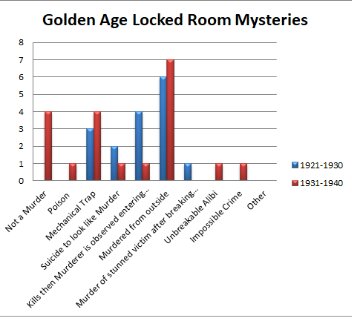
I would argue that the locked room genre reached its great flowering in this period. There was not only commercial pressure for writers to come up with new and ever more inventive (some might say contrived) solutions for their audiences but there was also perhaps greater awareness of the work of fellow exponents of the genre, for example through the social networks of the Detection Club which might enable an author to sound out plot ideas and, subtly, borrow from the ideas of others to build their own even more insoluble mysteries.

With the start of the Golden Age in the 1920s, we see more variety in the solutions than in previous decades. There are examples from five of Dickson Carr’s seven types of locked room mystery including two new types not seen before: suicides which have been made to look like murders and the murder of a stunned victim after the locked room has been unlocked.

And as we progress into the second decade of the Golden Age of those inter-war years, we have solutions in eight of the ten categories, covering all but one of Dickson Carr’s types plus examples for the first time of the unbreakable alibi and the impossible crime. The urge to satisfy the demand of readers for ever more ingenious puzzles is at its height now and this is reflected in the creative explosion of the Golden Age writers.

The years of the Second World War and the succeeding decade see for the first time a contraction in the variety of solutions. From a high point of eight out of ten types at the peak of the Golden Age we now find only four types in the war years and five in the next decade.
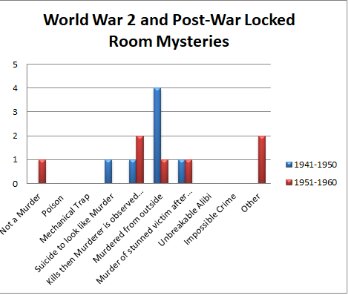
This turning away from the complex puzzles of the Golden Age might reflect a desire for a simpler world, where things are clear – divided into good and bad, black and white, which might suit a wartime mentality where the reader might feel somewhat “under siege”. Clarity is preferable to complication – more comforting.

The majority of solutions in the war years are of the “murder from the outside” type. This may unconsciously be reflecting the insularity of the reading population – wanting the psychological comfort of placing death and the murderer as coming from without rather than from within. Just as the wartime enemy is the other – the foreign – trying to invade the safety of the homeland.

In the 1950s we see also, for the first time, mysteries that fall outside the categories into which all the stories from earlier decades can be placed (or shoe-horned, if necessary). This “other” category may represent a new direction for the writers of detective fiction who remain attached to the locked room but must respond to the need for something different to challenge the readers.

As the locked room mystery continues to fall off in popularity as we move into the swinging sixties and the 1970s, the contraction in the range of solutions becomes marked. There are examples of only four of the different types by the 1960s and the most common, indeed the only type for which there is more than a single instance in the sample, is the “other” category. Did authors see this need to go beyond the traditional locked room genre as a desperate throw to stave off what seems to be a potentially terminal decline in the locked room genre?

By the 1970s the range has narrowed further with only three different types represented and, for the first time, none of the sample is an example of a locked room murder carried out from outside.

This decline continues into the 1980s with again only three different types of mystery being found in the now much contracted sample and only two of them are from the classic seven types outlined by Dickson Carr.
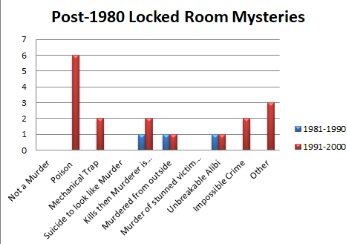
The above chart includes the 15 contemporary stories from the Mike Ashley edited compilation that were excluded, for reasons already given, from the main chart showing the number of stories produced by decade of writing and, unsurprisingly, given the artificial spike in the numbers of stories under consideration, we see a greater variety of solution. However, if these are excluded then there would be one poisoning and one unbreakable alibi only.

Again, though it is notable that nearly one third of the post-1990 stories feature solutions which are outside Dickson Carr’s original seven types, there is a resurgence of interest, in this artificially inflated sample, in the use of poison as the solution. Given this is arguably the simplest method of carrying out a murder without being physically present at the point of death, this makes for an uncomplicated solution to the locked room mystery in such cases. Perhaps this reflects a modern preference for realism over the joys of the puzzle while remaining true to the traditions of the genre.

Having considered the range of solutions on offer and developments in the relative emphasis placed on creating complex puzzles across the decades, it may be interesting to consider the rise and fall in popularity of each of the different types of locked room murder over time.

Taking the most common type of solution, the murder carried out by some means from outside the locked room, we see a very clear trend. This solution has progressively fallen out of favour from its high point in the Golden Age between the wars, reaching a nadir in the 1970s when there were no examples of this type of solution in the sample.
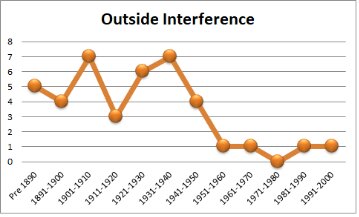
Given the eleven distinct sub-categories of this type identified by Adey, this decline suggests that there is progressively less interest, on the part of both writers and readers, from the Second World War onwards, in the more abstruse and ingenious but, perhaps, less plausible methods of “entry” that the murder required for this type of solution to work.
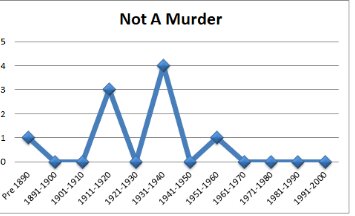
Turning now to Dickson Carr’s first type of locked room mystery, we see that there are two marked spikes in the prevalence of solutions where it was not, in fact, a murder. These occur in the decades 1911-1920 and 1931-1940. Could it be, since the first of these encompasses the years leading up to First World War and the second is the decade preceding the Second World War, that there is a sub-conscious reflection of the mood of the population in these years as international tensions rise and the risk of war looms. Is the twist that the murder was no murder at all evidence of wishful thinking that perhaps the political turmoil that threatens the readers may in the end be resolved without the outbreak of war?

Although it is impossible at this distance to establish any such causal link, the pattern is, as detectives of the Golden Age were so fond of saying, “suggestive”.

Poison (if we ignore the spike artificially created by the inclusion of Mike Ashley’s crop of contemporary locked room mysteries written specially in 2000) is little used as the solution for locked room mysteries. I am tempted to conclude that as a howdunnit it has little to baffle the reader looking for a puzzle. It is just too easy to explain how the murderer achieved his objective remotely. It is, ultimately, a dull solution and so, I think, was eschewed in favour of more esoteric and therefore more entertaining methods.
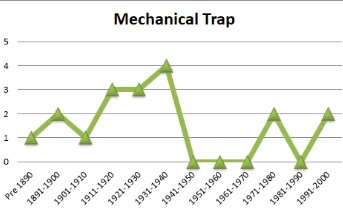
In contrast to the use of poison, the setting of a mechanical trap to bring about the murder of the victim clearly has appeal to the reader in search of a fantastic solution to the mystery. This type of locked room mystery scaled ever greater heights of invention to reach its peak in the second decade of the Golden Age before going off a proverbial cliff (sorry couldn’t resist that extended metaphor) in the Second World War with no examples at all in the sample from then until the 1970s.

Indeed, the level of mechanical ingenuity required, on the part of both author and their protagonist, to come up with these fiendish machines, which makes them a particular favourite of mine, may well have contributed to them subsequently dying a death (sorry, again) after the end of the puzzle oriented Golden Age. They hold, perhaps, the ultimate position on the spectrum of premeditation required – so no question of manslaughter here, other than on the grounds of diminished responsibility because only a madman would conceive of such a complicated way of achieving so simple an end – the death of the chosen victim. But they are so far away from the post-war shift towards more gritty realism that their decline seems almost inevitable.

As a solution to a locked room mystery, a suicide by a person who endeavours to give the appearance that they have been murdered by someone enjoyed a brief flowering in the Golden Age but fell into disuse after the Second World War.

This short period of “popularity” is perhaps accounted for by the psychological implausibility of the solution. Does anyone hate someone else so much that they would want to die in an effort to incriminate them so that they would be executed for the “crime”? Even if they are only bringing forward their death because they know they have a terminal illness and so they want to give their death meaning this remains hugely improbable given the desperation with which people will cling to life in even the most hopeless situations.

Clearly, once the death penalty for murder was removed (in the UK, if not in some states of the USA) then even that motivation becomes weak. No-one, surely, would commit suicide to try to get the object of their hatred locked away for a life sentence with the possibility of parole after only a handful of years. I see, therefore, little prospect of this type of solution being revived with any degree of success while ever there is no death penalty for murder.

Nevertheless, it represents an example of the way that authors in the Golden Age continued to find new, even if contrived, ways to puzzle their readers. The apparent victim “dunnit” is certainly a most unpredictable twist.

There is a clear peak in the popularity of the next type of solution proposed by Dickson Carr where the murderer somehow manages to effect the murder in the locked room but then be observed by unimpeachable witnesses to enter and or leave the room at a time which makes his or her involvement in the murder appear impossible. This type of solution requires great attention to the precise timing of the events described and for ways in which that timing might be, or at least insofar as it appears to the witnesses (and the reader), to be manipulated. It is essentially focused on the puzzle element of the timing and so it is no surprise that the peak popularity of this type of solution should have been in the Golden Age.
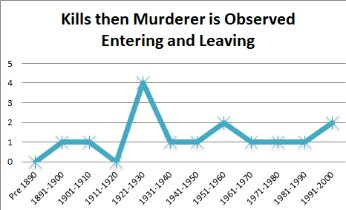
That the peak falls in the first decade of the Golden Age and is followed by a period of relative neglect of this potential solution suggests that this method was superseded by other types of solution, such as the increasingly complicated mechanical methods, which grew in popularity as the Golden Age progressed. Playing with the timing of the death is perhaps less “fun” for both the author to write and the reader to attempt to solve than these more involved puzzles which overtook it in popularity.

As a method though, it does continue to be used steadily throughout the subsequent decades when other methods have declined in use. This might be precisely because it does not rely on stretching the credulity of the reader too far. It remains a plausible way of trying to pull off a murder and get away with it without undue complication, and hence risk of failure, in the actual method of killing.

In contrast to some other types of solution, the murder of the pre-stunned victim by the first person on the supposed existing murder scene, or in through the door of the locked room after it has been broken down, although first used in the Golden Age, was not in favour during that inter-war period but rather retained a steady usage through the decades following the Second World War. It perhaps lacks the flair or flamboyance of some of the preferred Golden Age methods, relying as it does on swift, determined action on the part of the murderer who must retain his nerve in front of witnesses whose gaze he or she must attempt to mis-direct, rather after the fashion of a professional magician.

Looked at in this light, it can be seen why this solution might resonate with the post-war audience accustomed to a dour and unremarkable reality rather than flights of escapist fantasy.

It is interesting to note that having survived the early post-war decades, this type of solution was not found in the sample after 1980. Perhaps it is merely a reflection of the ongoing steady decline in the popularity of locked room mysteries outside the relatively limited number of aficionados of the genre.

Having exhausted the seven types of locked room mystery identified by Dickson Carr, we can now turn our attention to mysteries which, while absolutely in keeping with the spirit of the locked room, fall outside those original seven types.

The first of these is the Unbreakable Alibi (as distinct from Dickson Carr’s carefully choreographed entries and/or exits from the locked room which bamboozle the witness into believing the murderer was not, indeed could not be, guilty of the crime).
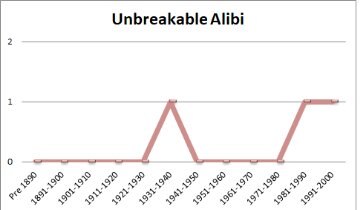
This type of solution first appeared in the latter half of the Golden Age but then disappeared and only re-surfaced again in the last decades of the twentieth century. At this point there was more emphasis on the psychological aspects in crime fiction and there was also increasing interest in the application of forensic science to the process of detection. I wonder if these priorities might account for the use of the unbreakable alibi in detective fiction latterly – where the forensic evidence, for example, points to a particular suspect, the tension in the story is derived from that person having an apparently unbreakable alibi.

The same might also apply to the next category; the so-called “impossible crime”. Appearances of this type of solution mirror exactly those of the unbreakable alibi with a first appearance in the second decade of the Golden Age followed by a period in the wilderness and a return at the end of the twentieth century. I am tempted to think that this pattern might, therefore, be subject to the same effects. The influence of television programming might also be a factor too. The trope of the locked room may be difficult to reproduce with sufficient variety in the visual settings and so authors of screenplays would be looking for something which while equally impossible is not constrained by the single concept that would quickly bore a TV audience if it reappeared constantly.


Which brings us to our final, catch-all grouping of “other”. These are the stories which no matter how I try, cannot be forced into any of the existing categories.

It is inevitable, I think, that these should all come in the last few decades of the century. Writers are by nature inventive and constantly look for new ways to entertain and, in the case of detective fiction, baffle their readers. The boundaries of the locked room must therefore be pushed further and further in pursuit of this aim until ultimately, they must be broken.

It is tempting to see this breaking out from the conventions occurring in the 1960s as in keeping with that decade’s more general throwing off of so many of the conventions of the older generation by the younger generation. Possibly as popular interest in the locked room genre declined, only a radical revolution in their production could revive them.

Seven Types of Locked Room Mystery (part 1/5)

Any analysis of locked room mysteries must begin with John Dickson Carr, the acknowledged master of the genre. He wrote more classic locked room mysteries, perhaps, than any other author and teased his readers with ingenious means by which seemingly impossible murders were pulled off in the confines of an apparently impregnable sealed room. The solutions to these puzzles – howdunnits – were required to be possible but need not necessarily be probable. Indeed, the murderer might frequently have carried out his crime more easily by other means. Means which might not have been investigated so closely as an apparently baffling and insoluble crime might be investigated. Who, after all, would call in the expert detective, when faced with an obvious, but wrong, solution?

In these stories, and frequently they were short stories rather than full length novels, where the tension of finding the solution to howdunnit questions is more difficult to maintain, greater emphasis was generally placed on the puzzle than on characterisation. Here, perhaps, even more than elsewhere in Detective Fiction of the Golden Age, solving the puzzle was the game being played between author and reader.

This analysis of the genre will examine trends in these mysteries over time and look at other factors which might influence the likelihood of one solution being favoured over another by the author. It may therefore assist you in directing your thinking to the more likely solutions for any given story but it will never give away a solution.

According to John Dickson Carr, there are no less than seven distinct types of locked room mystery. At least that is what his character Dr Fell tells the readers in chapter seventeen of his 1935 classic The Hollow Man (widely regarded as one of the masterpieces of that genre). To summarise Dr Fell’s categorisations as a reminder for those who have read the book some time ago or to enable those who have yet to do so to benefit from Dr Fell’s elucidation while skipping over the relevant chapter (as Dickson Carr invites them to do) so they can get on with the plot, the categories he proposes are:

1. The murder is not a murder but is, in fact, an accident. The circumstances are such that it appears there has been a murder but this is not the case. Instead there has been a fatal accident within the locked room. Hence no murderer was present or has made his escape without leaving any trace. Often the accident will involve a fall with the victim striking their head a blow on the fender. This method is becoming more difficult to carry off now with open fireplaces being replaced by central heating.

2. The murder is achieved by means of a poison gas which overcomes the victim (perhaps driving him into a frenzied paroxysm which causes damage to the furniture leading to investigators mistakenly believing a desperate fight has taken place between the victim and the murderer).

3. The murder is done by a mechanical trap planted in the room, which is set off by the victim while the murderer is safely elsewhere. The trick here is to make the method by which the trap is sprung undetectable and, if the trap is concealed, for the weapon to return to (or else remain in) its place of concealment after being triggered – such as a gun hidden in the workings of a clock which fires when the clock is being wound (a method which surely is falling out of fashion due to the inexorable rise of battery or mains electricity powered clocks).

4. It is suicide which is rigged up to look like murder, frequently with the intention of incriminating an innocent party against whom the suicide holds a grudge. The weapon might be an icicle with which the victim stabs himself. The icicle then melts, speeded no doubt by the fading body heat of the “victim”. In the absence of a weapon in the body, murder is presumed with the supposed murderer having made his escape with the weapon.

5. The murderer impersonates the victim after having first killed him. The murderer is later observed to enter the room disguised as the victim. He emerges immediately afterward having slipped out of the disguise thereby giving himself the alibi of having been seen to leave the room without having had sufficient time to commit the murder. The timing of the death is critical in this category; the elapsed time between actual and supposed later time of death must be sufficiently short for the body to be in an appropriate state of rigor mortis and at the correct post-mortem temperature.

6. The murderer manages to carry out the murder from outside the room in a manner which suggests that the murderer was inside the room to carry out the killing. Bullets made of ice, or even frozen blood, have been fired in through windows and subsequently melted leaving no trace to detect the method used.

7. This is the reverse of category 5. Here, the murderer has merely stunned or otherwise rendered the victim unconscious. They leave the room and after a suitable interval, during which no-one enters or leaves the now locked room, ensure they are on hand as efforts to break down the door are made. They ensure they are first into the room and in the initial confusion after entry is gained, they killed the unconscious victim swiftly – a stiletto is a favoured method – while misdirecting the others who have crashed into the room with them. This gives the impression that the victim has been lying dead in the hitherto locked room for some time.

If any of you are currently reading a book where it turns out that one of these tricks has been used, please don’t blame me for having outlined the method here. I’m only repeating Dr Fell’s 80 year old lecture which anyone can read for themselves.
Naturally, others have endeavoured to categorise such mysteries differently. Robert Adey in his book Locked Room Murders identifies twenty possible solutions:

1. Accident
2. Suicide
3. Remote control – the use of poison gas or the victim is impelled to kill themselves inadvertently
4. Mechanical or other devices
5. An animal carries out the murder
6. An outside intervention is made to appear as if the murder has taken place by a murderer inside the locked room, e.g. by throwing a dagger through a window at the victim from outside the room
7. The victim has been killed earlier but is made to appear as if they were alive at a later point
8. The victim is presumed to be dead but is in fact killed later than believed, e.g. by first person to enter the room
9. The victim is wounded outside the locked room but enters, locks the room and dies inside
10. The key, bolt or catch securing the door is manipulated from the outside, using pliers, string or some other device, to lock the door after the murderer has exited
11. The door or window of the room is unhinged and removed to gain entry and the murderer then replaces it after committing the crime
12. As above but confining the removal to a window pane
13. Entry to the room is gained by some acrobatic manoeuvre
14. The door is locked or wedged from the outside and the key is only replaced on the inside after entry to the room by those who find the body
15. As above but the key is returned into the room before everyone enters to discover the body
16. Other methods of gimmicking the door or windows
17. The murderer enters and exits through a secret panel or uses one to enable the weapon to be propelled at the victim
18. The murderer is in the room all the time
19. The murderer is provided with an alibi for the critical time when the murder is committed
20. Other impersonation stunts

It will be apparent that the more detailed breakdown suggested by Adey is a refinement of Dickson Carr’s approach. While it offers greater precision, for the purposes of statistical analysis it is more problematic. In order to draw meaningful conclusions from analysis of a sample, if there are twenty possible categories rather than seven, you will need a vastly larger sample to ensure that the resulting numbers are not spuriously accurate.

In fact, Adey’s twenty solutions can be allocated, or in some cases “shoehorned in”, as mere subsets to one or other of Dickson Carr’s categories.

As can be seen from the table, fully half of Adey’s twenty methods are variations on the theme which Dickson Carr pulls together under the catch-all heading of being achieved from outside.

Which brings me now to the vexed question of how to satisfy the ideal of selecting a random sample of locked room mysteries from which to draw statistically meaningful conclusions.
Out of the countless thousands of detective fiction stories I have neither the time, nor the boredom threshold to read them all and identify the “population” of locked room mysteries from which to derive a random sample for analysis. I must, therefore, fall back on a more practical method of selection. I will turn to a number of compilations, edited by recognised authorities on the genre, and trust that these will provide a suitably randomised sample for my purposes. I would contend that since the editors’ selections are based on aesthetic/literary grounds with an eye to commercial success, and not based on the criteria under which I am intending to make my analysis that their choices are suffieciently “random” for my purposes. It also, thankfully, means I get to read a selection of stories that the editors, whose views I respect on such matters, think are going to be amongst the best of the genre.

My sample for analysis is therefore the collected stories in the following compilations:

The Mammoth Book of Locked-Room Mysteries and Impossible Crimes edited by Mike Ashley

Miraculous Mysteries: Locked-Room Murders and Impossible Crimes edited by Martin Edwards

Ye Olde Book of Locked Room Conundrums edited by J.J.

The Black Lizard Big Book of Locked Room Mysteries edited by Otto Penzler

These give me a sample for analysis of 114 stories which should suffice to draw some meaningful conclusions about the writing, and reading, of locked room mysteries.

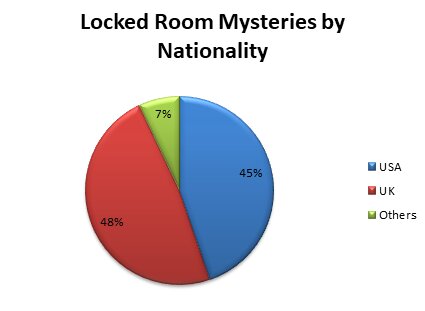
The first caveat I have to stress is that I am reading in English which gives a huge bias towards the UK and US markets for detective fiction. The “other category” includes Ireland, South Africa and Australia – all native English speaking – with only a couple of translations from the original French. This sample therefore doesn’t reflect the diversity of locked room story-writing globally but does reflect the paucity of translations of short-stories – sadly a reflection of commercial constraints, there being little profit in a short story sale compared to a sale of a novel which might therefore be worth translating for the English speaking markets. I would also add that the slight weighting in favour of UK over US mysteries is largely attributable to the selection of stories in the Martin Edwards compilation which is devoted to UK writers of the genre.

The period covered by the four compilations starts in 480BC (a single outlying example in the J.J. compilation) but really starts in the first half of the nineteenth century.

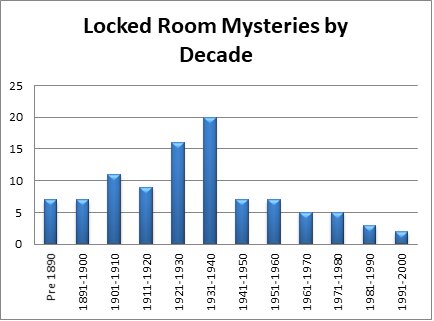
The chart shows a growing interest in the locked room mysteries from the beginnings of modern detective fiction in the nineteenth century through to the second world war. There is then a marked decline up to the current time. It is not too strong to describe interest in the genre as going off a cliff edge during the second world war. It is interesting to speculate why this might be. One possibility is the shift away from the puzzle element of the Golden Age of detective fiction to a greater emphasis on character. Certainly the locked room mystery places less emphasis on characters and motivation and more on methodology of the criminal. Indeed, it is often as much a howdunnit? as a whodunnit? with consequence precedence of plot over psychological motivation.
I should also mention that the above chart excludes fifteen of the stories included in the Mike Ashley compilation on the grounds that this modern compilation was intended to feature heavily works written (some even commissioned for the compilation) by contemporary writers of the genre. Their inclusion would have resulted in a massive spike in the final decade of the chart which would distort the picture and create the impression of a resurgence which, while this may be enjoyed by a small but dedicated audience for locked room mysteries, is not an accurate reflection of a wider popular interest.

We can now look at how these 114 locked room mysteries fall into the categories outlined by Dickson Carr. In order to avoid yet more shoe-horning, I have included, in addition to the seven categories of Dr Fell’s lecture, three additional categories which I think are sufficiently distinct as to merit recording separately. These are: Unbreakable Alibis, Impossible Crimes (i.e. in the spirit of the locked room but not involving a locked room or its equivalent) and Others, as a catch all for stories that defy categorisation under any of the other headings no matter how hard I try to get them to conform to one or other of the headings.

As you might expect, the most common form of locked room solution is that the murder was committed from outside – often by one of the sub-headings identified by Adey. I ought to emphasise that none of these murders from outside is so mundane as simply shooting the victim through an open window, which would not count as a true locked room mystery unless, for example, it was done with a pistol which was subsequently tossed into the room to give the impression that the victim had killed himself and then dropped the weapon. (This would qualify as a crude locked room mystery but might be improved if somehow the murderer contrived to have the victim to have scorch marks or powder burns apparently from the shot to increase the evidence suggesting it was suicide.)
I have a particular fondness for the next most common approach, the mechanical trap. These generally demand a high degree of ingenuity on the part of the murderer to set the trap in such a way that it will not be evident afterwards how the trap worked but, perhaps, even more than other locked room types tend toward a plot-bias over character-bias in the construction of the story. That the murderers could have achieved their goal more simply and at less risk of either failure or of detection by the experts called in to solve the crime is one of the ways in which I am happy for my credulity to be stretched a little.

The third most common solution is one used extensively by Dickson Carr himself in which the murder is seen entering and/or leaving the room which is subsequently found locked thereby “proving” that he could not have dunnit. This solution relies on accurate timing and an ability to misdirect both readers and the all important witnesses who testify to the murderer’s movements.

Poisoning – so easily achieved by the murderer in absentia – and the supposed murder turning out not to be anything of the kind are the other most frequently encountered solutions but, to my mind, they lack the sparkle of the more complicated solutions which, I think, have greater appeal as puzzles. That said, some of the reasons why it was not a murder are thoroughly ingenious.

Wilkie Collins: The Lighthouse

Wilkie Collins wrote The Moonstone in 1868, arguably the first great novel of the detective fiction genre, which provided the blueprint – establishing the conventions, if you like – of the police procedural:fair play, concealing nothing significant from the reader that is known to the detective, etc. The Lighthouse is his two act play, written a little over a dozen years earlier in 1855, and itself based on his own short story Gabriel’s Morning, which he wrote in response to seeing the Eddystone lighthouse while in Cornwall. The story revolves around the reactions of three lighthouse keepers, trapped in the lighthouse for weeks by bad weather which has delayed the arrival of their supply vessel, to the involvement of one of their number in a crime some years previously which he reveals inadvertantly as his mind wanders in the delerium brought on by their desparate starvation.

The play was first performed by Charles Dickens and his friends in an amateur production at Dickens’s home, Tavistock House. The cast was Dickens, Wilkie Collins, Augustus Egg (the famous painter and regular companion of Dickens and Collins on their hiking -and other less salubrious – expeditions), Mark Lemon (founding editor of Punch satirical magazine), Georgine Hogarth (Dickens’s sister-in-law), Naomi Dickens (Charles’s eldest daughter) and John Foster, with Dickens’s son Charlie responsible for special effects such as the noises off for the storm. Although technically an amateur company, thriugh Dickens’s connections they drew on west end theatre expertise to support the production. The painted backdrop (part of which is reproduced above) measuring some 3 metres by 4 metres was by leading marine artist Clarkson Frederick Stanfield.

The play was performed on two nights, opening on 18th June 1855, plus a dress rehearsal in front of the family, and the 25 seats were over-subscribed. It is not clear precisely who was in the audience on these two nights but regular attendees at such amateur theatricals put on by Dickens included Alfred Lord Tennyson, William Cavendish – Duke of Devonshire, novelist Anthony Trollope and reformer Baroness Angela Burdett-Coutts. Reviews were favourable with Dickens and Lemon singled out for particular praise for their “display of passion”. Wilkie himself was thought to be somewhat less convincing.

The staged reading of the play on Saturday 14th October by the Speakeasy Players, preceded by an introduction by Jak Stringer, was the first public performance of the play for 146 years. The modern audience greeted this Victorian melodrama with enthusiasm, joining in with applause, laughter and gasps of horror at appropriate points. The dramatic climax of the first act, when the name of the ship foundering on the lighthouse rock is revealed to be the same as the victim of the crime all those years previously brought a genuine shiver down my spine.

Of course the world of theatrical drama has moved on from Wilkie’s gothic Victorian melodrama but this re-staging showed that there was a core of gripping psychological truth which he conveyed a century and a half ago that retains its power to grip an audience willing to enter into the spirit of its original production.

Barry Pike talks about Margery Allingham and Dorothy L. Sayers

Barry Pike gave a talk at the inaugural Bodies From The Library conference in 2015 describing the relationship between these two Queens of Crime, covering the parallels in the lives and writing careers. Now, for the first time, you can view Barry’s talk in full online either by visiting the Margery Allingham Society’s website where it can be found on the Allingham Archives page . Or you can view the video directly through the link below:

Barry Pike Bodies From The Library 2015