Poirot v Miss Marple: head to head

The examination question used to be phrased along the lines: “compare and contrast…”

Having looked at each of Christie’s two greatest detectives in isolation, it is time to identify similarities and differences between them – or at least the short stories in which they appear.

If we consider the victims then we see that Poirot’s cases tend to have a bias towards male victims – they make up two-thirds of the victims – whereas Miss Marple’s cases almost exactly reverse this with slightly more than two-thirds of the victims being female.

A possible explanation for this is that Poirot, as a consulting private detective, is called in to investigate cases that are in the public domain whereas Miss Marple is more usually involved as an interested bystander in more domestic crimes. Since we are concerned with the period before the Second World War, the different spheres in which men and women moved are a significant factor. Generally, women at this time had a more domestic role than now. Married women tended not to go out to work but to stay at home and take responsibility for the household. Men, on the other hand, tended to go out to work as the main breadwinner of the family. Thus there would be a disproportionate number of men in any public setting and a proportionately greater number of women involved in a domestic scenario. Christie is therefore simply reflecting these differences in the proportion of  each sex which falls victim to crime.

If we turn to the age profiles of the victims we find that there is again a discernible difference between the Poirot and the Miss Marple cases. The chart below shows the age of the victims – bear in mind that there are some 50 Poirot cases and only 20 Miss Marple cases so interpretation of the chart must take this imbalance into consideration.

victim age

The ages of the victims in Miss Marple’s cases are decidedly skewed towards the younger end whereas there is a more even spread of victim’s ages in the Poirot cases with the most frequent age of the victims falling in their 40s.

This might again be attributable to the public nature of Poirot’s cases since the victims in this public arena would tend to require sufficient time to achieve whatever prominence in business or public life is required to precipitate their murder – or to enable them to acquire sufficient wealth to be worthwhile potential victims of some form of theft.

However, given the domestic nature of many of Miss Marple’s cases, and the tendency for inheritance to provide the motive for more of the crimes within the family (6 out of her 20 cases), it is perhaps surprising to find that the victims in the Miss Marple cases tend to be younger. It transpires that the inheritance motive tends to apply almost exclusively to the cases where the victim is at the older end of the range and that the young victims are more likely to be murdered for other reasons.  Love (as in the removal of an inconvenient obstacle in the form of a current spouse, for example) is the second most common motive for murder in Miss Marple’s cases (4 out of the 20) and this is more naturally a greater concern to the younger age groups. So on deeper analysis we see a divide in Miss Marple’s cases between older victims killed for inheritance motives and younger victims killed for motives of (misplaced) love.


Early Bird Offer ends midnight tomorrow

Just a final reminder that if you haven’t secured your place at the 2016 Bodies From The Library Conference at the Early Bird 2015 price then there are less than 48 hours remaining in which to do so.

We look forward to seeing both old friends and new faces at the conference and hope you will be able to join us.

To book your place just click on the link on this page.

Only a few days remaining of Bodies From The Library Early Bird Offer Price

As the Festive Season draws ever closer, we wanted to remind you that there is still time to book your tickets for The Bodies From The Library 2016 at the special early bird price of £30.06.  We have held the price at the same level as the 2015 event (give or take 6p extra booking fee) which we hope you will agree is great value for money.

Many of the audience’s favourite speakers will be returning next year, talking about authors we couldn’t fit into the 2015 programme. There will also be new speakers to be announced soon, including the author of one of the Crime Writers’ Association Top 100 Crime Novels.
We do hope you will join us at the British Library for the Bodies From The Library 2016, taking place on Saturday 11th June.
So why not book your tickets now before the price rises to £35.18 on the 1st of January. They will make an ideal Christmas present for the Golden Age Detective Fiction fan and will give them and you something to look forward to in the New Year.
We wish you a Safe, Peaceful Christmas and a Happy New Year!

Bodies From The Library 2016: first speakers confirmed

We are delighted to be able to announce the first speakers confirmed for the Bodies From The Library conference 2016. We are particularly pleased to welcome back several of the popular speakers from the first conference.

Confirmed returning speakers are:

David Brawn
17_DAVID_BRAWN

Dr John Curran
john curran

Martin Edwards
91b8f77a48810a22d17a30.L._V192619436_SX200_

Dolores Gordon-Smith
author pictures 016

Jake Kerridge
2011661156520193

B. A. Pike
Barry Pike

L.C. Tyler
P1000417

More speakers, including the female author of one of the Top 100 Crime Novels of All Time, according to the list compiled by the Crime Writers’ Association, will be announced shortly.

Miss Marple: The Bodycount Rises

Continuing the analysis of Agatha Christie’s short stories to test whether the stereotypes hold true, I shall turn my attention to the Miss Marple stories.  There are fewer of these than the Poirots; a mere twenty compared to more than fifty, but once again the analysis will go beyond the mere profiling of the murderer (though this is, of course, included) to examine the typical victim – if there is such a thing – and those crucial other factors: means and motive.

A crucial factor in the analysis is that out of these twenty stories, one is in fact a puzzle, which Miss Marple solves, in which there is no crime committed. Of the remainder fifteen are murders (there are no multiple murders) and four are other crimes: thefts or attempted swindles, including an attempt to frame someone for something they did not do. Since the thefts have multiple victims, these have been excluded from the analysis of the victims but, given the overwhelming majority of the crimes are murders, I have otherwise not distinguished between the murders and other crimes in the analysis.

Let us first consider the victim.

Here we find that the majority of the victims, more than two out of every three, are women.

marple victim gender

When it comes to determining the age of the victim, Christie only explicitly states the age of the victim once or twice, although sometimes a broad age band is given – such as “over forty” – but where such definitive statements are is absent we are left looking for clues as to the victim’s age.  One might infer, perhaps, that a couple are of a similar age unless a notable disparity is specifically mentioned. Or there are other clues, such as the fact that the victim has a child who is not yet adult, which implies perhaps that the person is in their thirties based on social customs of the inter-war period when the majority of these stories were written.

From these clues, the age range of the victims is perhaps younger than might be expected with more than one third being in their thirties and nearly a quarter in their forties. Barely a quarter of the victims appear to be over age fifty.

marple victim ages

The stereotype would have it that Christie’s stories are set in a middle class milieu and so the victims might be expected to be middle class. For the purposes of the analysis, I have therefore tried to differentiate between the finely nuanced gradations of class in English society between the wars. The middle class could be broken down into upper-middle (usually richer, posher, living in the country rather than the town, often with private incomes rather than working for a living); middle-class (genteel and might still have a maid but not a “household” of servants, may be in one of the professions such as law or medicine) – Miss Marple herself falls within this category; lower-middle (working for a living but not in a manual type of job).

These categorisations are by no means hard and fast though there was probably less fluidity between them than there is now. Indeed, a working class boy (and it would almost certainly have been a boy in this period) who passed his eleven plus and managed to attend a grammar school and did well there so that he might become a solicitor’s clerk might by dint of these efforts find himself in the lower-middle class but could never hope to pass himself off as one of the truly middle-middle class.  His voice and accent would betray him; and probably his taste and the choice of words for certain things – “tea” being a particular shibboleth. (A working class person, when referring to his “tea” ,would mean the main evening meal, eaten after returning home from work. A middle class person would mean the light meal – often comprising sandwiches and cakes – eaten in mid-afternoon.)

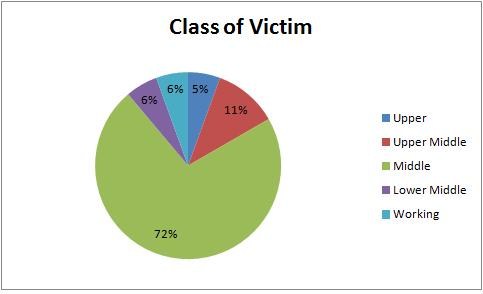
Even after making this gradation, however, the overwhelming majority of the victims fall into that middle class category that falls between the upper-middle and lower-middle classes.

marple victim class

We can therefore build up a profile of the typical victim in one of the Miss Marple short stories. She will be a middle class female in her 30s. Inevitably only two of the sixteen individual victims actually fit this profile perfectly but six others fit at least two of the criteria (so half the victims exactly fit or at least closely fit the “typical” profile).

Turning to the perpetrators, we find that there is a marginally greater likelihood that the perpetrator will be a woman, acting either alone, or with another person (who might herself be a woman). We see no example of two men acting in consort.

marple perpetrator gender

The age of the perpetrator tends to be older than that of the typical victim, with over two-thirds of the perpetrators being in their forties or fifties (again, much reliance has to be placed on interpretation of evidence of likely age rather than being able to rely on Christie absolutely stating their age). There are apparently no particularly young perpetrators.
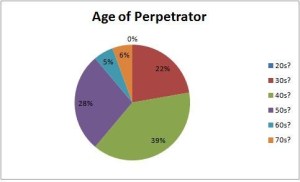
marple perpetrator age

There is, however, a wider class distribution of perpetrators than victims of crime. The myth that the working class in Christie’s stories are merely there to provide a little background colour and humour is exploded by the finding that even within an apparently middle-class dominated setting, they commit at least one-fifth of all the crimes.

marple perpetrator class

This enables us to build a profile of the typical murderer (for the crime as we have seen is much more likely to be murder in a Miss Marple story than in a Poirot story). She will be female, middle class and in her forties. This profile is a precise fit for four of the cases which is a remarkably accurate criminal profile – correct between 20% and 25% of the time.  If we allow for those cases where the profile is accurate in two out of three respects, then the perpetrator is a close fit in a further five cases.  This makes the profile reasonably accurate in about half the cases.

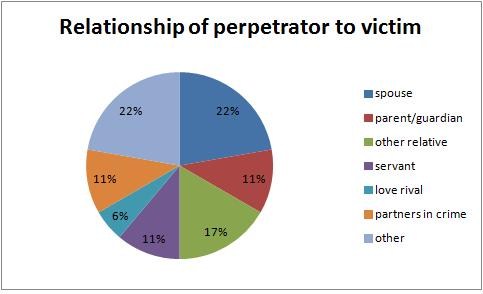
If we look at the relationship between the perpetrator and the victim of the crime, we find that the most common relationship is spouse.  In fact this is invariably the husband – which is perhaps unsurprising given the majority of victims are female, though of course a husband could not satisfy the “typical profile” of the female perpetrator. Other relatives add a further five cases, so over half the murders are committed within the family.
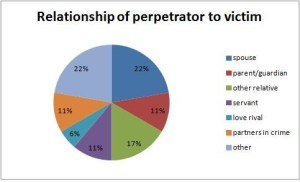
Marple perpetrator relationship

This domestic murder is perhaps to be expected in the Miss Marple stories. She is more likely to be involved in a purely domestic crime involving friends or neighbours than in other types of crime – though this rule might be stretched somewhat by the “story-telling” device which Christie uses for The Thirteen Problems/The Tuesday Night Club tales which are related by others including a senior police officer.

As might also be expected, given the preponderance of murders within the family, inheritance is the most common motive for the murder.  However, given, as we have seen, that the typical perpetrator is older than the typical victim, this motive actually does not tend to feature in the cases where these profiles hold true.  Inheritance is, therefore, likely to be a motive in cases where either the killer or victim does not fit the “typical” profile.
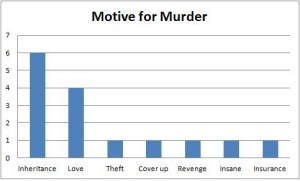
marple motive

Frustrated love, as can be seen above, is the second most common motive, often with the killing of a person who is either a love rival or an obstacle to marriage with the “love interest” in the story.

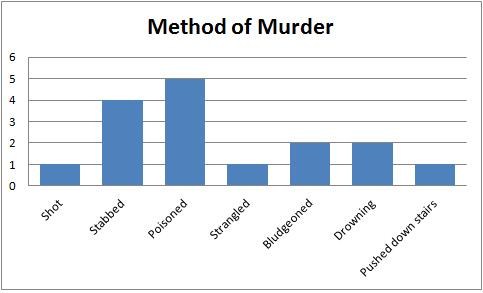
It is often said that poison is a woman’s weapon.  The lack of physical strength to carry out other types of murder is cited as the reason for this together with, in Christie’s case, her own background with training in a pharmacy during the First World War which gave her familiarity with poisons, how they worked and their effective doses so as to give her work a verisimilitude which others could only hope to emulate. It will come as no surprise, therefore, that poison is indeed the preferred method of dispatching the victim.

marple means

I should perhaps point out that one murder may be either a stabbing or a bludgeoning to death.  This is never made clear but the solution depends on the perpetrator having got the blood of the victim on their clothing so it must be one or other of these two methods requiring the perpetrator to be close to the victim at the time they are done to death.  It has been counted against both headings just to be on the safe side!

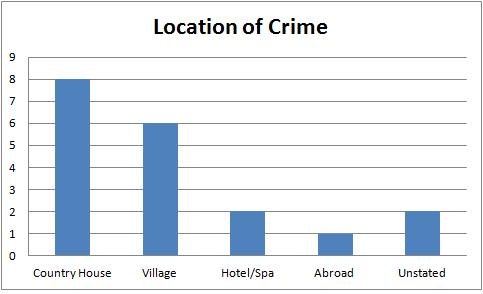
The other formula supposedly used by Christie is that of the country house murder. This seems to be supported by the evidence, with the majority of the crimes being committed in a country house setting or, failing that, in a rural village.

marple location

That is not to say that Miss Marple does not venture to the metropolis. One plot revolves around a plan she hatches to catch the criminals by a cunning use of “going up to town” shopping for linen to decoy them off the scent. And in another case, Miss Marple provides the solution for a murder done abroad without ever requiring a passport herself.

Nevertheless, that there should be no obvious urban setting for the Miss Marple stories is perhaps inevitable given that she is an elderly spinster living in a country village and mixing with people who live (and die) in similar locations. It would, in fact, be contrived of Christie to engineer many radically different settings for her Miss Marple short stories.

For the same reason, it is rare for Miss Marple to be involved other than after the fact.  She then either correctly deduces who was the criminal or identifies the criminal enabling the authorities to catch them. In only three cases is she involved before the crime is attempted and in one of these she prevents it taking place, in another she enables the police to identify and apprehend the criminals.  It is only in one case where she fails to prevent a murder and this she deeply laments though she observes that having put it off once she could not prevent the inevitable as the murderer could simply have waited until Miss Marple was no longer around before making a move. Would anyone take any notice of an old lady who says she knows a person has murder in their heart because she recognises the signs based on her experience of parallels in village life? Miss Marple thinks not, and I cannot disagree.

So, the analysis shows that Christie does conform to many of the stereotypes in her Miss Marple short stories with the middle class, country house settings for family or domestic crimes, that are often motivated by desire to inherit sooner rather than later after allowing time and nature to take its course.  It is a measure of Christie’s abilities as a writer of detective fiction that she manages to weave so many fascinating and perplexing mysteries within the limited scope for variation she is constrained to accept with Miss Marple as her sleuth.

Agatha Christie Kept It Simple – Dr John Curran

How did Agatha Christie, an otherwise unremarkable woman, with no formal education, and no family background in writing produce the biggest-selling books in history? How was this self-effacing woman able to set a standard in detective fiction that has never been surpassed, or indeed, equalled? Alone of her crime-writing contemporaries how was she able to turn a simple and formulaic entertainment into an international pastime for, seemingly, all time?

In both her own books and via my two books about her Notebooks, with their lists of her ‘Unused Ideas’, we can appreciate how her fund of ideas seems to have been inexhaustible; it was, in all likelihood, the envy of her fellow-writers. Throughout her life she was able to rattle off plot ideas and devices with enviable ease. And she could adopt and adapt an earlier idea in such a well-disguised fashion as to render it unrecognisable.

We do know where she got some of her characters and backgrounds. Poirot was given the nationality, Belgian, of WWI refugees arriving in 1916 Torquay and Miss Marple shared some characteristics with Christie’s grandmother. The Boyntons in Appointment with Death were inspired by fellow-passengers on a Nile cruise; Major Belcher, Archie’s boss with whom they travelled on a round-the-world trade mission in 1922, became Sir Eustace in The Man in the Brown Suit; a colleague from her dispensing days inspired a character in The Pale Horse, forty years later. And personal experience often provided a setting – the geography of Burgh Island, off the Devon coast, appears unchanged in Evil under the Sun; the swimming-pool of the actor Francis L. Sullivan (a West End Poirot) provided the murder scene in The Hollow; her own home and garden at Greenway is the setting for Dead Man’s Folly and Five Little Pigs. The Orient Express, an archaeological dig, a sea voyage, a Caribbean holiday – all these personally-experienced backgrounds were put to good (or should that be bad?) use over a half-century of writing. We even know the origins of some plots: the device underlying Lord Edgware Dies was stimulated by a performance by the American actress Ruth Draper; The Mysterious Mr. Quin was inspired by the Harlequin figures from her childhood home, The Mousetrap had its origins in a tragic true-life crime and Death Comes as the End was written at the instigation of Stephen Glanville, a colleague of her husband Max Mallowan. Her knowledge of poisons from her WWI dispensing experience provided her with many plot ideas, well-loved children’s nursery rhymes lent themselves to sinister interpretations and a love throughout her life of crosswords and bridge no doubt stimulated her ‘little grey cells’.

In Agatha Christie’s Secret Notebooks I speculated about her continuing appeal and offered possible reasons – readability, plotting, fairness and productivity.  And I still believe that they are of paramount importance in explaining her worldwide and enduring popularity. But I would add another factor and this may be the most important of all – simplicity. Although at first glance an Agatha Christie murder mystery may seem complicated, her last-chapter explanation always shows the underlying answer to be straightforward. When one simple fact is grasped, all the other pieces of the puzzle click neatly into place. But these simple facts of everyday life that provided many of her ingenious ideas and which Agatha Christie turned into an annual bestseller are observable to all. Everybody knows that…

…some names can be male or female, that nicknames and diminutives can be misleading, or that foreign names often use foreign alphabets…

Or

…that the best place to hide a murder is in a series of murders, or immediately after a natural death, or after an earlier ‘rehearsal’ murder…

Or

…that alibis no longer exist if Body A is identified as Body B and vice versa, or if a live body pretends to be a dead body, or if a killer is not acting alone…

Or

…that narrators are not always reliable, that policemen and children are not always innocent and that ‘foreigners’ are not necessarily guilty…

Or

…that mirrors reverse images, that suicide can be disguised as murder and that sometimes the most obvious person is the villain after all…

None of these facts depend on expert knowledge or an expensive education; they are all self-evident truths known to everyone. And it is on foundations such as these that, for over half-a-century, Agatha Christie built her clever structures of misdirection. Readers happily acknowledged her superiority and were content to let her fool them over and over in her annual Christie for Christmas. As her publishers put it in 1939 on the blurb for Murder is Easy: ‘Surely you won’t let Agatha Christie fool you again. That would be again, wouldn’t it?’ Over 70 years later they are still saying it.

Golden Age Scavenger Hunt

Vintage Golden Scavenger 2016

For those of you who like a challenge, and for those of you who like structure to your reading, may I recommend you visit the following site:

http://myreadersblock.blogspot.co.uk/2015/11/vintage-mystery-cover-scavenger-hunt.html

Here you can find details of a Scavenger Hunt Challenge for 2016. The idea is very simple. To complete the challenge you need to read Golden Age titles which feature the items listed in the Scavenger Hunt in their cover illustrations. There are 75 items to locate and, to make things just a teensy bit harder, a book can only be counted once even if it features more than one of the items listed. Could make for some tricky decisions as to which item is the “rarest” when deciding where to record a book in the list.

So I shall be hunting through my copies of Golden Age novels to see which to re-read with a view to making some quick inroads into that list in the New Year.

Mark

The Detection Club’s Fogginess

IMG_2673

I know, I know. Fogginess is part of what we look for in a Golden Age detective novel, if, by “Fogginess”, we mean the ability to cast a swirling haze of mystery over a labyrinthine plot so that we can be taken by surprise when the denouement looms shockingly out of the mist and upsets our every preconception of what has been going on up to that point.

But that’s not the type of “Fogginess” to which I refer.

Instead, I am concerned with the received wisdom that Agatha Christie wrote, for want of a better expression, “pulp fiction” but others, notably Dorothy L.Sayers, wrote, according to some at least, “literature”. I want to test whether that is true, and, if so, to what extent.

Measuring quality is surely an oxymoron. But that is what I am setting out to do. Quality of writing is, you might argue, a matter of style, of how the content is presented to the reader, and, of course, some ineffable something about the actual content itself. One can imagine Oscar Wilde or P. G. Wodehouse concocting aphorisms which positively ooze style but which on closer examination are found to be quite deliberately empty.

Yet there is a measure which might serve my purpose: the Gunning Fog Index. This elegant device neatly sidesteps questions of quality and considers matters purely from the perspective of the reading age it requires of the reader to enable them to make head nor tail of what is written.

My hypothesis is that a work of “literature” is more demanding to read than is a work of “pulp fiction”.

Put another way: a work of pulp fiction will be easier to read than a work of literature. The former might be read by a person with a reading age of 12 whereas the latter might require a person with a reading age of 18 or more.

For those who are interested, I include at the end a note on how the Gunning Fog Index is calculated but it is sufficient for our purposes to observe that writing which uses long sentences and long words is more demanding than writing which uses short sentences and short words. It is not for no reason that our earliest childhood books are filled with sentences like, “The cat sat on the mat.”

The rather brilliant Robert Gunning devised the Index in the early 1950s (so it’s not strictly a Golden Age creation) and it estimates how many years of schooling a given text demands of its readers to make sense of it. Thus a text with a Gunning Fog Index of 8 demands some eight years of schooling for its readers to make sense of it – i.e. it can generally be understood by a high school teenager. This is regarded as the benchmark for a piece to be “universally accessible”. A piece with a Gunning Fog Index of 12 or above, on the other hand, assumes a level of reading equivalent to university education.

On which basis, one might expect that Agatha Christie would have a lower Gunning Fox Index score for her writing than more supposedly literary contemporaries such as Dorothy L. Sayers or Anthony Berkeley.

The difficulty, of course, is that writers will tend to adapt their style, to a greater or lesser extent, to fit their supposed market. Think Roald Dahl. His style for his children’s book Charlie and the Chocolate Factory would be very different from that he employed in Kiss, Kiss, his collection of adult short stories.

Which is where the Detection Club comes into its own. During the 1930s, members of the Detective Club wrote a number of collaborative novels. Therefore, anything included in any one of these novels is, perforce, aimed at the same intended target audience. So a head to head comparison of the various sections of the five books written collectively by the different authors gives a direct and valid comparison of the complexity of their writing given each is writing for the same audience with the same purpose in mind.

The first collaboration by members of the Detection Club was Behind The Screen, published in 1930. This was written by E. C. Bentley, Anthony Berkeley, Agatha Christie, Ronald Knox, Dorothy L. Sayers and Hugh Walpole.

The chart below shows the Fog Index of each of the authors measured from a sample page selected at random from each of their contributions.

Behind the screen fog

It is notable that Agatha Christie and Ronald Knox use a markedly simpler style than do Anthony Berkeley, Dorothy L. Sayers and Hugh Walpole. The contributions by Christie and Knox might be read and understood by an 11 year old (assuming 5-6 years of schooling starting at age 5). Note however, that even the most complex style of Anthony Berkeley, demands a reading age of less than 14.

From which we conclude that Behind The Screen was intended for a universal audience and we see evidence to support the theory that Agatha Christie’s style was less demanding (and therefore arguably, less self-consciously literary) than that of her contemporaries Berkeley, Sayers and Walpole.

But is this pattern repeated in the next collaboration, The Scoop, published in 1931?

Inevitably, of course, we are faced with a different collection of writers in this second story: E. C. Bentley, Anthony Berkeley, Agatha Christie and Dorothy L. Sayers remain but Knox and Walpole are replaced by Freeman Wills Crofts and Clemence Dane.

Scoop fog

Here we see that there has been a distinct upward shift in the demands placed with all contributors aiming at a reading age of 12 and above.  Bentley has seen a marked shift upward to a Fog Index of 9.6, implying a reading age of over 14.  More surprisingly, for our theory that Sayers’ writing is more demanding of its readers than Christie’s we find that Sayers has a Fog Index of 6.0 (down from 8.0 in Behind The Screen) whereas Christie has a Fog Index of 6.9 (up from 5.6 in Behind The Screen).  The evidence of this second book, therefore, contradicts the theory that Sayers is a more demanding, and hence by implication, more literary writer than Christie.

Which brings us to the third, and arguably most famous collaborative effort: The Floating Admiral, also published in 1931. Once again we see Berkeley, Christie and Sayers amongst the usual suspects, penning sections of the novel. This time they are joined by a host of others: G. K. Chesterton, G. D. H. And M. Cole, Freeman Wills Crofts (again), Clemence Dane (once again), Edgar Jepson, Milward Kennedy, Ronald Knox (another return), John Rhode, Henry Wade and Victor L. Whitechurch.

Floating Admiral Fog

Now here things, as they say, start to get really interesting. Firstly we see a far greater inconsistency in style (in terms of the reading age at which each writer pitches his or her chapter). We have Clemence Dane, for example, “upping his game” (or should that be “her game” given this is the pseudonym of playwright Winifred Ashton) and writing a chapter with a Fog Index of 11.8 (demanding a reading age of about 17) while G. D. H. and M. Cole have a Fog Index of a mere 4.8 (making it readable by the typical 10 year old).

It is perhaps unsurprising that G. K. Chesterton’s prologue is demanding on its readers but we also see Dorothy L. Sayers rise to a more demanding Fog Index of 11.0 (reading age 16 or over) after the easing off for The Scoop. This leapfrogs Christie whose chapter once again has a Fog Index of 6.9. Perhaps we see here evidence of Christie having perfected a style which is pitched at precisely the level which is readily accessible to and matches her audience’s expectations.

A noteworthy feature though is Berkeley’s contribution which this time has a Fog Index of a mere 6.5 (reading age of less than 12). It appears that he has been making his style less demanding over the course of these three books.

Sadly for us in our efforts at making an ongoing comparison, this is the last collaboration in which Christie participated (don’t be fooled by her name featuring prominently on the covers, Harper Collins, wise to her bank-ability, have included in each volume essays by her which are unrelated to the main titles and not necessarily even written  contemporaneously with them) but as we move on to Ask A Policeman, published in 1933, we still see both Berkeley and Sayers involved. They are joined this time by: Milward Kennedy (again), Gladys Mitchell, John Rhode (again) and Helen Simpson.

Things are more complicated here as the authors involved were writing pastiches using each others’ detectives and so their personal styles may be overlaid with an exaggerated impersonation of their peers’ own styles.

Ask A Policeman Fog

The most remarkable feature of this collaboration is the contribution by Gladys Mitchell (borrowing Helen Simpson’s detective Sir John Saumarez -actually co-created by Simpson and Clemence Dane) which has a Fog Index of 15.2 (implying a reading age of a third year under-graduate student). This may, in fact, reflect the Clemence Dane influence on the style appropriate to that character rather than Simpson’s own, given Dane’s Fog Index of 11.8 in The Floating Admiral). So far out of line with the rest of her collaborators was this chapter that I actually selected a second page at random to double-check the Index score and, in fact, recorded an even higher Index the second time.

It is notable also that Berkeley has returned to a Fog Index of 8.7 which is more consistent with his contributions to Behind The Screen and The Scoop than his simplified style in The Floating Admiral. Mitchell’s contribution aside, his is the most demanding chapter. Sayers has returned to a less demanding style with a Fog Index of 7.6, making her the least consistent (or is that most erratic) of the regular contributors in terms of the fluctuating demands she places on her readers.

And so we come to the final fictional collaboration from the Golden Age Detection Club members, Six Against The Yard, published in 1936.  This features in addition to Berkeley and Sayers – the only authors to appear in all five titles: Margery Allingham (making her debut as a collaborator), Freeman Wills Crofts (making a welcome return), Ronald Knox (likewise) and Russell Thorndike.

I should perhaps mention that I am avoiding contaminating this analysis of the works of fiction with the potentially confusing element that might be introduced should I also bring into consideration the non-fiction true crime essay collection The Anatomy of Murder.

six against the yard fog

Here Sayers chapter is markedly more demanding than that of any of her collaborators with a Fog Index of 12.9 (requiring a reading age of 18) which is definitely not within the bounds regarded as “universally accessible”.

This is in marked contrast to the other contributors whose chapters range from a Fog Index of 5.4 (Allingham) to 8.5 (Knox) which would make them all accessible to the average reader. Indeed, Berkeley’s chapter has a Fog Index of 6.1, his simplest yet.

Indeed, if each book is considered as a whole, the overall trend has been one of increasingly demanding reading prior to this last book.  However, this upward trend is in part attributable to the high outliers in each of the preceding books (Sayers and Clemence Dane in the 12 author The Floating Admiral and Mitchell in Ask A Policeman).  Indeed, Sayers contribution to Six Against The Yard inflates its overall Fog Index which would otherwise be marginally the lowest of all five books. Overall though, all of the books fall within the reading capabilities of the typical teenager and so might be regarded as “universally accessible” – albeit with difficult chapters!

Average Fog

In all nineteen authors contributed to the five collaborative books published by The Detection Club in the 1930s. The following chart captures the Fog Index for all of their contributions. It is perhaps worth highlighting some key findings of the analysis.

There are certain authors (Chesterton, Dane, Mitchell and Sayers) whose contributions are markedly more “Foggy”. This finding is not inconsistent with the hypothesis that Fogginess is a reasonable proxy for measuring the literary quality of the writing, based on the premise that a more demanding read is likely to be a more satisfying literary experience (I would not venture to put it any more strongly than that).

It also provides evidence to support the assertion that Sayers (and Chesterton) were more literary writers (or at least more demanding of their readers) than was Christie. Indeed, Christie might be said to have found almost the “golden mean” with a consistent Fog Index in a narrow band between 5.6 and 6.9 making her “universally accessible” to potential readers. Sayers on the other hand is less consistent, sometimes writing simply but often, and particularly later when she was becoming more self-consciously literary and contemplating moving away from the prosaic world of Golden Age Detective Fiction, her work was to become significantly more demanding.

Berkeley is perhaps most interesting in that his Fog Index varies quite widely (his lowest Fog Index is 6.1 in Six Against The Yard which follows on immediately from his highest 8.7 in Ask A Policeman giving a variability  almost exactly twice that of Christie). On closer examination this may be an indication of him deliberately adopting different approaches for each piece. His chapter in Six Against The Yard, for example, is written in the tone of American pulp fiction of the time – a hard-boiled/noir voice with simplified delivery in short, sharp sentences and punchy vocabulary which naturally tends to lower the Fog Index.

Detection Club Authors Fog

For those who wish to understand more about the calculations used to derive the Gunning Fog Index, the formula takes into consideration the length of sentences (longer sentences raise the index) and the use of longer words (taken to be those with more than three syllables ignoring any names or other proper nouns).

Fog Index = 0.4 x ((Number of words in sample / Number of sentences in sample ) plus ((Number of words with more than three syllables in sample / Number of words in sample) x 100) )

For example: a sample page of 300 words, in 20 sentences, with 10 words of three or more syllables would have a Fog Index calculated as follows:

Fog Index = 0.4 x ((300/20) + ((10/300)*100))

                   = 0.4 x (15+3.333)

                   = 7.333

The 0.4 used in the calculation is the factor that Gunning decided was appropriate to derive a number that was meaningful in terms of years of education undergone (and hence reading age).

It is an arbitrary measure but, as can be seen from the above analysis of the Detection Club books, it is one that can produce meaningful results.

I should also point out that when carrying out the analysis, I found that several of the authors had a penchant for using semi-colons in their writing where now we would use full-stops. Thus they might have a huge, long sentence with several clauses, punctuated by semi-colons, with each clause capable of standing on its own as a grammatically acceptable sentence. Where I encountered this, I treated these clauses as if they were indeed sentences separated by full-stops for the purposes of calculating the Index. This ensured an approach consistent with current methods of punctuation, which have more or less eradicated the semi-colon from use in the way these Golden Age authors sometimes chose to use it. This approach is, I believe, justified, since readers in the Golden Age would have been habituated to this method of punctuation and would not have struggled with the resulting immense sentences in the way that a modern reader might.

Mark

Sleeping Murder

 Illustration by Andrew Davidson, taken from the Folio Society edition of the novel.

It is often said that Agatha Christie’s novels lack characterisation or that she employs two-dimensional stock characters to populate her village settings. If a reader wants psychological depth then he or she should look elsewhere – perhaps to Anthony Berkeley or Dorothy L. Sayers amongst her contemporaries of the Golden Age.

Whatever the truth behind such generalisations, there is no doubt that Christie did employ great psychological insight in more than one of her novels. Let’s face it, if she didn’t and the plots were always psychologically implausible she’d have gone out of fashion years ago. One such example of her penetration into the workings of the mind is to be found in the “last” Miss Marple case, Sleeping Murder. I say “last” because although it was published in 1976, shortly after her death, it was actually written in 1940*. Indeed the book is set in the late 1930s, mentioning His Majesty’s Theatre and the princesses Elizabeth and Margaret Rose, and appears to pre-date the story of Nemesis since in that novel she has given up gardening on doctor’s orders but is evidently still an active gardener in the course of this novel.

It is in fact at His Majesty’s Theatre that a pivotal moment in the plot takes place. Gwenda, the young heroine of the book, is shocked by the lines from the play The Duchess of Malfi and recalls a traumatic incident from her childhood in which she saw a murdered woman with a person standing over the body speaking the self-same lines.

The plot revolves around this partial recollection from childhood and it is in describing this that Christie is so psychologically accurate. She notes that children are very peculiar in what they do and don’t remember from their childhood. These repressed memories of trauma became very much more widely known during the 1980s and 1990s when suppressed memories of childhood abuse were widely discussed in the context of trials of abusers based on the testimony of victims recalled many years after the event.

The reliability of such memories has been the subject of much debate in legal and medical circles. There is evidence to support the concern that such memories may be inaccurate, even false, being reconstructed by the people under conditions where they may be very suggestible. The process of trying to aid the recollection of repressed memories may in fact result in wholly artificial memories being created in the truth of which the person is wholly convinced.

Subsequent experiments have been conducted which replicate the conditions for recalling lost childhood memories and memories have been “recalled” based on the deliberate false stories included amongst true stories.

The way in which the memory works is still becoming understood with differences in short term memory and long term memory retention or loss being found to be quite different and occuring in different parts of the brain.

Christie’s novel is consistent with the current thinking on the operation of memory, quite ahead of academic thinking at the time, and so would appear to have been based on careful and close observation of the phenomenon – perhaps in her daughter Rosalind and other children she came across. In many ways, the empathy with the victim of the memory loss, Gwenda, is almost maternal and so the more understandable.

It is also possible that Christie drew on her own troubled psychological experiences when writing of the memory loss or repression. Her temporary disappearance in 1926 was marked by many of the hallmarks of a “fugue” episode under dissociative disorders. She was suffering stress through overwork and traumatised by the death of her mother and by the breakdown of her marriage to Archie Christie. She displayed classic symptons when she disappeared, travelling to unfamiliar surroundings, assuming a different name and identity (taking the surname of her husband’s new lover) and suffered from amnesia relating to the period of her disappearance. Certainly these events would have given her a personal understanding of the confusion and state of mind of a person under such circumstances. Maybe she was echoing her own personal experience when she had her character Gwenda cry out that she must surely be going mad.

*There is some debate about the actual date of writing. Christie indicated in her Autobiography that it was written during the blitz when she feared she might be killed in the bombing as she was living and working in London at the time. Correspondence between Christie and her literary agent also discusses the book in 1940 and she executed a deed transferring the anticipated publishing royalties to her husband Max that year, which would seem an odd thing to do if the book was not already written.  There is however evidence from her notebooks uncovered by John Curran that she was planning work on it as late as 1947 and 1948. Certainly the title was changed from the original. The first draft was called Murder in Retrospect but that had to be dropped when her US publishers used that title for the novel Five Little Pigs. The title was then changed to Cover Her Face, the line from the play The Duchess of Malfi which trigger Gwenda’s memories of the traumatic event from her childhood, but that too had to be changed when P. D. James used that title for her first novel.

Poirot: The Bodycount Rises

Recent academic study has apparently been able to reduce Agatha Christie’s plots down to an formula which enables the reader to predict, within statistically tolerable boundaries, who has done the murder. That the formula is complex is inevitable – there are so many variables for Agatha to play with. That it relies on the reader spotting the relevant factors and is unreliable where these are missed is an equally inevitable constraint on its successful application. That is completely misses the point of reading Christie is surely also abundantly clear. For me, at least, its use is akin to tackling yesterday’s Times crossword with the solution open beside you. Reading Christie is about solving the puzzle she sets, differentiating the clues from the red herrings and reaching a conclusion based on the evidence presented – assuming you have not missed a vital clue through her masterly misdirection.

So it is with some trepidation that I offer the following analysis.

Its purpose is to explore features and patterns in Christie. And in this at least it shares some common ground with the research described above. But it does so not for the purpose of helping the would-be solver of the mystery – for that he or she must read the tales themselves. Its scope is broader than merely examining the murderer, but gives equal consideration to the victims and to the nature, location and method of the crimes. In this it shares some common ground with the studies of Kathryn Harkup, who has examined in minute detail the uses of poison in Christie’s work, in her book A is for Arsenic.

However, it considers solely the Poirot cases and, in order that it is not disproportionately concerned with murder – which is invariably the case with the novels – it does so only in respect of the 51 short stories which feature Poirot. For the record the stories include only the longer versions where two different versions exist (eg The Mystery of The Spanish Chest is used rather than the shorter The Mystery of the Baghdad Chest) and the Poirot version of stories which are also available in different form with another detective such as Parker Pyne.

Of the 51 short stories, three feature no actual crime. To avoid spoilers, in this, as in every other feature discussed, I shall not identify the specific stories (since there being no crime may, but may not, be the twist in the tale for a crime story). So we are reduced to 48 stories, featuring murders, thefts, blackmail and so on – some stories, of course, featuring more than one type of crime or, indeed, more than one instance of the same type of crime (though serial killers are a little thin on the ground, not that the term had been coined during the Golden Age). The actual breakdown is:

crime

It may also be interesting to note in passing that fully half of the thefts are of jewels or jewellery worth fabulous sums.  I suppose that just lends more colour to the story than anything so sordid as stealing bags of notes.

But who are the victims? What are they like?

In total there are 55 victims. Of these, the majority are men – 36, compared to 18 women. That ratio holds true for the murder victims – 25 male compared to 12 female.

Gender of victims

The age of the victims is more difficult to ascertain.  Rarely does Christie give a specific age of a person in her short stories although often a person will be described, for example, as “a few years over thirty”. The reader therefore has to infer from other information, such as having adult children who are working but do not themselves have children that they are perhaps in their forties or fifties rather than in their thirties. On the basis of such information, the age profile of the victims is as follows (in necessarily broad age bands).

Age Profile Murder Victims

Age profile of victoms

I have separated out the murder victims from the victims of other crimes (theft, blackmail etc) because there is a distinct difference in the profiles. The majority (64%) of Christie’s murder victims are under 50 whereas less than half (44%) of the victims of other types of crime are under 50. Indeed, the difference is most marked in the 20s and 40s age bands where there are significantly fewer victims of crimes other than murder. Interestingly, there are very similar proportions of murder victims and victims of other types of crime who are in their 30s, which was the age-band Agatha had reached at the time most of the Poirot short stories were written. Perhaps she simply felt comfortable writing about people of a similar age to herself.

It is a widely held view that Christie wrote mostly about the upper- and upper-middle classes. England at the time she was writing these stories, between the two world wars, was indeed a very class-conscious society and there were nuances of class which are blurred or lost today. I have, therefore, attempted to reflect these differentiations in the analysis.

Class profile murder victims

class profile of victims

The data confirms Christie’s bias towards the victim being drawn from the upper- or middle-class. The interesting difference between the murder victims and the victims of other crimes is that socialites (celebrities??) are only ever victims of murder but not other crimes, whereas the rich businessman is more likely to be the victim of a crime other than murder.

So can we draw up a profile of the typical victim in a Poirot short story? We might suggest that the murder victim was most frequently male, middle class and in his 40s. The typical victim of other crimes might most frequently be male, slightly older, perhaps in his 50s and more likely to be a rich businessman.

A quick check reveals, almost inevitably, that there is in fact no example of a middle class, male murder victim in his 40s (though there 8 of the 37 murder victims – more than 20% – display two out of those three characteristics).

There is in fact one example of a victim of other crimes who fits the profile of a rich, male businessman in his 50s and there are five others who satisfy two of the three criteria (so that’s fully one-third of the 18 victims, which is starting to look more impressive).

But what of the murderer? Or the perpetrator of other crimes?

There is a marked difference in the gender of the murderers compared with the gender of perpetrators of other crimes. As can be seen below, murderers are overwhelmingly more likely to be male (87% if you add in the males who are halves of murderous couples or gang members), whereas there is an even split for perpetrators of other crimes. I have separated out murders carried out by couples as this is a distinctive feature of murder stories – there are no other crimes committed by husband and wife “teams”.

Murderer Gender

Criminal gender

On the face of it this might be attributable to the theory that men have greater physical strength and so are more capable of carrying out a murder, but that pre-supposes that the method used requires an element of brute force. Given that Christie is supposed to have a preference for poisons – which make no such physical demands on the perpetrator – it will be interesting to examine the methods used in the Poirot stories to see if this has any bearing on the gender bias in Christie’s murderers.

However, before we look at that, we must consider the age of the perpetrators to build up our criminal profile. As with the victims, so too are the perpetrators’ ages rarely specifically mentioned so once again, it is necessary to infer the likely age band from the ancillary information about the characters – a father of teenagers is unlikely to be younger than his mid-thirties and may be somewhat older still, for example.

Murderers age

Criminals age

There are, it transpires, subtle differences in the age profiles of Christie’s murderers and other criminals. The murderers tend to be slightly older – we see them going on into their 60s in a way that doesn’t seem to arise in other areas of crime (maybe criminals retire like the rest of us?).  And fewer murderers are in their 20s than commit other types of crime. Though it has to be said that age seems to be no bar to any type of criminal activity in Christie’s book – they are at it at all ages in very similar numbers.

Which brings us back to that archetypal English question of class. Does Christie have a better class of murderer?

murderer class

criminal class

To which the answer would appear to be yes. The vast majority of crimes are committed by upper- and middle classes.  In the case of murders this is 77%; and 72% of other crimes. There are some notable peculiarities.  Members of the medical professions (doctors and nurses) are disproportionately more likely to be involved with murders.  Maybe it is the easy access to poisons? But there is an amusing discrepancy between the penchant for murder – an exclusively naval urge – and the willingness to commit other crimes where members of both Army and Navy are equally likely to be involved. Intriguingly show-business types appear as both murderers and other criminals. Did Agatha have something against the stage? Maybe that accounts for her reluctance to attend performances of The Mousetrap?

And what of the nature of the relationship between the criminal and his (and as we have seen in the case of murder it is more likely to be “his”) victim?

Here there is a very marked difference between the murders and other crimes. There is almost invariably a long-standing, and frequently close relationship between the murderer and victim.  In the case of other crimes, however, there is almost always none – or at best acquaintance only.  Although listed below as friends for the purposes of comparison, it frequently emerges that these “friendships” have often been struck up by the criminal expressly for the purpose of committing the crime.

Relationship

It can be seen that the most likely culprit in the case of a murder is the spouse. Whereas for other crimes, in 61% of cases, there is no relationship beyond an apparent friendship or acquaintance. (“Criminal” in the chart above indicates there is no relationship other than that of criminal and victim of that crime.)

So our prime suspect in a murder story is a middle-class male, in his 30s or 40s, married to the victim. (Let’s forget that the typical victim is male – the Golden Age pre-dates same sex marriage by several decades!) Miraculously there is indeed one such example satisfying all four criteria. There are however, three other murderers who are middle class male in their 30s or 40s and a further three if we allow members of the medical profession and officers in the armed forces (both of which categories would be middle class in the period). Thus our profile (ignoring the relationship) fits nearly one in five cases.

In the case of other crimes, there is no clear profile as the the criminal is equally likely to be either gender and any age.  They are more likely to be middle class but then the social setting for the majority of the stories is middle class. So that doesn’t help much. Perhaps the only guidance that can be taken from the data is to beware of military men and those in show-business with whom you have a slight acquaintance. And vet your servants carefully!

Another aspect to consider is the criminal’s motive.

The murderers’ motives vary. The most common is to speed up an inheritance. This is also a complicating factor in two of the murders “for love” – in an almost Trollopian regard for the need to finance whatever subsequent love-nest is desired. No doubt insurers will be relieved to note that murder for the insurance money is a rare occurrence (even in respect of spouses to be bumped off so that the way is clear for another).

Motives

Other crimes are, sadly, almost invariably motivated by money. Theft, blackmail, kidnapping: the end object is pretty much always the same. So nothing much in the way of interesting analysis of motives emerges there. The only exceptions are two later stories which feature attempts to frame someone as a drug dealer. One is left wondering what provoked Christie to use this plot device not once but twice in a relatively short space of time.

Now it has already been mentioned that Christie is said to favour poison as a method for her murderers to use. This, of course, draws on her own training in the hospital pharmacy when serving as a nurse for wounded soldiers during the First World War. Nevertheless, it is instructive to look at the means employed in her Poirot stories to see that this expectation is borne out.

Means

It is perhaps worth considering that the poisons used included three uses of cyanide and two of arsenic at a time when such chemicals were more freely available to purchase than they are now. Pest control between the wars left a much scope for abuse! As did the prevalence of firearms, especially as a result of bringing home “trophy” weapons from the War. It is hard to imagine such conditions in the UK now with our much stricter gun controls. In her choice of methods, Christie simply allowed her murderers to use what was readily to hand in many upper- and middle-class households.

The “other” methods include being pushed from a train, being pushed downstairs and two unspecified methods.

Having proved that Christie did indeed prefer poison, did she also prefer that archetypal Golden Age setting for her crimes: the country house? On the face of it, the answer is no.

 scene of crime

The location Christie used most often was somewhere in London, usually central London, though also sometimes in the suburbs. And for the record, where she has specified a suburb at all – or where it may be inferred from other information such as references to the nearest county outside the city (such as Essex or Surrey) – she shows no preference for either north or south of the river!

That said, lumping all London locations in together does sidestep rather than face head on the fact that the commonest type of location Christie uses is the country manor house. So perhaps there is quite a bit of truth in the stereotype.

She does, however, for a quintessentially English form, use foreign settings surprisingly often.

She is also fond of transport for her settings. As well as the two murders on trains, one of the murders and one of the other crimes “abroad” take place on a cruise ship and a train respectively while a further crime takes place in a moving car in a UK country (village) location.

Which brings me to a potentially controversial concluding section on Poirot’s own involvement in the stories.

You see it has always struck me – perhaps sacrilegiously – that being around Poirot is a pretty damn dangerous, nay even fatal perhaps, place to be. He may, like the Mounties, always get his man (or woman), but he doesn’t always succeed before another murder has been committed. So I thought it would be interesting to look at when he is called in relative to when the crime takes place. In short, how many times does someone request his help only to get themselves murdered before he has got himself around to investigating what is going on.

What I found, somewhat shockingly, was that out of the 37 murders he investigated, he was involved before they took place on 10 occasions. And he only foiled 3 of the possible murders. Okay, in fairness, some of the time he was merely a bystander before the murder took place and then investigated after the event but still… If I saw Hercule coming I’d run.

Of course, this being an analysis of crimes – albeit fictional crimes.  It is impossible to end without considering the solving of those crimes.

Here, this being Poirot, his clean up rate is 100%.  He always solves the case but, interestingly, he is concerned with justice in its broadest sense. So the criminal doesn’t always face the justice of the legal system. Two killers are allowed to go free – one because it was an accidental killing of a blackmailer and the other because the killing was done to prevent the “victim”, who was himself a murderer, from killing again. And 5 of the 18 criminals, other than murderers, were also allowed to walk away, either on the grounds that they had learned their lesson or their crimes were not too serious.

This is more important than it might appear. At the time these stories were written, the penalty for murder was death. So Poirot’s success in identifying the murderer was, in effect, a death sentence. Christie was of a generation that had no problems with this (though interestingly Dorothy L. Sayers’ amateur detective Lord Peter Wimsey, perhaps as a result of his experiences in the War, appeared to suffer agonies over this fact – not that it stopped him solving crimes at the time, you understand, but afterwards he was often seen to be deeply conflicted by the results of his actions). Yet she allows Poirot occasionally the latitude to extend his mercy to those for whom he (and therefore Christie, we may speculate) felt that the full rigours of the law would be an injustice.

 Mark