
So many maps

One of the great delights of golden age detective fiction is the plethora of maps that appear.

As I read through the recommended list of books from our conference speakers, three of the books I have just completed, Overture To Death by Ngaio Marsh, Look to The Lady by Margery Allingham and The Nine Tailors by Dorothy L. Sayers feature maps (and sometimes more than one such map) of the locations where the crimes take place. And one need look no further than Agatha Christie’s first Poirot novel The Mysterious Affair at Styles to complete your full house of all four Queens of Crime including a plan of the setting for the action. They are, of course, not alone in having this feature.  Fully half of the books I have been reading in preparation for the conference, by almost any of the golden age authors, have something of the kind.

This fascination with pictorial representations of the scene in no way indicates shortcomings in the descriptive powers of the writers. This is far from the case. It appears more to be adherence to a convention and bowing, therefore, to their audiences expectations.

It does make for an interesting diversion from the main business of reading the story to check the maps to follow routes taken by characters – do they seem to be sensible ways to get from A to B in the time available? Will the alibis stand up?

But sometimes, the layout is not significant to the plot. In that case, is the presence of the map in itself a giant red herring, implying that character’s movements around the setting for the events is of greater importance to the solution of whodunnit than is in fact necessary?

Perhaps this is why two other books I have also read recently, X v Rex by Philip Macdonald (writing as Martin Porlock) and Malice Aforethought by Frances Iles (aka Anthony Berkeley) do not use maps. Each is, in its way, consciously breaking with the traditions and conventions of the genre.  Neither is a classic whodunnit puzzle to be solved. The former is arguably the first attempt to portray a serial killer and reveal something of the killer’s psychology that drives them to commit the crimes; the latter is an inverted tale where you know the identity of the killer and the question is whether or not he will get away with the murder or be caught (wherein lies the suspense).
Golden Age at CrimeFest 2015

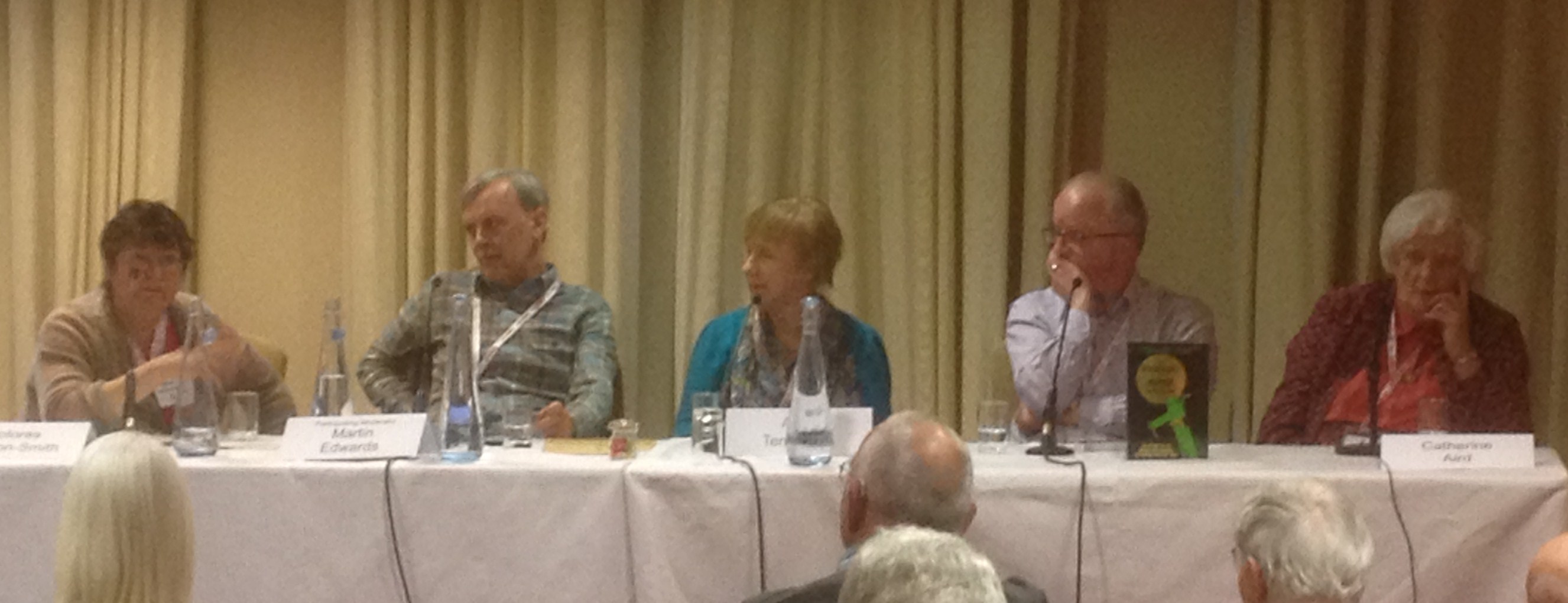
CrimeFest Golden Age Panel

One of the best attended sessions at CrimeFest 2015 was the panel “Forgotten Authors: The Golden Age of Murder”. Five leading authors and experts on the Golden Age took turns to urge readers to rediscover their favourite authors whose books are unjustly neglected.

Dolores Gordon Smith advocated Freeman Wills Crofts and G K Chesterton.

Martin Edwards spoke up on behalf of G D H and Margaret Cole; and Milward Kennedy.

Aline Templeton recommended Margery Allingham and Ronald Knox.

John Curran put forward J J Connington and Henry Wade.

Catherine Aird proposed Josephine Tey.

Three of the panel, Dolores, Martin and John will be speaking in more detail about Golden Age Detective Fiction at The Bodies From The Library conference.  Dolores will be talking in more detail about Freeman Wills Crofts, while Martin will be expanding on the theme of Forgotten Golden Age authors and John will be speaking on Agatha Christie.

Martin’s new book The Golden Age of Murder about the authors of that era is out now and provides the most comprehensive review of the genre yet to appear. It is a must read for anyone who wants to get to grips with the sheer volume and variety of crime fiction from the golden age. For more information and to buy a copy follow the link below:

Looking forward to CrimeFest 2015

I am looking forward to CrimeFest 2015 which is taking place in Bristol this week from Thursday 14th to Sunday 17th May.

In particular I want to catch up with John Curran, Martin Edwards, Dolores Gordon-Smith, Jake Kerridge and L C Tyler who will be there and who will all be speaking at The Bodies From The Library conference on 20th June.

For more information about CrimeFest go to:

CrimeFest

Ruth Rendell

We are sad to hear of the death of Ruth Rendell, aged 85. The author of more than 60 books,she published her first novel From Doon With Death in 1964.  It featured her series character Chief Inspector Reginald Wexford who featured in 24 novels. She also wrote under the pen-name Barbara Vine and in this guise particularly explored the psychological aspects of criminals and those on the edge of society.

Rendell had a deep interest in social issues and as a Labour Peer was instrumental in bringing to the House of Lords a bill which came into law as the Female Genital Mutilation Act 2003.

She often said that Wexford reflected her view of the world though, interestingly, she characterised him as a Liberal Democrat in her fiction.

Along with the PD James, who died last year, Rendell was acclaimed as one of the two new Queens of Crime, inheriting the mantle from Agatha Christie, Dorothy L. Sayers, Margery Allingham and Ngaio Marsh.  Together the two writers transformed the crime thriller, moving it on from the Golden Age and achieved critical literary acclaim as well as popular sales.

Her final novel, Dark Corners, is scheduled for publication in October 2015.