The Body In The Library

IMG_2517

The above image, by Andrew Davidson in The Folio Society edition of The Body In The Library, for me epitomises the “cozy” in Agatha Christie – a palm court in a hotel with Miss Marple observing crucial developments. The resemblance in the illustration’s style to the railway posters of the 1920s and 1930s – a retro feel also exploited by The British Library Crime Classics series – is marked. So the reader is very clearly steered into the appropriate vintage feel and atmosphere.

The cast of characters in The Body In The Library includes the professional dancers who were a feature of such genteel hotels in resorts such as Torquay with which Agatha would be very familiar. Dorothy L. Sayers included a similar setting and captured too the slightly shabby truth behind the glamourous facade of the dancers’ lives in Have His Carcase.

Miss Marple is frequently viewed, by both readers of the books and by protagonists within the books, as an interfering old busy-body. Murderers, to their cost, have been known to dismiss her in such terms. Even her fellow gossips in St Mary Mead often snipe behind her back about her nosiness.

However, in this instance, contrary to such sniping, she is brought into the case by Mrs Bantry, the mistress of the house in which the body is discovered. Mrs Bantry recognises the insidious power of malicious gossip in a small village and understands all too well that there will be a presumption among their neighbours that her husband, in spite of all his protestations to the contrary, will be judged by them to have been carrying on with the young woman whose body turned up overnight in their library. She foresees that he will inevitably respond to the subsequent snubs he will suffer by withdrawing into his shell. This eventuality will ruin both their lives. Mrs Bantry therefore, trusting her husband’s statement that he has never seen the girl before in his life, brings in the only person she feels can get to the bottom of the mystery and save her husband, and her, from the fate she sees awaiting them. Miss Marple is, therefore, involved from the outset of the investigation, not as a nosy bystander but as a trusted friend.

Christie’s understanding of the dynamics of relationships in a small country village and the nasty undercurrents that swirl beneath the picture book exterior makes this apparently stereotypical “cozy”, in fact, anything but cozy. It is insightful and merciless in its exposure of the unpleasant truths about human nature that are normally hidden behind the genteel facade. Layers of this facade are peeled away to reveal the seamier reality beneath.

This ability to portray so accurately the English middle class of the inter-war years, both as they wish to appear and as they actually are – identifying their fine qualities and skewering their nastiness – is frequently overlooked in Christie. It is too easy for the modern reader to dismiss her depiction of this “cozy” world as a collection of lazy, stereotypes recycled endlessly in the service of fantastic plots. In fact, like so many stereotypes, they represented an all too recognisable collection of characters, many of whom would have been recognised by her contemporary readers as portraits, albeit at times perhaps caricatured, of people they actually knew. The modern reader who fails to appreciate this important point misses a vital aspect of Christie’s brilliance and relevance to the student of the social and cultural norms of that era.

Mark
Nostalgia by Design

hogs-back

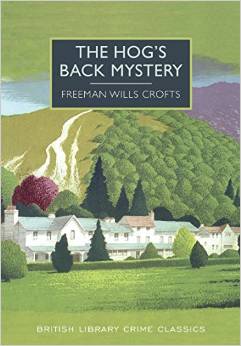
A feature of the cover design of the British Library’s Crime Classics series is the use of illustrations taken from old railway posters. This, no doubt, is tapping into a feeling of nostalgia for a bygone era when for most people travelling on holiday meant a train journey to the seaside.

Rob Davies of the British Library explained in his session at The Bodies From The Library conference in June that the adoption of this new retro look for their Crime Classics series saw a quantum leap in sales. With the series featuring John Bude novels such as The Cornish Coast Murder and The Lake District Murder, the connection between the locations and entertaining holiday reading was too good to miss so the 1920s and 1930s railway poster designs became an intrinsic part of the brand.

The evolution of such posters is intriguing in itself. Initially, when the railways first sought to encourage passenger travel they were torn between conflicting approaches – to load the posters with information about the destinations or to let the picture replace a thousand words and rely on strong images to attract attention. Gradually the latter approach prevailed with minimal text and often a strong “strapline”.  Who can forget “Skegness is so bracing”?

For a quick journey through the timeline of the evolution of railway posters go to:

http://www.bbc.com/culture/story/20150817-vintage-tourism-posters-railways-britain

Mark

The ABC Murders

IMG_2434

Agatha Christie’s 1936 novel The ABC Murders (also known as The Alphabet Murders) is her first stab at a serial killer story. Sorry – couldn’t resist the pun.

She followed on from Philip MacDonald’s opening foray into the sub-genre X v Rex, published in 1934 under the alias of Martin Porlock. This book, written from the perspective of the killer – the so called inverted style in which the suspense is generated by whether or not the killer, whom the reader already knows, will be caught rather than trying to solve whodunnit – begins to explore the psychology of the murderer. In this it has similarities to the earlier Malice Aforethought by Anthony Berkeley, writing under his Francis Iles pseudonym, in 1931.

Christie also purported to examine the psychology of the criminals – indeed, you could argue that much of Miss Marple’s detecting follows a psychological profiling approach – finding similarities in patterns of thought or behaviour that follow archetypes she has observed in her village of St Mary Mead. However, Christie never felt the explication of the criminal psyche should ever be anything but subordinate to the plot.

But then Christie only used her own name for her detective fiction (she reserved her alter-ego Mary Westmacott for romances), so she was to an extent hidebound by the public’s expectations of “the next Christie”. Both MacDonald and Berkeley made use of pseudonymous novels to explore new avenues to writing detective fiction in a way that Christie chose not to. They were thereby freed from the constraints of audience expectations by taking this approach.

In fact, Christie’s approach in The ABC Murders is innovative, mixing conventional first person narrative through her usual character of Captain Hastings, with narrative from the perspective of the killer.  She finesses the latter sections through the device of a purported reconstruction of the killer’s perspective after the fact by Hastings (with the benefit then knowing of Poirot’s solution) for his telling the story in the book. This is mixed with the introduction of actual letters from the killer addressed to Poirot, which give the killer a voice on the page. Such a mix of narrative perspectives had been done before – as early as 1868, Wilkie Collins was experimenting with this approach in his detective novel, The Moonstone.

What makes Agatha Christie’s entry into this multiple-perpective, serial killer world more significant than the more ambitious works of Anthony Berkeley/Francis Iles and Philip MacDonald/Martin Porlock is the size of her market. She was selling vastly more books than the others. Therefore he influence was commensurately greater.

I would argue, therefore, that The ABC Murders is one of the most significant Golden Age novels and a vital step out of the cozy and into the murkier, much more sinister world of the serial killer. Without her breaking the ground with the mass audience, the seeds could not have been sown which later bore fruit in the multitude of later novels which we see now featuring serial killers driven by innumerable warped psychotic impulses.

So it’s Agatha I have to thank for the sleepless nights I now endure having been “creeped out” by the visceral, nightmare visions I have subjected myself to, reading the likes of everything from Mark Billingham’s Tom Thorne books to the gruesome finds of Patricia Cornwell’s Kay Scarpetta.

Mark

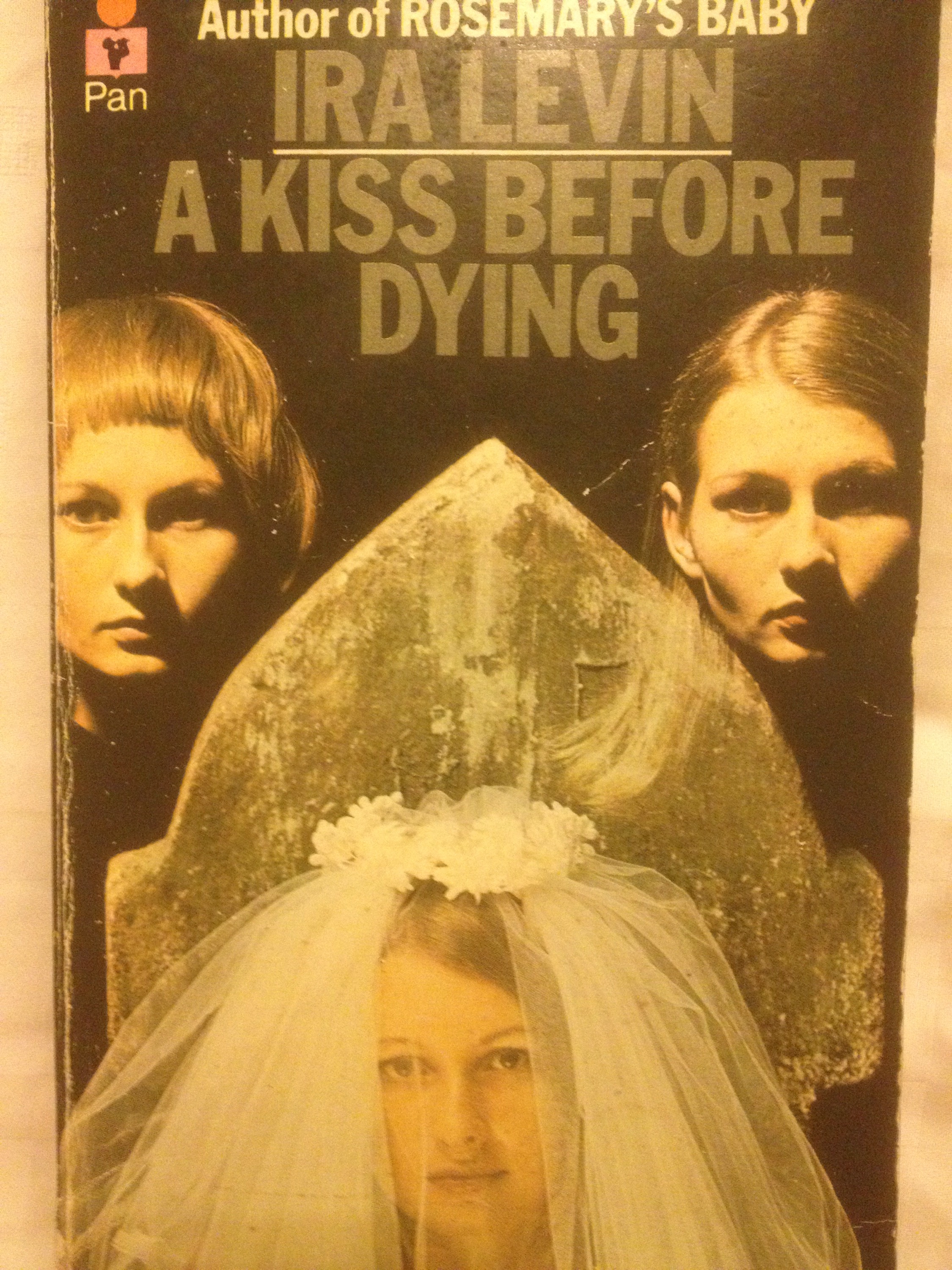
A Kiss Before Dying


Not strictly a golden age novel – it was written in 1952 – but it has all the hallmarks of the finest writing of the golden age.

It is hard to imagine how Levin will manage to sustain the tension in his first person narrative when his thoughts turn to murder on page 27. There is somehow an inevitability about him succeeding. It is only at the end of part one, when the reader is flipped to the perspective of the person trying to find him that you realise that although you have been walking around in his head for 80 pages, you don’t know his name and neither does the detective. You suspect everybody that you now encounter is the man you now know so well from the inside. The shock when he is finally revealed is superb.

The book takes the psychology of the protagonist further along the trail started by Frances Iles in Malice Aforethought to create a believable insight into the mind of the character. The likely cause of his self-centred world view is made clear almost from the outset – well chapter 2 – and his ability to both plan and carry out complex schemes and improvise brilliantly when circumstances require makes him a thoroughly creepy and unnerving subject to read.

I was lent this book about a year ago and am finally able to share a discussion about it with the person from whom I borrowed it after they recommended it to me. It must have been so frustrating for them not to be able to talk about it without spoiling its various plot twists and revelations. And now I can only add my personal recommendation. Read it.  You will not be disappointed. It is brilliant.

Mark 

The Murder At The Vicarage

This is the first full length Miss Marple novel (earlier appearances had been in short stories).

It is easy to forget that when Agatha Christie wrote this in 1930 that it was far from being a “cozy” – a murder set in a small English village populated by apparently nice middle-class people who attend church, buy their groceries for delivery from the local shop and drink tea out of bone-china cups while gossiping about whose servants fail to polish the silver properly. Although St Mary Mead – the village in which the novel is set – has undoubtedly been the model for many such imitations that make up that sub-genre, this is a far more radical novel than its successors.

What is frequently overlooked is that it marks the entrance of one of the first female detectives to the genre in a full-length novel.

The great detectives of the Golden Age were previously (and for some time afterward remained) an almost exclusively male club. Christie already had Hercule Poirot. Dorothy L. Sayers had Lord Peter Whimsey. Margery Allingham had Albert Campion. John Dickson Carr had Dr Gideon Fell. Edmund Crispin had Professor Gervase Fen. Freeman Wills Crofts had Inspector French. Ngaio Marsh had Roderick Alleyn. G. K. Chesterton had Father Brown.

Christie, it is true, did include the female Tuppence as one half of her Tommy and Tuppence, light-hearted adventure stories but even though smarter than husband Tommy, she was not a standalone lead character in the way that the other detectives listed here were. There were also isolated examples of “Lady Detectives” from the Victorian era (indeed, one of these books has been published by the British Library as part of its Crime Classics series) but they had already sunk into obscurity by the dawn of the Golden Age.

Yet here was a woman solving the crimes and doing so by close attention to the facts, sharp observation and an understanding of human nature which, as Miss Marple herself points out, is the same the world over whether it be in a cosmopolitan city or a small village. No reliance on “female intuition” here.

In fact Miss Marple provides the role model for all the female detectives, private investigators and forensic scientists who have followed in her wake, solving crimes that baffle their male colleagues. Without Jane Marple’s trailblazing there would be no path for Sara Paretsky’s V.I. Warshawsi, Patricia Cornwell’s Dr Kay Scarpetta, Sue Grafton’s Kinsey Millhone or Kathy Reich’s Temperance Brennan to follow.

So tip your hats (and deerstalkers should you prefer), gentlemen, to the mould-breaking Miss Marple.

Mark