
Thou shalt not break Knox’s Third Commandment

Way back when God was a boy, in 1929 to be precise, Ronald Knox, a Catholic priest and author of such Golden Age detective fiction novels as The Viaduct Murder, composed a set of ten commandments for his fellow members of the Detection Club, for the writing of their detective novels. He was not the only one given to setting out such rules. SS Van Dine came up with twenty different rules in a 1928 article. And Raymond Chandler also came up with another decalogue which, in a sideways blast at what he perceived as the effete and unrealistic English detective stories, focused more on what makes a good novel rather than a good puzzle plot – reflecting his view that too often the puzzle got in the way of good writing.

Naturally, Knox’s fellow club members set about breaking every one of his rules with cheerful energy. Indeed, they had all been breaking them equally often before they were codified. But, and this is crucial, they and the other Golden Age writers knowingly broke Knox’s commandments with malice aforethought. They transgressed for effect and for their own ends. They did not merely blunder into their breaches to no purpose.

My doubts about the writers of modern crime fiction is that they are unwitting breakers of the rules. Many modern crime writers express reverence for the Golden Age authors and cite them as major influences since their childhoods. Others at least acknowledge that the Golden Age authors, whatever their short-comings from a modern perspective, did at least manage to sell vast numbers of books and so cannot be dismissed out of hand.

It is therefore somewhat depressing for me to find that so much of the modern crime fiction I read is stuck in stereotypical tropes. The cliche which concerns me here is the penchant for the serial killer in too many of the newer psychological crime thrillers of the “Noir” end of the spectrum to break Knox’s Third Commandment:

“Not more than one secret room or passage is allowable.”

Now, it seems, every Tom, Dick and Harry on a killing spree has recourse to a hidden basement. I am sure that the dreadful crimes of Josef Fritzl, who incarcerated his daughter in a secret underground annex and sexually abused her for 24 years, and which came to light only in 2008, have been an influence on this recent trend. Now, as back in the Golden Age, real life crime inspired the writers of fictional crimes.

Knox, when he devised the rule, was concerned with ensuring the Golden Age plots did not descend into absurdity. He knew that the plot devices employed by his fellow writers frequently stretched realism – as Chandler accused them of doing – but he wished to keep authors on the correct side of breaking point. The reader will suspend their disbelief but only so far. At some point their credulity is overtaxed and the whole edifice collapses beyond any shoring up on the part of the author – or his perpetrator.

I would like to consider the practical implications for the lone serial killer in constructing his underground chamber of horrors for inclusion in what might, with some justice, be regarded as this sub-genre of modern crime fiction.

Beneath his apparently normal suburban house, he must excavate a chamber that measures some two metres in all directions as a minimum. This gives room for him or her to stand upright and for the victim to do so too if they are not physically restrained. It also gives room for the imprisoned victim to lie down, or to be tied down if that is the perpetrator’s preference, full-length on the floor – if no bed is provided. It also gives space for the killer to come in and torture the victim if that is his particular thing.

Imagine that space. It is the size of a small box-bedroom in a modern home.

What this requires is that 8 cubic metres (2m x 2m x 2m) of soil has to be removed. Dug out by the lone killer without the benefit of power tools. It must be done by hand to avoid the noise and vibration – let alone the difficulties of smuggling any sort of serious earth moving equipment into and out of the supposed cozy family dwelling.

Each cubic metre of soil weighs somewhere between 1,200 kg and 1,600 kg – depending on how compact it is. So 8 cubic metres represents between about 10,000 kg and 12,500 kg of soil.

Shifting that, once the killer has dug it out, is no small matter. A large family estate car, say a BMW 5 series, has a maximum load-carrying capacity of about 600 kg – including the driver (taking up the better part of 100 kg himself). So we are looking at approximately 20 to 25 full car-loads of earth to take to the local tip.

And all of it has to be hauled out through the house, from wherever the secret panel is that conceals the entrance to the bunker, and loaded into the car. Managing this without leaving any trace, particularly of the sort that a police investigation team – or even more painstaking, a forensics team – might notice would be a spectacular feat of cleaning up after oneself. Think how quickly carpets or even wooden floors show up the dirt you tread into the house if you are not meticulous in taking off your outdoor shoes when arriving home. Think how hard it is to get them looking clean again if you neglect them in this way for even a relatively short period of time. And how they never do quite look as good as new. Now multiply that effect by the impact of shifting the equivalent of a decent sized garden’s-worth of top soil through the house. That’s an industrial scale challenge for even the toughest of steam-cleaners.

But let’s return to all that digging our serial killer is doing in his patient plan to construct the perfect secret torture chamber for his victims. How long is this going to take a man on his own?

To answer that question, based on practical experience of underground digging in secret, I must return to Tom, Dick and Harry. These were the nicknames given to the three tunnels dug by Allied prisoners of war at the Stalag Luft III camp where they were held by the German Luftwaffe. In his book The Great Escape, Paul Brickhill explains that the tunnels were constructed over a period of 12 months from March 1943 to March 1944  (with a three month break when one of the tunnels was discovered by the guards). The work was carried out by some 600 of the prisoners. Harry, the longest tunnel and the one through which the eventual escape was made, measured some 102 metres in length and was slightly more than 50 cm high and 50 cm wide. The volume of soil removed was, therefore, of the order of 25 cubic metres.

The other two tunnels were shorter but would require broadly similar volumes of soil to be dealt with.

The dispersal of the soil – much done through pouches concealed in the trousers of the airmen by which the soil could be released and then hastily trodden into the surrounding earth to disguise it (since it was a different colour from the topsoil) – took an estimated 25,000 trips. Clearly here, by the way, we have a vital clue for the maverick detective in the hunt for his serial killer: forget the shifty, nervous-looking creep in the skinny jeans, it’s the bloke with the baggy trousers you should be watching.

So if we allow that the 600 POWs, working in shifts, took a nine months to dig three tunnels whose total volume was perhaps approaching 75 cubic metres – that is about ten times the volume our hypothetical serial killer must deal with on his own – we have some measure of the scale of the task when tackled in the real world. He is facing some 45 man-year’s worth of work at the rate they achieved to build their secret tunnels.

Of course, the 600 POWs were not working full time on the escape tunnels – they had to maintain a presence in the camp under the watchful eye of the guards who would notice the absence of any significant number at any given time.

But, our serial killer must also conduct his secret life as some sort of human mole behind a facade of normality. He may be holding down a full-time job. His murderous hobby cannot be carried out to the exclusion of everything else if he is to appear like the average man in the street to his neighbours and work-colleagues – even if with hindsight they may reflect that he was “a bit of a loner”.

Nevertheless, 45 man-year’s worth of work does seem a lot to tackle as mere preparatory task before one can begin to indulge even the sickest of fantasies.

So I am forced to conclude that Reginald Knox was right to bar the use of secret rooms and passages when he drew up his list of commandments.  He was right not only on purely aesthetic grounds, that they were an affront to the intelligence of the reader and spoiled the enjoyment of a well-plotted story if over-used, but also on purely practical grounds. Creating the secret chamber would be quite simply beyond credible bounds as a one-man feat of engineering. As a result, whenever I now read a novel in which the serial killer conducts his business in a secret underground bunker I feel entitled to throw the book across the room in disgust – where it hits the opposite wall almost exactly 2 metres away…


Deal Noir on Saturday 25th March

Final preparations are now underway for Deal Noir 2017, taking place next Saturday, 25th March at the Landmark Centre, Deal.

At the moment I am reading through the entries for the Flash Fiction competition for which I am one of the judges. Once again the standard is very high with a variety of approaches to writing a crime story (not necessarily a murder) in 50 words or fewer. They range from a police procedural (yes, you can capture procedure in 50 words), through dark psychology to the downright macabre with one entry in the form of poetry rather than prose. It’s going to be a difficult decision.

There are still a few tickets remaining for what promises to be a fascinating day. To book your place go to:

A Conference on Crime Fiction

where you can also find details of the programme and speakers.

Murder on the Orient Express v Stamboul Train

1200px-Orient-Express_Historic_Routes_(en).svg

When Agatha Christie published Murder on the Orient Express in 1934, she faced a dilemma regarding its title. Graham Greene had published a novel – what he somewhat dismissively called “an entertainment” – Stamboul Train in 1932 which had been published in the United States as Orient Express. A film of Greene’s novel, under its American title, was also released in 1934. In the United States, Christie’s novel therefore appeared under the different title, Murder in the Calais Coach, in an effort to avoid confusion between the two works.

The two novels are very different, with quite dissimilar objectives, and have perhaps only the setting on the Orient Express, in common.  There would also, no doubt, be some overlap of readership though, as we shall see, the writers’ target audiences were somewhat distinct.

Fans of Golden Age detective fiction will no doubt be aware that Poirot takes the Orient Express from Istanbul for Calais and, ultimately, London. Greene’s novel sees the journey taking place in the opposite direction.

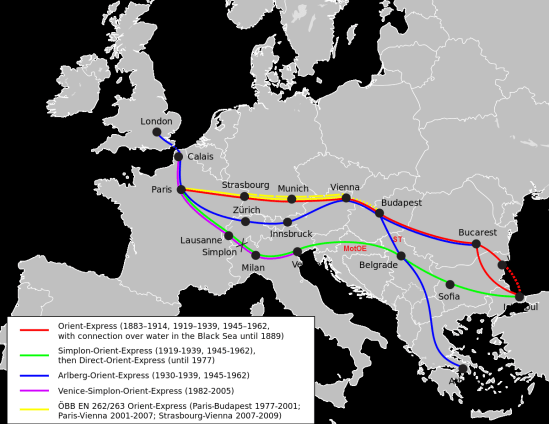
What also becomes apparent is that the trains in the two novels are in fact different variants of the Orient Express. As the map above shows, there were numerous routes taken by trains to and from Istanbul, connecting it with Paris and London. Christie has Poirot travel on the Simplon Orient Express which departs from Istanbul and travels via Belgrade and Venice to Paris, Calais and London via the Simplon tunnel, though, of course, it does not complete that journey before the murder takes place while the train is forced to a standstill by snowdrifts across the line in what is now Croatia between Vinkovci and Brod (marked on the map with “MotOE”) .

In contrast, Greene’s novel follows a route not shown on the map, from Ostende via Cologne to Vienna, joining the route shown on the map to continue via Budapest and Belgrade to Istanbul. The climax of the novel takes place close to the border between Hungary and what is now Serbia at the Subotica halt (marked on the map “ST”).

Both writers, therefore, chose to site their dramatic scenes (one cannot really refer to Greene’s novel having a denouement.in the sense that Christie’s murder mystery does) at the point on the journey where the travellers are passing through the northern Balkans. The area is perhaps perceived as being a lawless country beyond the norms of western European behaviour. Death and intrigue may take place here and the rule of law is subject to the corrupting influence of money.

That Christie, perhaps the most celebrated popular novelist of the era, with successes such as The Murder of Roger Ackroyd already to her name, should have deferred to the little known Graham Greene with what was only his second mature novel, when choosing the American title for her book, indicates that she was aware of it and of its significance.

Certainly, in spite of the throw away label of “an entertainment” which Greene applied to it, his novel addresses more serious themes than does Christie. One of the principal characters is a Jewish merchant who reflects frequently on the treatment he receives at the hands of gentiles, culminating in a frightening encounter with a Yugoslav soldier, who is barely restrained from shooting him. The rich Jewish businessman, once out of the comfort and security of the affluent surroundings of the train, is brought face to face with the personification of the underlying anti-Semitic hatred which, he recognises, fuelled the pogroms. Ironically, he is able to distance himself from this by treating it as an anachronistic throwback to former times compared with his familiar western Europe. Yet the book was published barely a year before the rise to power of Hitler and the National Socialists in Germany which would all but annihilate Jews from much of the continent over which the Nazis ultimately gained control.

In another unconscious irony, Greene, has another passenger on the train be on a return journey to Yugoslavia where he hopes to lead a communist uprising against the government. However, due to an error in timing, the rising takes place before he arrives in the country and, possibly as a result of his absence from its head, fails, leading to the imposition of martial law in the country. Greene provides a sympathetic outline of the conditions of poverty and oppression which lead to the uprising but expresses doubt as to its ever having prospects of success with or without its figurehead. Certain biographical details of this character including foreign parentage coincidentally mirror the background of Joseph Tito who eventually led Yugoslavia as a communist state in the aftermath of the Second World War.

Greene, as a less well-known author, was also free from constraints which would apply to Christie.  He was thus able to include an overtly lesbian character in a leading role and include her reflections on other women characters as potential sexual partners in a way that Christie could only touch on obliquely in her writings to avoid risking alienating her large and essentially conservative audience. In this respect, being perceived as a more serious writer, as distinct from a popular plotter, gave him greater licence.

A related freedom enjoyed by Greene, because he was not writing in the detective fiction genre, was that of presenting his characters’ inner thoughts. This without a doubt enables him to create fully rounded characters whose motivations and emotions are clear to the reader so that they are able to engage with them deeply. The writer of detective fiction must ensure that to a greater or lesser extent the motivations of his or her characters on the page are more or less obscured in order to sustain the puzzle. This makes the creation of fully developed characters significantly more difficult for the author and so they must rely on presentation of external clues to the interiors of their characters.  These clues must be sufficiently recognisable that they may be seen as stereotypical leading to criticism that the writer creates only cardboard cut outs – two dimensional characters which lack the vitality of “better” writers. This accusation fundamentally misses the handicap under which detective fiction writers must perforce operate. Indeed, Christie is masterly in her use of such clues to the personality of her characters so as to either misdirect the too-casual reader or lead the more observant reader to make a more accurate guess at the solution.

The most striking contrast in approach between the two writers is, however, their treatment of the train. For Christie, the Orient Express is a hermetically sealed world of glamour, populated by exotic characters, rich Americans, an elderly exiled Russian princess, a “beautiful foreign-looking” young woman.  It is a place into which the reader escapes from his or her humdrum exist ence to enjoy the thrill of the natural order being disturbed by that ultimate taboo – murder – in an atmosphere of suppressed or hidden passions.

Yet for Greene, the train, while also a sealed off world of its own, detached from the countries through which it passes, is a haven of normality.  It is the outside which is threatening. Myatt, the businessman, spends the bulk of the journey in preparation for a difficult meeting concerning a potential takeover of a rival firm. He might be simply engaged in a long commuter journey – a state perhaps well known to many of the book’s audience for whom the train journey to and from work might be their opportunity to read. It is only when he is outside the safe confines of the train that he is confronted with danger. No-one dies aboard the train – any such drama takes place on the outside, in the exotic foreign locations.  Any glamour attached to the train is debunked with his reflection that there is no point in buying expensive wines on the list since they would invariably be rendered inferior by the constant disturbance of the train’s motion.

How different this is from Christie, who, perhaps with tongue in cheek, and with, no doubt, a consciously ironic overlooking of Greene’s recently published novel, has a character in the restaurant car of the train say to Poirot, “If I had but the pen of a Balzac! I would depict this scene…you agree? It has not been done, I think? And yet it lends itself to romance, my friend.”

Postscript: I cannot let this opportunity pass without mentioning another fictional journey on the Orient Express taken some years later, in Ian Fleming’s 1957 novel From Russia With Love, which sees James Bond take the train from Istanbul accompanied by the glamourous Russian spy Tatiana Romanova. This cold war era, escapist thriller once again uses the lawless Balkans for the Russian agent to board the train but the climactic fight scene between him and Bond takes place while the train is in the Simplon tunnel (marked with an X on the map) – much further west. And I might add that in that novel, the train passes through Greece on a more southerly route than any shown – a necessary diversion to avoid passing through the Iron Curtain into Bulgaria as another portion of the train does, receiving only a passing mention in the book. Perhaps Fleming enjoyed his private joke when he name-checked Vinkovci and Brod as stations through which his secret agent travelled while on board, passing, for those of his readers who also shared a liking for Christie, the ghost of Poirot’s earlier train.


Recommended reading for 2017 Conference

We know that many attendees at the conference like to prepare for the day by reading books by, or about, the authors who will be discussed by our speakers. In order to get the most out of the session on Miles Burton, who also wrote under the name of John Rhode, and who was a member of The Detection Club (in which capacity he participated in two of that group’s collaboratively written novels), speaker Tony Medawar recommends:

Death in the Tunnel by Miles Burton
Death Leaves No Card  by Miles Burton
Death of Two Brothers by Miles Burton
Murder of a Chemist by Miles Burton
The Secret of High Eldersham by Miles Burton
The Floating Admiral by The Detection Club
Ask a Policeman by The Detection Club
The Fourth Bomb by John Rhode
The Paddington Mystery by John Rhode
Masters of the ‘Humdrum’ Mystery by Curtis Evans

This last book is a non-fiction overview by critic Curtis Evans of the sub-genre of Golden Age Detective Fiction which focused on the dogged investigative policeman as its central character – a school which included not only Burton/Rhodes but others such as Freeman Wills Crofts. Don’t be fooled by the subtitle of this book, by the way. Cecil John Charles Street, the first named of the authors, is none other than Burton/Rhodes. Indeed they were only two of his numerous pseudonyms as an author.