The Return of the Golden Age of Crime Fiction – The British Library

We thought fans of Golden Age detective fiction might be interested in an evening event taking place at the British Library next Thursday 3rd November. Martin Edwards, who will be familiar to those who have attended past Bodies From The Library conferences and heard him talk about the resurgence of interest in Golden Age detective fiction, and Ann Cleeves will be speaking on this return to favour of a previously neglected genre. The event starts at 7pm and tickets can be obtained direct from the British Library at the link below:

http://www.bl.uk/events/the-return-of-the-golden-age-of-crime-fiction

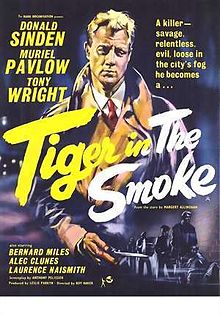
Tiger in the Smoke

This weekend the Margery Allingham Society arranged a screening of the 1956 film of Allingham’s 1952 novel The Tiger in the Smoke. The book was the 14th to feature her aristocratic sleuth Albert Campion but for the film, his character was written out. Indeed, like many of the Campion novels, the pace of the action is more in keeping with the thriller genre than the more genteel, cerebral approach of the typical Golden Age detective novel. As such, the film works as a crime thriller without the distraction of the portrayal of a series detective which can dog transitions from book to screen.

The screening took place at St Mary Abchurch in the City of London, the unusual venue having been selected because its interior was used as the location for one of the key confrontations with the eponymous Tiger character. I must confess to a certain frisson of excitement at the crucial scene as the surroundings in which we were seated were suddenly on screen. It was but a small imaginative step to picture the principals acting out their roles in the pews just in front of my own seat.

The film was certainly atmospheric with its representation of a pre-Clean Air Act London, fogbound in a classic pea-souper through which the action was as often obscured as revealed in the black and white of the period. That immediately post-war world must indeed have felt monochrome so that colour images would seem out of place.

Margery Allingham was apparently unhappy with the film but apart from the excision of her beloved Campion the plot stuck very closely to her original so it is hard to see to what she objected.

Part of the fun of movies of this vintage is spotting youthful early appearances of stars more familiar in their middle age. The romantic lead was played by Donald Sinden and there were cameos by the likes of Dandy Nicols which were a delight to spot.

I found the whole experience gripping and I am not ordinarily a fan of big screen adaptations. The pace was taut and the characterisation was both true to the novel and convincing in its own right. It’s screening is a fitting part of the events being put on by the Margery Allingham Society to mark the fiftieth anniversary of her death.

For more information about the Society and its activities go to their website:

http://www.margeryallingham.org.uk

Agatha Christie Trail

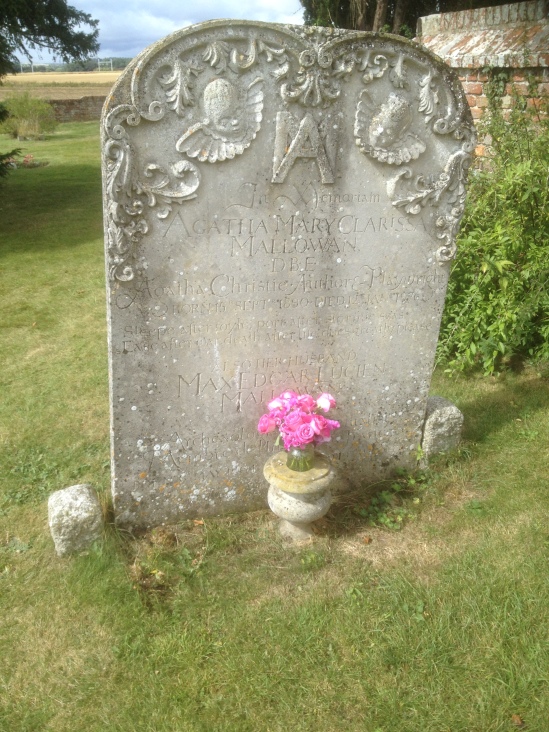
Christie's Grave

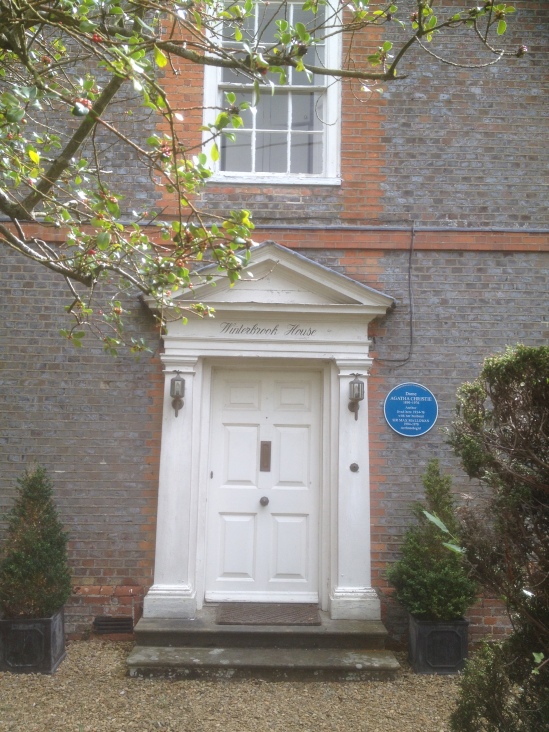
Agatha Christie is irrevocably associated with her childhood home, Greenway, on the River Dart, near Torquay in Devon. Yet she spent far more of her adult life at a very different house in Wallingford, on the River Thames, near Reading, with her second husband, archaeologist, Sir Max Mallowan. They lived from 1934 till her death in 1976 at Winterbrook House, an unassuming home on the Reading Road, tucked away behind a high hedge, only yards from the main road.

Winterbrook House

The house is privately owned and not open to visitors. The closest Christie fans can get is to peer over the front gate as I did.

From Wallingford you can then make your way down a lane opposite the house into fields where a footpath beside the Wallingford branch line (which was frequently used to “store” the Royal Train when not in use) that leads down to the mainline station at Cholsey. It is perhaps a couple of miles stroll through pleasant countryside.

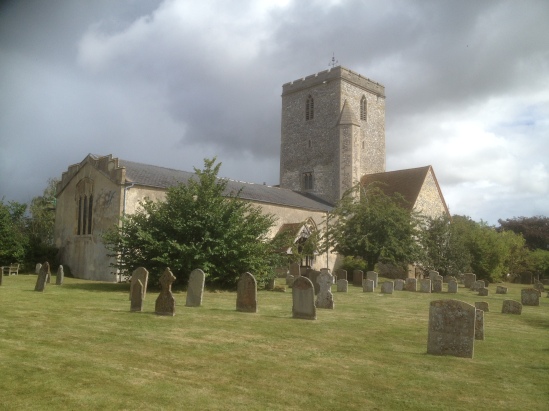
Here you can find the church of St Mary’s in the churchyard of which Agatha’s grave can be seen – buried with her husband Max who died two years after Christie.

St Mary's Cholsey

Z Murderer foiled by SatNav (almost)

z murders satnav

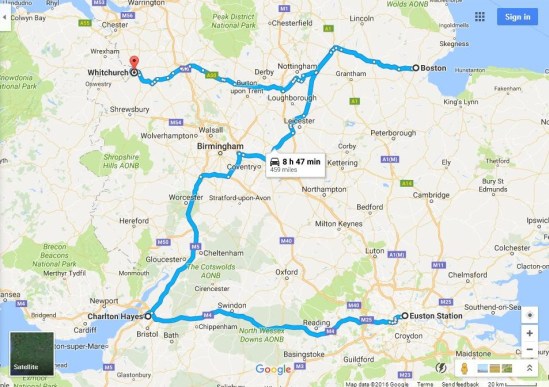
Without giving too much away, indeed a simple perusal of the chapter headings in J Jefferson Farjeon’s The Z Murders will reveal that after the opening at Euston Station and the subsequent journey to Bristol (or more accurately the village of Charlton which is now a suburb on the north side of the city), the plot continues by way of Boston (Chapter XIX) to reach Whitchurch in Shropshire (Chapter XXXIV). This creates a neat capital Z across the roadmap of England which the taxi-driver purchases to facilitate his journey from Bristol to Boston.

However, with the advent of SatNav, who needs a road atlas? You plug in your destination postcode and follow the instructions without necessarily any clear idea of where exactly you are going. Indeed, even with that knowledge, your SatNav may not take you the route followed by the intrepid hero of the plot through Gloucester, Stratford Upon Avon and Grantham which most perfectly forms the letter Z. Indeed, the programme of roadbuilding which has taken place since the book was written in 1932 includes the M5, the M42, the M6  and the M69 along which your SatNav will take you, thereby shaving 19 minutes from your prospective total journey time (albeit at the cost of an extra 21 miles driving by the less direct but faster route).

The resulting route not only distorts the perfection of the Z achieved by Farjeon but places the top corner of the Z at Nottingham, leaving Boston as a stranded outlier. What if the hunt had been so thrown off the scent? Imagine being caught miles from the scene of the action. How would the intrepid hero arrive at the true solution?

Fortunately, the low-tech approach is taken. Writing is done with pencil on paper rather than typing on a touch-screen phone and justice prevails.

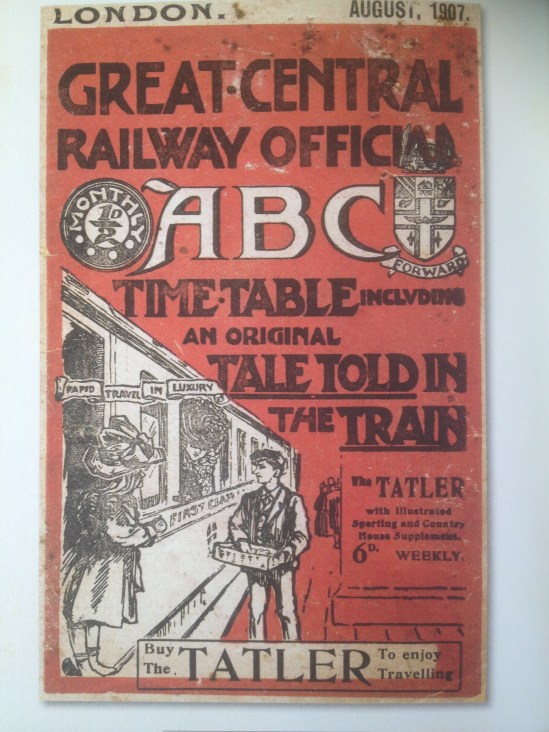
The book also features the use of a clue from an ABC Guide, pre-dating Agatha Christie’s more famous use of this publication by some four years. Less comprehensive than Bradshaw’s Guides (which aim to provide timetables of all services), the ABC Guides gave details only of services to and from London but, crucially, gave information on fares as well as timetables. One wonders whether there is scope for a plot driven (if that is the correct term to use in this case) by use of the online National Rail Enquiries service? (Remember – you saw the idea here first!)

IMG_3087


The Moving Toyshop: A Walking Tour of Oxford

IMG_2990

Oxford is a delightful city and sufficiently compact to enable you to walk around its heart and enjoy the atmosphere, the architecture and the history of the place. Rather than meander aimlessly, however, we decided to conduct our walking tour taking Edmund Crispin’s The Moving Toyshop as our guidebook.

We began our tour at location A on the map which serves as the frontispiece for the book: The Toyshop (second position). Here we encountered our first dilemma. The large, even one might say, grand houses and buildings on the side of the Banbury Road indicated by the map were patently of greater vintage than the novel and looked exceedingly unlikely to have ever been used as retail emporia of any description. We therefore concluded that we must move the Toyshop a second time and transpose it to the other side of the road where a delightful row of shops was to be found.

Toyshop (second position)

Walking down the Banbury Road we reached the site of St Christophers, which was a little underwhelming, but we persevered.

St Christopher's

Continuing down the broad expanse of St Giles’ we reached St John’s, which proved much more impressive.
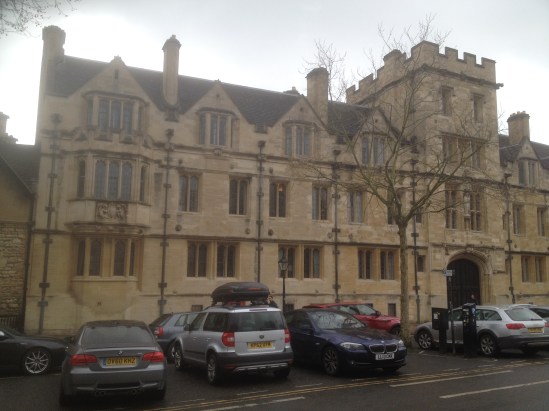
St John's

We continued our walk to the junction of St Giles’ and Broad Street where we reached the magnificent Balliol College.

Balliol

Walking along Broad Street we reached the delightful garden courtyards of the equally impressive Trinity.

Trinity

Retracing our steps we came to the junction of Cornmarket and George Street where we found Lennox’s shrouded in plastic sheeting and scaffolding for restoration works.

Lennox's

Continuing along George Street we reached the corner of New Inn Hall Street where we found the Mace and Sceptre public house, now gone the way of so many of our public houses and been subsumed into a chain of Irish Bars to become O’Neills.

Mace and Sceptre

We then returned to Broad Street to see the very much still functioning Sheldonian.

Sheldonian

A further U-turn brought us back to Cornmarket down which we walked to reach Rosseter’s Office.
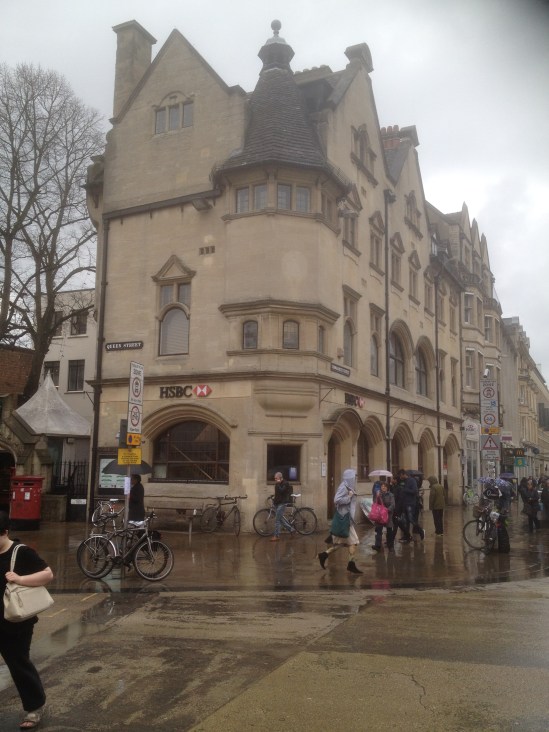
Rosseter's office

And on the opposite corner, though better viewed perhaps from a little way along the High Street, the Market.

Market 2

A short walk down St Aldate’s brought us to the council offices on the site of Crispin’s police station.

Police Station

Here we broke off from our Crispin tour to take a small diversion down a lane off St Aldate’s to visit the house where Dorothy L. Sayers was born and spent her early years.

Dorothy L Sayers House

Dorothy L Sayers

We then walked along the High Street and crossed the Magdalen Bridge to reach the junction from which the Iffley Road proceeds to find the location of the Toyshop’s first position.  However, here Crispin’s map diverges even more from reality. The Iffley Road is not the one so-labelled in Crispin’s map. Instead it is the one which goes down off the bottom of the map. It is in any case flanked by genteel houses which clearly would never have been home to a Toyshop, however, briefly. We therefore followed the Cowley Road (which corresponds to what Crispin calls the Iffley Road on the map – i.e. the middle one of the three roads out of the city centre at that junction) to end our walking tour at the site of the Toyshop’s first position. So, albeit the address is on Cowley Road not Iffley Road, we are sure that on this occasion we have not subjected the Toyshop to the further indignity of another unnecessary move.


Toyshop (first position)

What to do next?

Barry Forshaw (3)

If you attended the Bodies From The Library Conference over the weekend at the British Library and are wondering how to get your next fix of top quality crime fiction, then look no further than returning to the British Library where you can study the genre of the moment – European Noir. Running over three weeks, starting on 28 June and continuing on successive Tuesday evenings, the course is led by the UK’s leading authority on European Crime Fiction, Barry Forshaw.

Follow the link to find out more about the course and to book your place.

http://bit.ly/1U7anxO

Final preparations for Bodies From The Library 2016

So excited! Just getting ready to head up to London to join the team and put in place the final preparations for tomorrow’s Bodies From The Library Conference at the British Library. I’ve checked that everything is packed I don’t know how many times already.

Looking forward to welcoming everybody, meeting old friends again and hoping to make lots of new ones.

See you there!

Mark


Exclusive opportunity to buy new Golden Age editions before publication date

If you want to get your copy of new editions of Golden Age Detective Fiction novels months before they go on sale to the general public then the Bodies From The Library Conference at the British Library on Saturday 11th June is the place to be. We are delighted to be able to reveal that conference sponsors Harper Collins and the British Library will be making available a selection of new titles for sale exclusively to conference attendees. I am dying to tell you which books will be on offer but I am sworn to secrecy. All I am allowed to reveal is that I am very excited about the list I have seen and will be raiding my own piggy bank to get my copies on the day.

If you want to take this opportunity to be one of the first to have copies of the new editions, and you haven’t already got your ticket, then all you have to do is click on the link on this page to secure your place at the conference and you can join those who are already at the front of the queue.