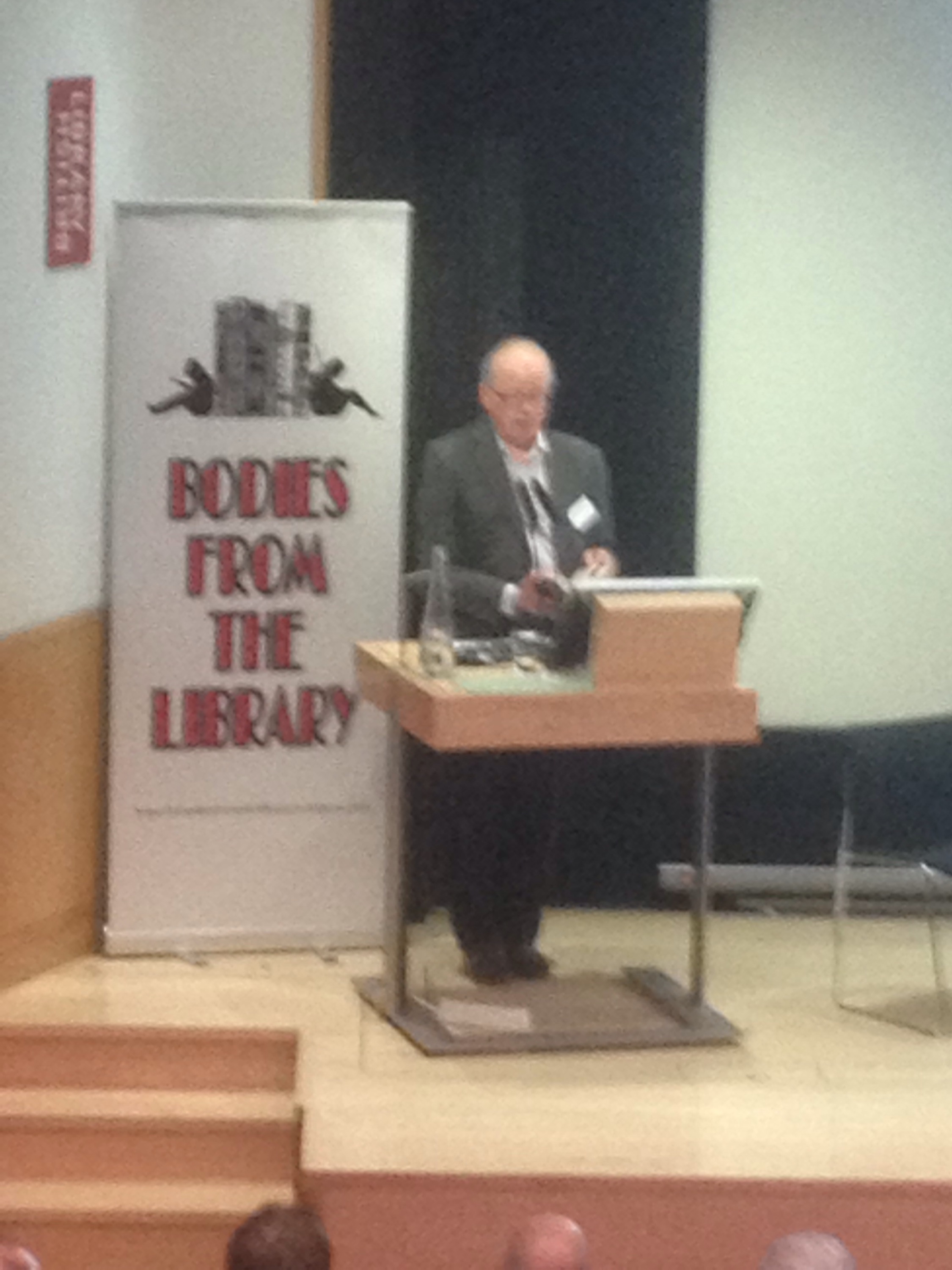
We are very pleased that Richard has kindly compiled a list of all the books he mentioned in his talk on Oxbridge Detective Fiction at the Bodies From The Library conference. We have added the list to the Recommended Reading page of our website but include the list below for easy reference.
Happy reading,
Mark
*R E Swartwout: The Boat Race Murder
*Michael Innes: Death in the President’s Lodging
J I M Stewart: Myself and Michael Innes (out of Print – Gollancz)
Michael Innes: Operation Pax
Michael Innes: Hamlet revenge
Michael Innes: The Secret Vanguard
Michael Innes: The weight of the Evidence
These Innes books go in and out of print – (Stratus publishing – always worth enquiring )
*Ronald Knox: Footsteps in the Lock
*Ronald Knox: The Viaduct Murder (and 4 more from Orion’s Murder Rooms POD imprint)
J C Masterman: An Oxford Tragedy
*Nicholas Blake: A Question of Proof (and lots more available from Vintage books /Random House )
*Edmund Crispin: Holy Disorders
*Edmund Crispin: The Moving Toyshop (all the other titles available from either Harper Collins, Vintage, Felony & Mayhem (USA) or Bloomsbury POD)
*Adam Broome: Oxford Murders
* Victor Whitechurch: Crime At Diana’s Pool
Victor Whitechurch: Murder in College
*Mavis Doriel Hay: Death on the Cherwell
*Mavis Doriel Hay: Murder Underground
*Dorothy L Sayers: Gaudy Night
*H C Bailey: Shadow on the Wall
Katherine Farrar books: The Missing Link, Cretan Counterfeit, Gownsman’s Gallows (out of print)
Stanley Casson: Murder by Burial
*Cyril Alington: Archdeacon’s Afloat
*Dermot Morrah: Mummy Case Murder
Lois Austen-Leigh: The Incredible Crime (NYP 2017)
*A Conan Doyle: Missing Three-Quarter
*Douglas G Browne: May Week Murder
*Glyn Daniel: The Cambridge Murders (*& Welcome Death available too)
*Adam Broome: Cambridge Murders
*Aceituna Griffin: Punt Murder
* VC Clinton-Baddeley: Death’s Bright Dart (& My foe Outstretched Beneath the Tree, Only a Matter of Tiime, No Case for the Police, To Study a Long Silence – all available)
* Margery Allingham: Police at the Funeral (and loads of others available from Vintage, Felony & Mayhem & Bloomsbury POD)
*T H White: Darkness at Pemberley
*F J Whaley: Trouble in College
*Q Patrick: Murder at Cambridge
*Dorothy L Sayers: Nine Tailors (all available from Hodder & Stoughton)
*A A Milne: Winnie the Pooh
*A A Milne: Red House Mystery
If you have trouble obtaining any of the * items, which denote they’re in print, please contact Richard Reynolds on literature@heffers.co.uk