Thou shalt not break Knox’s Third Commandment

Way back when God was a boy, in 1929 to be precise, Ronald Knox, a Catholic priest and author of such Golden Age detective fiction novels as The Viaduct Murder, composed a set of ten commandments for his fellow members of the Detection Club, for the writing of their detective novels. He was not the only one given to setting out such rules. SS Van Dine came up with twenty different rules in a 1928 article. And Raymond Chandler also came up with another decalogue which, in a sideways blast at what he perceived as the effete and unrealistic English detective stories, focused more on what makes a good novel rather than a good puzzle plot – reflecting his view that too often the puzzle got in the way of good writing.

Naturally, Knox’s fellow club members set about breaking every one of his rules with cheerful energy. Indeed, they had all been breaking them equally often before they were codified. But, and this is crucial, they and the other Golden Age writers knowingly broke Knox’s commandments with malice aforethought. They transgressed for effect and for their own ends. They did not merely blunder into their breaches to no purpose.

My doubts about the writers of modern crime fiction is that they are unwitting breakers of the rules. Many modern crime writers express reverence for the Golden Age authors and cite them as major influences since their childhoods. Others at least acknowledge that the Golden Age authors, whatever their short-comings from a modern perspective, did at least manage to sell vast numbers of books and so cannot be dismissed out of hand.

It is therefore somewhat depressing for me to find that so much of the modern crime fiction I read is stuck in stereotypical tropes. The cliche which concerns me here is the penchant for the serial killer in too many of the newer psychological crime thrillers of the “Noir” end of the spectrum to break Knox’s Third Commandment:

“Not more than one secret room or passage is allowable.”

Now, it seems, every Tom, Dick and Harry on a killing spree has recourse to a hidden basement. I am sure that the dreadful crimes of Josef Fritzl, who incarcerated his daughter in a secret underground annex and sexually abused her for 24 years, and which came to light only in 2008, have been an influence on this recent trend. Now, as back in the Golden Age, real life crime inspired the writers of fictional crimes.

Knox, when he devised the rule, was concerned with ensuring the Golden Age plots did not descend into absurdity. He knew that the plot devices employed by his fellow writers frequently stretched realism – as Chandler accused them of doing – but he wished to keep authors on the correct side of breaking point. The reader will suspend their disbelief but only so far. At some point their credulity is overtaxed and the whole edifice collapses beyond any shoring up on the part of the author – or his perpetrator.

I would like to consider the practical implications for the lone serial killer in constructing his underground chamber of horrors for inclusion in what might, with some justice, be regarded as this sub-genre of modern crime fiction.

Beneath his apparently normal suburban house, he must excavate a chamber that measures some two metres in all directions as a minimum. This gives room for him or her to stand upright and for the victim to do so too if they are not physically restrained. It also gives room for the imprisoned victim to lie down, or to be tied down if that is the perpetrator’s preference, full-length on the floor – if no bed is provided. It also gives space for the killer to come in and torture the victim if that is his particular thing.

Imagine that space. It is the size of a small box-bedroom in a modern home.

What this requires is that 8 cubic metres (2m x 2m x 2m) of soil has to be removed. Dug out by the lone killer without the benefit of power tools. It must be done by hand to avoid the noise and vibration – let alone the difficulties of smuggling any sort of serious earth moving equipment into and out of the supposed cozy family dwelling.

Each cubic metre of soil weighs somewhere between 1,200 kg and 1,600 kg – depending on how compact it is. So 8 cubic metres represents between about 10,000 kg and 12,500 kg of soil.

Shifting that, once the killer has dug it out, is no small matter. A large family estate car, say a BMW 5 series, has a maximum load-carrying capacity of about 600 kg – including the driver (taking up the better part of 100 kg himself). So we are looking at approximately 20 to 25 full car-loads of earth to take to the local tip.

And all of it has to be hauled out through the house, from wherever the secret panel is that conceals the entrance to the bunker, and loaded into the car. Managing this without leaving any trace, particularly of the sort that a police investigation team – or even more painstaking, a forensics team – might notice would be a spectacular feat of cleaning up after oneself. Think how quickly carpets or even wooden floors show up the dirt you tread into the house if you are not meticulous in taking off your outdoor shoes when arriving home. Think how hard it is to get them looking clean again if you neglect them in this way for even a relatively short period of time. And how they never do quite look as good as new. Now multiply that effect by the impact of shifting the equivalent of a decent sized garden’s-worth of top soil through the house. That’s an industrial scale challenge for even the toughest of steam-cleaners.

But let’s return to all that digging our serial killer is doing in his patient plan to construct the perfect secret torture chamber for his victims. How long is this going to take a man on his own?

To answer that question, based on practical experience of underground digging in secret, I must return to Tom, Dick and Harry. These were the nicknames given to the three tunnels dug by Allied prisoners of war at the Stalag Luft III camp where they were held by the German Luftwaffe. In his book The Great Escape, Paul Brickhill explains that the tunnels were constructed over a period of 12 months from March 1943 to March 1944  (with a three month break when one of the tunnels was discovered by the guards). The work was carried out by some 600 of the prisoners. Harry, the longest tunnel and the one through which the eventual escape was made, measured some 102 metres in length and was slightly more than 50 cm high and 50 cm wide. The volume of soil removed was, therefore, of the order of 25 cubic metres.

The other two tunnels were shorter but would require broadly similar volumes of soil to be dealt with.

The dispersal of the soil – much done through pouches concealed in the trousers of the airmen by which the soil could be released and then hastily trodden into the surrounding earth to disguise it (since it was a different colour from the topsoil) – took an estimated 25,000 trips. Clearly here, by the way, we have a vital clue for the maverick detective in the hunt for his serial killer: forget the shifty, nervous-looking creep in the skinny jeans, it’s the bloke with the baggy trousers you should be watching.

So if we allow that the 600 POWs, working in shifts, took a nine months to dig three tunnels whose total volume was perhaps approaching 75 cubic metres – that is about ten times the volume our hypothetical serial killer must deal with on his own – we have some measure of the scale of the task when tackled in the real world. He is facing some 45 man-year’s worth of work at the rate they achieved to build their secret tunnels.

Of course, the 600 POWs were not working full time on the escape tunnels – they had to maintain a presence in the camp under the watchful eye of the guards who would notice the absence of any significant number at any given time.

But, our serial killer must also conduct his secret life as some sort of human mole behind a facade of normality. He may be holding down a full-time job. His murderous hobby cannot be carried out to the exclusion of everything else if he is to appear like the average man in the street to his neighbours and work-colleagues – even if with hindsight they may reflect that he was “a bit of a loner”.

Nevertheless, 45 man-year’s worth of work does seem a lot to tackle as mere preparatory task before one can begin to indulge even the sickest of fantasies.

So I am forced to conclude that Reginald Knox was right to bar the use of secret rooms and passages when he drew up his list of commandments.  He was right not only on purely aesthetic grounds, that they were an affront to the intelligence of the reader and spoiled the enjoyment of a well-plotted story if over-used, but also on purely practical grounds. Creating the secret chamber would be quite simply beyond credible bounds as a one-man feat of engineering. As a result, whenever I now read a novel in which the serial killer conducts his business in a secret underground bunker I feel entitled to throw the book across the room in disgust – where it hits the opposite wall almost exactly 2 metres away…


Deal Noir on Saturday 25th March

Final preparations are now underway for Deal Noir 2017, taking place next Saturday, 25th March at the Landmark Centre, Deal.

At the moment I am reading through the entries for the Flash Fiction competition for which I am one of the judges. Once again the standard is very high with a variety of approaches to writing a crime story (not necessarily a murder) in 50 words or fewer. They range from a police procedural (yes, you can capture procedure in 50 words), through dark psychology to the downright macabre with one entry in the form of poetry rather than prose. It’s going to be a difficult decision.

There are still a few tickets remaining for what promises to be a fascinating day. To book your place go to:

A Conference on Crime Fiction

where you can also find details of the programme and speakers.

Murder on the Orient Express v Stamboul Train

1200px-Orient-Express_Historic_Routes_(en).svg

When Agatha Christie published Murder on the Orient Express in 1934, she faced a dilemma regarding its title. Graham Greene had published a novel – what he somewhat dismissively called “an entertainment” – Stamboul Train in 1932 which had been published in the United States as Orient Express. A film of Greene’s novel, under its American title, was also released in 1934. In the United States, Christie’s novel therefore appeared under the different title, Murder in the Calais Coach, in an effort to avoid confusion between the two works.

The two novels are very different, with quite dissimilar objectives, and have perhaps only the setting on the Orient Express, in common.  There would also, no doubt, be some overlap of readership though, as we shall see, the writers’ target audiences were somewhat distinct.

Fans of Golden Age detective fiction will no doubt be aware that Poirot takes the Orient Express from Istanbul for Calais and, ultimately, London. Greene’s novel sees the journey taking place in the opposite direction.

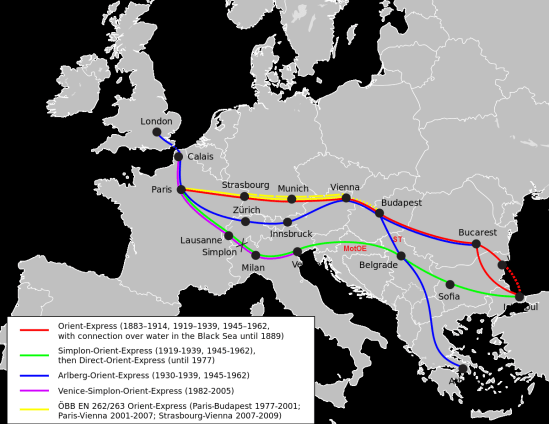
What also becomes apparent is that the trains in the two novels are in fact different variants of the Orient Express. As the map above shows, there were numerous routes taken by trains to and from Istanbul, connecting it with Paris and London. Christie has Poirot travel on the Simplon Orient Express which departs from Istanbul and travels via Belgrade and Venice to Paris, Calais and London via the Simplon tunnel, though, of course, it does not complete that journey before the murder takes place while the train is forced to a standstill by snowdrifts across the line in what is now Croatia between Vinkovci and Brod (marked on the map with “MotOE”) .

In contrast, Greene’s novel follows a route not shown on the map, from Ostende via Cologne to Vienna, joining the route shown on the map to continue via Budapest and Belgrade to Istanbul. The climax of the novel takes place close to the border between Hungary and what is now Serbia at the Subotica halt (marked on the map “ST”).

Both writers, therefore, chose to site their dramatic scenes (one cannot really refer to Greene’s novel having a denouement.in the sense that Christie’s murder mystery does) at the point on the journey where the travellers are passing through the northern Balkans. The area is perhaps perceived as being a lawless country beyond the norms of western European behaviour. Death and intrigue may take place here and the rule of law is subject to the corrupting influence of money.

That Christie, perhaps the most celebrated popular novelist of the era, with successes such as The Murder of Roger Ackroyd already to her name, should have deferred to the little known Graham Greene with what was only his second mature novel, when choosing the American title for her book, indicates that she was aware of it and of its significance.

Certainly, in spite of the throw away label of “an entertainment” which Greene applied to it, his novel addresses more serious themes than does Christie. One of the principal characters is a Jewish merchant who reflects frequently on the treatment he receives at the hands of gentiles, culminating in a frightening encounter with a Yugoslav soldier, who is barely restrained from shooting him. The rich Jewish businessman, once out of the comfort and security of the affluent surroundings of the train, is brought face to face with the personification of the underlying anti-Semitic hatred which, he recognises, fuelled the pogroms. Ironically, he is able to distance himself from this by treating it as an anachronistic throwback to former times compared with his familiar western Europe. Yet the book was published barely a year before the rise to power of Hitler and the National Socialists in Germany which would all but annihilate Jews from much of the continent over which the Nazis ultimately gained control.

In another unconscious irony, Greene, has another passenger on the train be on a return journey to Yugoslavia where he hopes to lead a communist uprising against the government. However, due to an error in timing, the rising takes place before he arrives in the country and, possibly as a result of his absence from its head, fails, leading to the imposition of martial law in the country. Greene provides a sympathetic outline of the conditions of poverty and oppression which lead to the uprising but expresses doubt as to its ever having prospects of success with or without its figurehead. Certain biographical details of this character including foreign parentage coincidentally mirror the background of Joseph Tito who eventually led Yugoslavia as a communist state in the aftermath of the Second World War.

Greene, as a less well-known author, was also free from constraints which would apply to Christie.  He was thus able to include an overtly lesbian character in a leading role and include her reflections on other women characters as potential sexual partners in a way that Christie could only touch on obliquely in her writings to avoid risking alienating her large and essentially conservative audience. In this respect, being perceived as a more serious writer, as distinct from a popular plotter, gave him greater licence.

A related freedom enjoyed by Greene, because he was not writing in the detective fiction genre, was that of presenting his characters’ inner thoughts. This without a doubt enables him to create fully rounded characters whose motivations and emotions are clear to the reader so that they are able to engage with them deeply. The writer of detective fiction must ensure that to a greater or lesser extent the motivations of his or her characters on the page are more or less obscured in order to sustain the puzzle. This makes the creation of fully developed characters significantly more difficult for the author and so they must rely on presentation of external clues to the interiors of their characters.  These clues must be sufficiently recognisable that they may be seen as stereotypical leading to criticism that the writer creates only cardboard cut outs – two dimensional characters which lack the vitality of “better” writers. This accusation fundamentally misses the handicap under which detective fiction writers must perforce operate. Indeed, Christie is masterly in her use of such clues to the personality of her characters so as to either misdirect the too-casual reader or lead the more observant reader to make a more accurate guess at the solution.

The most striking contrast in approach between the two writers is, however, their treatment of the train. For Christie, the Orient Express is a hermetically sealed world of glamour, populated by exotic characters, rich Americans, an elderly exiled Russian princess, a “beautiful foreign-looking” young woman.  It is a place into which the reader escapes from his or her humdrum exist ence to enjoy the thrill of the natural order being disturbed by that ultimate taboo – murder – in an atmosphere of suppressed or hidden passions.

Yet for Greene, the train, while also a sealed off world of its own, detached from the countries through which it passes, is a haven of normality.  It is the outside which is threatening. Myatt, the businessman, spends the bulk of the journey in preparation for a difficult meeting concerning a potential takeover of a rival firm. He might be simply engaged in a long commuter journey – a state perhaps well known to many of the book’s audience for whom the train journey to and from work might be their opportunity to read. It is only when he is outside the safe confines of the train that he is confronted with danger. No-one dies aboard the train – any such drama takes place on the outside, in the exotic foreign locations.  Any glamour attached to the train is debunked with his reflection that there is no point in buying expensive wines on the list since they would invariably be rendered inferior by the constant disturbance of the train’s motion.

How different this is from Christie, who, perhaps with tongue in cheek, and with, no doubt, a consciously ironic overlooking of Greene’s recently published novel, has a character in the restaurant car of the train say to Poirot, “If I had but the pen of a Balzac! I would depict this scene…you agree? It has not been done, I think? And yet it lends itself to romance, my friend.”

Postscript: I cannot let this opportunity pass without mentioning another fictional journey on the Orient Express taken some years later, in Ian Fleming’s 1957 novel From Russia With Love, which sees James Bond take the train from Istanbul accompanied by the glamourous Russian spy Tatiana Romanova. This cold war era, escapist thriller once again uses the lawless Balkans for the Russian agent to board the train but the climactic fight scene between him and Bond takes place while the train is in the Simplon tunnel (marked with an X on the map) – much further west. And I might add that in that novel, the train passes through Greece on a more southerly route than any shown – a necessary diversion to avoid passing through the Iron Curtain into Bulgaria as another portion of the train does, receiving only a passing mention in the book. Perhaps Fleming enjoyed his private joke when he name-checked Vinkovci and Brod as stations through which his secret agent travelled while on board, passing, for those of his readers who also shared a liking for Christie, the ghost of Poirot’s earlier train.


Recommended reading for 2017 Conference

We know that many attendees at the conference like to prepare for the day by reading books by, or about, the authors who will be discussed by our speakers. In order to get the most out of the session on Miles Burton, who also wrote under the name of John Rhode, and who was a member of The Detection Club (in which capacity he participated in two of that group’s collaboratively written novels), speaker Tony Medawar recommends:

Death in the Tunnel by Miles Burton
Death Leaves No Card  by Miles Burton
Death of Two Brothers by Miles Burton
Murder of a Chemist by Miles Burton
The Secret of High Eldersham by Miles Burton
The Floating Admiral by The Detection Club
Ask a Policeman by The Detection Club
The Fourth Bomb by John Rhode
The Paddington Mystery by John Rhode
Masters of the ‘Humdrum’ Mystery by Curtis Evans

This last book is a non-fiction overview by critic Curtis Evans of the sub-genre of Golden Age Detective Fiction which focused on the dogged investigative policeman as its central character – a school which included not only Burton/Rhodes but others such as Freeman Wills Crofts. Don’t be fooled by the subtitle of this book, by the way. Cecil John Charles Street, the first named of the authors, is none other than Burton/Rhodes. Indeed they were only two of his numerous pseudonyms as an author.

Gone Girl: the Golden Age revisited?

SPOILER ALERT:
If you are one of the handful of people left on this planet who have neither seen the movie of Gone Girl nor read the, to my mind, somewhat better book by Gillian Flynn on which it is based and have also managed to avoid inadvertently happening on the big plot twist and wish to discover it for yourself in your own good time then stop reading this article right now, go away, get yourself a copy of the book, read it and then come back to read this.

It has been suggested that there are certain parallels between the fictional Amy’s disappearance in the novel and the real life disappearance and subsequent reappearance 11 days later of Agatha Christie in 1926. On these somewhat tenuous grounds it has been argued that Gone Girl might be considered as a homage to the Golden Age of Detective Fiction – updated for the 21st century sensibilities.

It is not the purpose of this article to consider the merits of this claim or to explore the parallels between fact and fiction on which the link might be founded. Instead it is to consider the plot of the novel to determine whether it succeeds or not on the basis of the criteria by which Golden Age novels’ plots are measured. Namely: do they hold water?

I was fortunate to read the novel early enough to be unspoiled by foreknowledge of The Big Twist. I read it with high expectations.  People had recommended it to me, knowing how much I like Golden Age fiction.  They told me it was superbly plotted with a brilliant twist. You’ll never guess it, they said.

They were right. I didn’t guess it.  And it is a brilliant twist. To have not one but two unreliable protagonist narrators with conflicting stories is a superb twist on Agatha Christie’s original stroke of genius.

So why am I unhappy? I think I had better say from the outset that I am not, like many male critics of the novel whose views I have come across, unhappy because of the ending. There is poetic justice in the two-timing jerk being forced to live unhappily ever after with a self-harming sociopath who is perfectly capable of trying to kill him at any point should he step out of line.

No, I am unhappy because the plot by which the straying husband Nick is trapped is full of holes. It’s a complaint that many of the people who dislike the ending have raised but I have yet to see a halfway decent exposition of the plot holes. Indeed most of the so-called plot holes pointed out relate to the movie version, which does stick pretty closely to the book’s storyline, but doesn’t, for reasons of time constraints, address in detail the underlying explanations for the apparent plot holes which are adequately covered in the book.

I’m not concerned with those so-called plot holes that aren’t plot holes at all for readers of the book but with the genuine plot holes: holes that Agatha would not have allowed to remain in one of her Golden Age plots let alone plot holes on which vital outcomes depend.

Why does this matter? It matters because the novel is touted as building an escalating series of plot twists to reach its inevitable surprise conclusion. Whereas, in fact, Flynn has tried to be too clever and overreached a twist, or two, too far. The editors and proof-readers should have spotted these flaws and resolved them, as they could have been resolved or removed, in order for the book to succeed on its own terms.

Let’s take them in turn. Remember: at all points Amy has to construct a plausible reason why something is as it is to fit first one storyline – her husband Nick has murdered her – and then a second storyline – she was abducted by Desi an obsessive ex-boyfriend.

First we encounter the faked violent abduction scene with the overturned sofa.

It is established fairly early on that at least some of the evidence of a violent abduction is faked.  The over-turned sofa proves difficult to overturn and, if overturned, this would not happen without consequential accidents to other precariously balanced items in the room that have remained upright and intact.

This fits the first storyline – that Nick has faked the violent abduction evidence to cover up his own murder of Amy.

But when Amy flips to the alternative storyline of a real abduction then this faked evidence of a violent abduction is inexplicable. If there is a real abduction why is there also faked evidence of an abduction. Discredited fake abduction evidence cannot support a story of a true abduction. This is never explained; it is simply glossed over and ignored.

It is worth noting at this point that ignoring, glossing over or moving swiftly on are all established writer’s tricks to get over awkward, inexplicable plot holes.  Think of it as misdirection, like a stage magician will direct your attention elsewhere while pulling off his sleight of hand.

By the way, some people have criticised the lack of a head wound on Amy after her return to account for the amount of blood on the violent abduction scene. This is a mistake – even a small scalp wound bleeds profusely but heals very quickly – I speak from experience having once cut my head on a corner of a bathroom cabinet creating a bloodbath scene that would have not been out of place in the original Psycho but which left only a small cut, once cleaned up, that healed in a couple of days.

Secondly – Amy’s cut and brown-dyed hair.

Amy chops her hair shorter (significantly shorter and quite crudely) and dyes it brown at the beginning of her disappearance. She also, with remarkable foresight keeps some long blonde hairs carefully preserved which she uses subsequently to plant as evidence of her abduction in the boot (trunk for our US readers) of Desi’s car.

Given she has no inkling at the time she chops her hair that this is the way events will turn out, just why did she save those blonde hairs? Quite simply, there is no reason. It’s a basic chronological error on the part of the author.

There is also the question of why Nick fails to notice that Amy’s hair on her return is dyed blonde rather than naturally blonde. Remember, this is a self-applied wash in hair dye not a top quality salon colouring. That makes Nick crucially unobservant of a critical fact on which the plot depends.

Why is the hair dye so important?

Because there is no reason why an obsessed ex-boyfriend who recreates rooms, colours and flowers based on his accurate memory of what the teenage object of his desire was like would dye her hair and cut it short in a way that is completely different from his memory of her.

So cropped, dyed hair is incompatible with Amy’s “abduction” story on her return. Just how long was she gone that her hair could regain its original length, more or less, and any evidence of brown dye have grown out. Not long enough.

So we are left with a crucially unobservant character who misses a vital clue that would solve his difficulties and give him his “get out of jail free” card despite being very acute in other areas. It is too convenient for the author’s purpose that he should be so.  Again this is not a plot device that a great Golden Age writer would expect to get away with.  And again it is glossed over very quickly in the text.

Moving swiftly on.

Thirdly, why does Amy let two dumb strangers, who almost ruin her perfect plot, get away without any attempt at revenge.

Amy has accused a guy who ended a brief relationship with raping her.  She has gone to the police with that accusation and faked evidence of physical abuse, only stopping just short at the last moment from seeing it through to prosecution. In so doing she more or less ruined his life.

Amy has duped a schoolfriend who did better than her in class into behaving in ways that resulted in the friend being labelled a stalker and having to move away. Again, Amy without compunction, and for relatively slight reason, more or less ruined the friend’s life.

Amy is currently engaged in framing her husband for her murder because he cheated on her.

She does not strike me as the sort of person who just lets things go when other people do her wrong (as she sees it). Yet she lets two people rob her and thereby ruin her plan to disappear without a reaction. She just runs away and puts it behind her.

Of course she is the meticulous planner type and her careful calculations are thrown off course. So immediate revenge is out of the question.

But just letting it go? Even slight insults have been avenged out of all proportion in the past. Why not this major interference in a cherished plan?

You could argue that her previous revenge motives have been directed at social equals for relationship and interpersonal reasons whereas this pair are socially not Amy’s class and their actions are practical – theft – rather than emotional sleights.

If this is the reason, and I do find it implausible that she would behave in this way, then the author should at least have explained it, perhaps with some internal monologue. Otherwise it is a psychological loose end and that is downright careless if you’re writing a novel that’s supposed to be strong on the psychology as this is.

Or, of course, it could be a plot hole that the author wants to gloss over.

Fourthly, lets now consider Amy’s relationship with Desi.

Ultimately it is necessary from the author’s perspective that Desi should be an obsessive ex-boyfriend type. The sort of obsessive ex-boyfriend with loads of cash who will build a mansion to the memory of his childhood “sweetheart” – painting rooms her favourite colour, stocking it with her favourite flowers.  He will also build the mansion with impregnable security so that should the object of his desire ever call on him out of the blue then he can move her into the mansion and keep her prisoner there. With no prior warning or preparation time.

Now that strikes me as the actions of a deeply disturbed multi-millionaire.

He sounds the sort of person to whom a quick jaunt across a part of the USA – not coast to coast, remember, but reasonable driving distance by US standards – to abduct the object of his desires would come quite easily.

Which, of course, fits Amy’s abduction story on her return.

Except he didn’t. He builds the beautiful gilded cage but never does anything with it, other than maintain it in good condition. Until one day, quite by chance, the very bird he built it for decides to fly into it. Then, without a moment’s hestation, he acts. And does so decisively and effectively, trapping Amy.

If he’s that obsessive, why did he stop short of acting out the obsession and carrying out the abduction?

And if he’s not that obsessive, why did he build the mansion to her memory with the impregnable security?

Which is he?

But maybe she’s been stringing him along? The love letters he sends that Amy keeps as evidence of his obsession to use should the ever be needed (wow, more planning ahead for contingencies that are wildly unlikely) are perhaps only one side of a correspondence.  But then where are her replies? Did he keep them at the mansion – in which case Amy could have found them and destroyed them? If not, then where are they? She can’t really risk there being tangible evidence.  So letters and emails are out as a means of keeping him hanging on. So could it be phone calls? Possible, but there there are the pesky phone company records.  It really needs to be addressed in the text how Amy pulls this off and by what means. Having it as an unanswered question is sloppy plotting on the part of the writer if this is what is intended to be the backstory.

It does seem pretty implausible though. Among all the people Amy has lied about to mess up their lives it turns out that there was one person about whom she told the truth to mess up his life.

So in a novel with two unreliable narrators we now depend for the plot to work on a sociopath turning for help in her hour of need to someone who is an even loopier psychopath, knowing he is obsessed with her, because she has no other option. And when it all goes horribly wrong on her, our sociopath murders the psychopath and frames him for everything.

Desi’s fall guy fate is all a bit too Deus ex machina for me. A Golden Age writer on the top of her game would never hope to get away with such a ridiculous ruse.

Which brings us, fifthly, to the deep frozen vomit.

If you’ll forgive the pun, but this really involves some sloppy thinking on the part of the author.

The vomit is significant because Amy, in yet another example of her capacity for self-abuse, swallows the poison. She has carefully researched it using Nick’s computer, creating the damning audit trail. She has also made entries in her fake diary describing the symptoms she experienced.

But the fake diary at this point is describing her “happy” version of events. She describes the symptoms because at this point in the fake diary she has not yet started to “suspect” Nick or be “scared” of him.

But if she is happy and not suspecting Nick of trying to kill her, why did she freeze a sample of the vomit. Preserving a sample of the vomit is the action of a person who suspects she may be being poisoned, which is inconsistent with how she is describing herself in the diary entries.

Amy uses the existence of the vomit sample, hidden from Nick, to persuade him that she can revert back to her “Nick has been trying to kill me all along” story and back it up with evidence.

But this logic doesn’t hold up.

If the diary is real in Amy’s version of events then she was happy and unsuspecting at the time Nick tried to poison her.  Therefore she has no reason to deep freeze the vomit.

If she did suspect she was being poisoned and deep froze the vomit as evidence, then why does her secret diary, discovered by the police after the event, not mention those fears at this point or the fact that she has frozen vomit evidence. From which, the existence of frozen vomit is in fact proof positive that the diary is a fake concocted by Amy.

So what Amy holds as evidence to keep Nick under her control actually proves she is lying in the diary if that evidence were to be produced. In short, far from being her means of control over Nick it is his get out of jail card.

In fact the author has Nick destroy the vomit sample when he does find it in a classic case of the author misdirecting herself.  If the author had got the logic right then a) there never would have been any frozen vomit in the first place for Amy to use as she did or b) the author would have pointed out that by destroying it, Nick had wrecked the one piece of hard – frozen hard – evidence available to him at that point that Amy’s story was a pack of lies.

The fact the author does neither means that it hasn’t been thought through properly. Another unforgivable Golden Age faux pas.

So we come, sixthly, to whether Amy could in fact change her story again.

Amy’s hold over NIck in the end is basically – if you don’t do what I say then I can go back to my original story again at any time and claim you really did try to kill me.

How credible would that be? She would now be claiming that she, this poor wife, was abducted by an obsessive ex-boyfriend fortuitously just in time to prevent her being murdered by her husband.

Except that having killed the said obsessive boyfriend to escape him she then went straight back to the now supposedly murderous husband rather than staying well away.

Not very convincing, I think.

Which just leaves us, seventhly and lastly, with Amy’s pregnancy hold over Nick.

I will set aside the objections put forward by some critics that men don’t care as much about their babies and would be willing to walk away, which could be countered by the argument that this is by no means universally true and is even less likely to be the case where the man is aware of the true sociopathic nature of the woman he is contemplating leaving with the care of the baby. (To mix in another piece of fiction at this point as is permitted in Golden Age detective fiction – has Nick never seen Glenn Close’s bunny-boiler character in Fatal Attraction?)

Nick, very sensibly, doesn’t have sex with Amy immediately on her return. Well she’d been trying to frame him for murder and get him executed so that is kind of understandable however high his sex-drive.

So why cave in and create the ultimate hostage to fortune by indulging in acts that Nick knows Amy is using to get pregnant and gain a permanent hold over him? Why not continue to prevaricate – it would be understandable under the circumstances – and get a vasectomy with the time bought thereby? It certainly avoids the risk and it’s reversible later. His doctor would no doubt be able to give him a good indication of the probable fall in his sperm count over the future weeks and months.

Remember also that the sperm bank was a red herring – Amy wasn’t really pregnant through using Nick’s frozen sperm – that was her story and Nick would be aware that a proportion of pregnancies end in miscarriage so why not wait and see.

Even allowing for Amy getting pregnant, what’s to stop Nick going along with it and then doing a disappearing act of his own with the baby once it is born. Or try to demonstrate that Amy  is mentally unfit to look after the child after it is born.

Of course to an American author it might be  that simply running away with the baby, leaving the USA and setting up home in a country with no extradition treaty with the USA is inconceivable. But the alternative for Nick is living with a murderous sociopath who is using the baby as a means to have him do anything she wants.  That’s a pretty desperate choice.

I would want my author to do a better job of ensuring that Nick can’t exercise any of these options.

Which brings me to my conclusion.

I was led to expect a carefully plotted, nay watertight, storyline with a fantastic twist.

Unlike those who were unhappy with the ending and sought to find ways for Nick to wriggle out of it, I am definitely with Gillian Flynn who says that she couldn’t conceive of any other (better) ending. I don’t want Amy to be found out. I want her to get away with it, dreadful though she is. I want her careful planning to come off…almost. And I want Nick to be stuck with Amy. I don’t want him to kill her.  I don’t want anyone else to do it for him.

I want the novel to have the ending that it does. But I want the flaws in the plot addressed. I want a story that stands comparison with the best of Agatha’s Golden Age plots. I don’t want to feel short-changed. I want Gone Girl in a revised, plot hole free, edition.



More speakers announced for Bodies From The Library

We are very pleased to announce two more speakers at the Bodies From The Library conference, they are:

Kirsten Saxton

image001

Kirsten Saxton is professor at Mills College, Oakland, California, where she teaches and writes about 18th-century literature, early British women writers, gender and criminality. The Incredible Crime fuses her love of Jane Austen, feminist literary recovery, and crime fiction.She is particularly fascinated by murderesses, the subject of her book Narratives of Women and Murder in England, 1680–1760, a recent essay on Vera Caspary’s Bedelia, and her new project on the genealogy of the domestic thriller.

David Whittle

revised

David Whittle studied Music at Nottingham University, and wrote his PhD thesis on Bruce Montgomery/Edmund Crispin. His biography of Crispin was published in 2007 and has just been issued in paperback. He has contributed to publications such as the Oxford Companion to Crime and Mystery Writing, the Oxford Dictionary of National Biography, and Irish Musical Studies. He has been Director of Music at Leicester Grammar School since 1986.

Last few days for discounted early bird tickets to Bodies From The Library conference

The deadline for you to buy your tickets for this year’s Bodies From The Library conference at the specially discounted price of £35 is fast approaching. You have until 15th February to secure your place before the price goes up.

What could be a better Valentine’s Day surprise for your loved one than tickets for two to the conference dedicated to Golden Age Detective Fiction at the British Library?


Bodies From The Library 2017 Programme Announced

We are delighted to announce the programme for this year’s Bodies From The Library conference. It will be the usual mix of discussion panels and lectures with plenty of opportunity for attendees to question the speakers.

We are also thrilled to be able to tell you that, following the “official” close of the conference, there will be a special extra item: the announcement of the CWA Dagger in the Library Award followed by the CWA Wine Reception. All conference attendees will be invited to attend the reception.

The full day’s programme is:

10.00 Welcome by Martin Edwards

10.10 Panel: The Continuing Popularity of The Golden Age

10.50 John Rhode / Miles Burton

11.20 Coffee Break

11.40 Lois Austen Leigh

12.10 Crosswords & The Golden Age

12.40 Story of Crime In 100 Books

1.10 Lunch

2.10 Radio Play

2.40 Panel: Neglected Queens of Crime

3.20 Edmund Crispin

3.50 Break

4.15 Ronald Knox

4.45 Panel: Desert Island book

—————————————

The conference will be followed immediately by:

5.30 CWA Dagger In The Library Award

5.40 CWA Wine Reception – to which all conference attendees are invited.

Conference speakers will include favourites from previous years including Martin Edwards and Dolores Gordon-Smith and others plus exciting new speakers to be announced over the coming weeks.

Usual caveat: The above timings and content are for guidance only and may be subject to change due to force of circumstances.

EARLY BIRD TICKETS NOW ON SALE

We are delighted to invite you to the third annual Bodies From The Library Conference.

Early Bird Tickets are on sale now for a discounted price of £35 but hurry – the price will not stay at this special rate indefinitely.

You can book your tickets at:

https://www.eventbrite.co.uk/e/bodies-from-the-library-tickets-30290346241

What you can expect:

Once again it is a one day conference with an exciting programme of discussions, presentations and panels on the Golden Age of Detective Fiction Writers, giving you a chance to:

•Meet leading experts on classic detective fiction

•Talk with modern authors whose novels follow in the Golden Age tradition

•Enjoy the amazing surroundings of our prestigious venue at the British Library.


Just to whet your appetite

61bflh0vpnl-_sy346_

For those of you looking for a little Detective Fiction to while away those long, dark, winter nights, you could pit your wits against the authors of the British Library’s collection of winter mysteries, Crimson Snow, edited by Martin Edwards.

We are also very pleased to announce that Martin will be returning to next year’s Bodies From The Library conference on Golden Age Detective Fiction taking place at the British Library on 17th June 2017 (by which time we hope all the snow, crimson stained or otherwise, will have long since melted).

Also returning are popular speakers Dolores Gordon-Smith and Tony Medawar.

We are also delighted to announce that we will be joined by two fabulous speakers, new to Bodies From The Library, Professor Kirsten Saxton and Dr David Whittle.

More speakers will be announced shortly.

Tickets for the conference will be going on sale very soon – watch out for our announcement to book your place at a special Early Bird price.