Z Murderer foiled by SatNav (almost)

z murders satnav

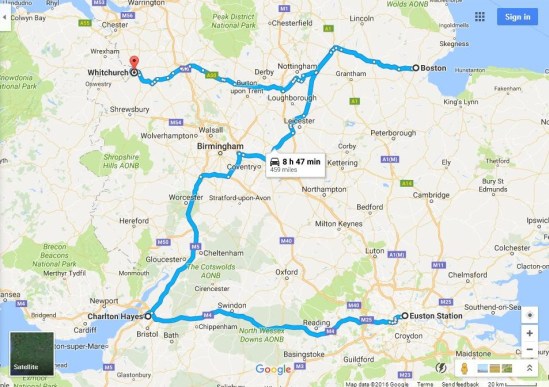
Without giving too much away, indeed a simple perusal of the chapter headings in J Jefferson Farjeon’s The Z Murders will reveal that after the opening at Euston Station and the subsequent journey to Bristol (or more accurately the village of Charlton which is now a suburb on the north side of the city), the plot continues by way of Boston (Chapter XIX) to reach Whitchurch in Shropshire (Chapter XXXIV). This creates a neat capital Z across the roadmap of England which the taxi-driver purchases to facilitate his journey from Bristol to Boston.

However, with the advent of SatNav, who needs a road atlas? You plug in your destination postcode and follow the instructions without necessarily any clear idea of where exactly you are going. Indeed, even with that knowledge, your SatNav may not take you the route followed by the intrepid hero of the plot through Gloucester, Stratford Upon Avon and Grantham which most perfectly forms the letter Z. Indeed, the programme of roadbuilding which has taken place since the book was written in 1932 includes the M5, the M42, the M6  and the M69 along which your SatNav will take you, thereby shaving 19 minutes from your prospective total journey time (albeit at the cost of an extra 21 miles driving by the less direct but faster route).

The resulting route not only distorts the perfection of the Z achieved by Farjeon but places the top corner of the Z at Nottingham, leaving Boston as a stranded outlier. What if the hunt had been so thrown off the scent? Imagine being caught miles from the scene of the action. How would the intrepid hero arrive at the true solution?

Fortunately, the low-tech approach is taken. Writing is done with pencil on paper rather than typing on a touch-screen phone and justice prevails.

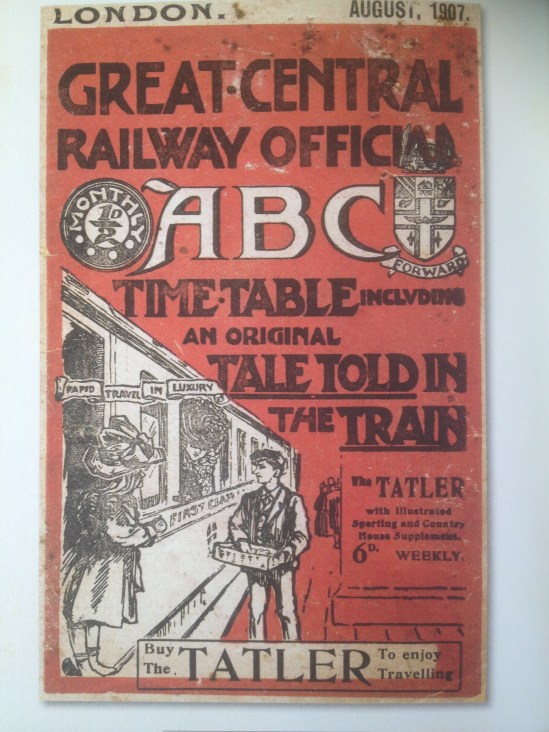
The book also features the use of a clue from an ABC Guide, pre-dating Agatha Christie’s more famous use of this publication by some four years. Less comprehensive than Bradshaw’s Guides (which aim to provide timetables of all services), the ABC Guides gave details only of services to and from London but, crucially, gave information on fares as well as timetables. One wonders whether there is scope for a plot driven (if that is the correct term to use in this case) by use of the online National Rail Enquiries service? (Remember – you saw the idea here first!)
IMG_3087


The Moving Toyshop: A Walking Tour of Oxford

IMG_2990

Oxford is a delightful city and sufficiently compact to enable you to walk around its heart and enjoy the atmosphere, the architecture and the history of the place. Rather than meander aimlessly, however, we decided to conduct our walking tour taking Edmund Crispin’s The Moving Toyshop as our guidebook.

We began our tour at location A on the map which serves as the frontispiece for the book: The Toyshop (second position). Here we encountered our first dilemma. The large, even one might say, grand houses and buildings on the side of the Banbury Road indicated by the map were patently of greater vintage than the novel and looked exceedingly unlikely to have ever been used as retail emporia of any description. We therefore concluded that we must move the Toyshop a second time and transpose it to the other side of the road where a delightful row of shops was to be found.

Toyshop (second position)

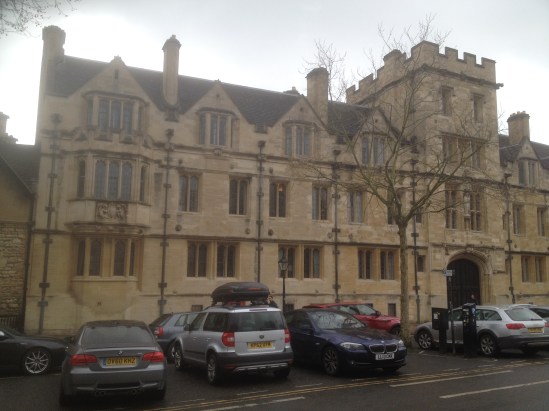
Walking down the Banbury Road we reached the site of St Christophers, which was a little underwhelming, but we persevered.

St Christopher's

Continuing down the broad expanse of St Giles’ we reached St John’s, which proved much more impressive.

St John's

We continued our walk to the junction of St Giles’ and Broad Street where we reached the magnificent Balliol College.

Balliol

Walking along Broad Street we reached the delightful garden courtyards of the equally impressive Trinity.

Trinity

Retracing our steps we came to the junction of Cornmarket and George Street where we found Lennox’s shrouded in plastic sheeting and scaffolding for restoration works.

Lennox's

Continuing along George Street we reached the corner of New Inn Hall Street where we found the Mace and Sceptre public house, now gone the way of so many of our public houses and been subsumed into a chain of Irish Bars to become O’Neills.

Mace and Sceptre

We then returned to Broad Street to see the very much still functioning Sheldonian.

Sheldonian

A further U-turn brought us back to Cornmarket down which we walked to reach Rosseter’s Office.

Rosseter's office

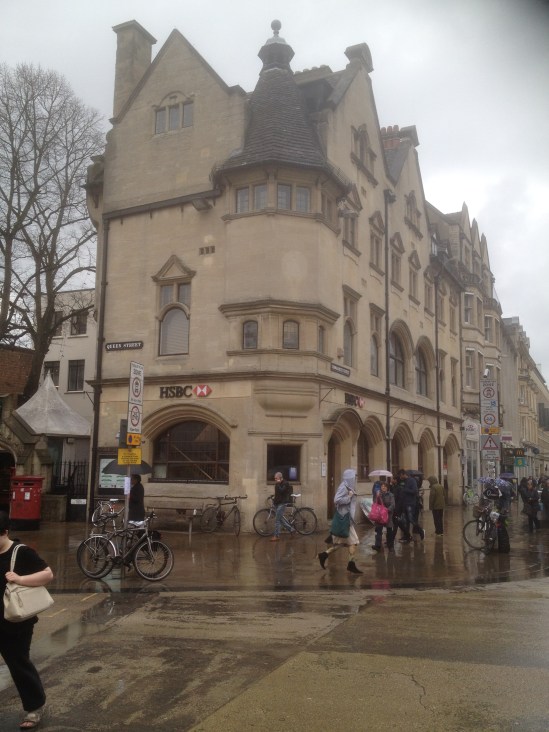
And on the opposite corner, though better viewed perhaps from a little way along the High Street, the Market.

Market 2

A short walk down St Aldate’s brought us to the council offices on the site of Crispin’s police station.

Police Station

Here we broke off from our Crispin tour to take a small diversion down a lane off St Aldate’s to visit the house where Dorothy L. Sayers was born and spent her early years.

Dorothy L Sayers House

Dorothy L Sayers

We then walked along the High Street and crossed the Magdalen Bridge to reach the junction from which the Iffley Road proceeds to find the location of the Toyshop’s first position.  However, here Crispin’s map diverges even more from reality. The Iffley Road is not the one so-labelled in Crispin’s map. Instead it is the one which goes down off the bottom of the map. It is in any case flanked by genteel houses which clearly would never have been home to a Toyshop, however, briefly. We therefore followed the Cowley Road (which corresponds to what Crispin calls the Iffley Road on the map – i.e. the middle one of the three roads out of the city centre at that junction) to end our walking tour at the site of the Toyshop’s first position. So, albeit the address is on Cowley Road not Iffley Road, we are sure that on this occasion we have not subjected the Toyshop to the further indignity of another unnecessary move.

Toyshop (first position)

What to do next?

Barry Forshaw (3)

If you attended the Bodies From The Library Conference over the weekend at the British Library and are wondering how to get your next fix of top quality crime fiction, then look no further than returning to the British Library where you can study the genre of the moment – European Noir. Running over three weeks, starting on 28 June and continuing on successive Tuesday evenings, the course is led by the UK’s leading authority on European Crime Fiction, Barry Forshaw.

Follow the link to find out more about the course and to book your place.

http://bit.ly/1U7anxO

Final preparations for Bodies From The Library 2016

So excited! Just getting ready to head up to London to join the team and put in place the final preparations for tomorrow’s Bodies From The Library Conference at the British Library. I’ve checked that everything is packed I don’t know how many times already.

Looking forward to welcoming everybody, meeting old friends again and hoping to make lots of new ones.

See you there!

Mark


Exclusive opportunity to buy new Golden Age editions before publication date

If you want to get your copy of new editions of Golden Age Detective Fiction novels months before they go on sale to the general public then the Bodies From The Library Conference at the British Library on Saturday 11th June is the place to be. We are delighted to be able to reveal that conference sponsors Harper Collins and the British Library will be making available a selection of new titles for sale exclusively to conference attendees. I am dying to tell you which books will be on offer but I am sworn to secrecy. All I am allowed to reveal is that I am very excited about the list I have seen and will be raiding my own piggy bank to get my copies on the day.

If you want to take this opportunity to be one of the first to have copies of the new editions, and you haven’t already got your ticket, then all you have to do is click on the link on this page to secure your place at the conference and you can join those who are already at the front of the queue.

Unique Sleuth’s Corner Opportunity

In 1938 Margery Allingham devised a Sleuth’s Corner Crime Competition for the Sunday Times National Book Fair. This short story – and its accompanying visual clues and photographs – remained an ‘unknown’ story for over 75 years. Now Bodies From The Library is delighted to offer Golden Age fans the opportunity, exactly as it was almost 80 years ago, to match wits with one of the Queens of Crime and see if they can decide ‘Who Killed Robin Cox’. No prizes on offer this time and it will only be available during Bodies From The Library on 11th June but Margery Allingham Society members will be happy to answer questions on the day.

P.D. James Golden Age Favourites

In 2006 P.D. James wrote in The Wall Street Journal about her favourite detective novels. Four were Golden Age novels and I shall focus on them.  For the record, her fifth choice was Dissolution  by C.J. Sansom published in 2003.

Her choices were: Tragedy at Law by Cyril Hare, The Franchise Affair by Josephine Tey, The Moving Toyshop by Edmund Crispin and Murder Must Advertise by Dorothy L. Sayers.

James selected Tragedy at Law because it “provides a fascinating portrayal of the judge in court and of the coterie of people, including barristers, who travel with him… [and is]… Written with elegance and wit.” I have to agree with her on all points. As I knew nothing of the itinerant lifestyle of a circuit judge I found the whole unfolding cycle of travel from place to place with an entourage of lawyers acting for both defence and prosecution a revelation. I suppose if I had stopped to think about it, the world Hare describes so vividly -in all its ups and downs, vicissitudes and petty one upmanship, focussing on pecking order and who shall have the worst room in the inn – is what is to be expected and follows an ancient custom.  Nevertheless, Hare brings it to life with the insider knowledge of one who has endured it.

She says that The Franchise Affair “is an unusual detective story in that it contains no murder. It is, however, enthralling from beginning to end…The setting and the people come brilliantly alive and, despite the absence of egregious violence, the tension never slackens.” What is also important to me is that once again Tey stands conventions of the genre on their heads and pulls it off. The purpose of the protagonist is to prove the innocence of the accused of the crime of which they are accused – not so unusual on that score I know (she even tried this with The Man In The Queue) – but what is unusual is that instead he is seeking to do so by proving the guilt of the supposed victim. He is not looking for the alternative perpetrator but for evidence of the victim’s having lied. In short, to prove that no crime took place at all. A novel twist for a detective fiction story.

I find it intriguing that both the above books are one-offs rather than series books and feature moderately successful legal professionals as the detective. I wonder if there was scope for either to have become a series detective with a legal background- think Perry Mason. But perhaps in each case there was a unique reason which impelled the also ran lawyer to become an insightful detective and in the absence of this impetus they would not have the perseverance to follow through in the detecting line.

James observes that the author of The Moving Toyshop, Edmund Crispin, “is one of the few mystery writers able to combine situation comedy and high spirits with detection. Readers are advised that “Suspension of disbelief is occasionally needed, but this spirited frolic of a detective story retains its place as one of the most engaging and ingenious mysteries of its age.” The premise with which the novel is set up in its opening chapter is startling and original. So startling that almost any solution is bound to be accompanied with a sense of deflation. To finally understand how the crime was pulled off in this case is rather akin to standing in the wings and watching the magician palm the card to confuse the audience.  A little of the magic is lost. And it must be said that this is one of the examples of the type of detective fiction in which the perpetrators of the crime eschewed easier and more obvious means to achieve their end in favour of the complex and risky approach that was likely to be no more effective. A clear case for accepting the possible while ignoring the probable when coming to the correct solution.

She regards Murder Must Advertise as “One of [Dorothy L. Sayers’s] most enjoyable novels, and the most credible judged as a mystery… The novel shows Sayers’s virtues of originality, energy and wit. Anyone interested in what it was like to work in an advertising agency in the 1930s has only to read “Murder Must Advertise.” Copywriters today may feel that little has changed.” Once again we are transported into an unfamiliar world and fwwl throughout the author’s intimate knowledge of its inner workings which is based on personal experience rather than any amount of research and this shines through. For that alone I would love this novel even though Wimsey is beginning his metamorphosis from upper class amateur to infallible Greek god as Sayers falls in love with her creation. He turns out to have been a cricketing blue on top of all his other accomplishments. And the murder is pulled off by one of Sayers’s ingenious but improbable methods requiring a supreme level of skill on the part of the murderer for a very uncertain result.

Would any of these four make my top five detective novels? Possibly. Tragedy at Law is for me the one that succeeds both as a book, evoking a specific time and place and populating it with believable characters, and as a detective story with a solution which manages to surprise and yet be inevitable once explained. The Franchise Affair comes close though it depends on its time – modern police questioning methods and protocols would remove several of the plot’s features leaving the case against the accused women significantly weaker. But for tension it is definitely up there. The Moving Toyshop falls short for me after a brilliant start, for the reason outlined above. And Murder Must Advertise is another example for me of why I both love her novels (superb description of the situation that is totally believable and engrossing) but am exasperated that her solutions are less watertight than she would have us believe.

Mark


Detective Fiction and the Theatre

There is a symbiotic relationship between Golden Age Detective Fiction and the Theatre. It is no coincidence that the longest continuous run of any theatre production is of Agatha Christie’s The Mousetrap, which is currently in its 64th year. The play is, like many of the 16 plays written by Christie, an adaptation of one of her short stories. Of course, Christie felt at liberty when reproducing her plots for the stage to play fast and loose with the original storyline so that knowledge of the novel or story – whodunnit, how and why may be of little help to the theatre-goer in predicting the dramatic conclusion in any of them. Indeed, that fore-knowledge may serve as an extra red herring for the unwary.

Christie is not, however, the Queen of Crime most steeped in the theatre. That honour falls more to Ngaio Marsh. Indeed, her OBE citation was “for services in connection with drama and literature in New Zealand”. She spent much of her professional life working as a theatre director and managing acting companies. This inside knowledge gives her stories set in the theatre an added realism. Like Dorothy L. Sayers in Murder Must Advertise, she is writing about a world in which she has worked and it shows.

When reading Marsh’s Enter A Murderer and Vintage Murder, both on the recommended reading list for this years Bodies From The Library conference, I was struck by how well suited the theatrical world is to provide a setting for detective fiction. There is a closed circle of potential suspects and sufficient scope for animosities and jealousies, petty, personal and professional, which can give a multitude of motives for murder, especially when mixed in with the artistic temperament and attendant hysteria and over-reaction to perceived slights.

I did note also that there was even the hierarchy of the characters – stars, character actors, aspiring actors that might be analogous to the wealthy upper and middle class inhabitants of the country house or village settings beloved of Golden Age authors and readers alike. The stage crew might then be seen as being the counterparts of the servants and working class.

Such an analysis would lead one to discount those anonymous stagehands as potential murderers when trying to puzzle out whodunnit but, to her credit, Marsh avoids this trap. Select members of the back-stage crew are given sufficient space in the narrative to be regarded as possible suspects with means to hand, motives established and opportunities identified.

By way of light relief, I also read the British Library Crime Classics newly republished edition of Alan Melville’s Quick Curtain. This also takes place in a theatrical setting and, like Enter A Murderer, features a murder occurring on stage before the theatre audience’s eyes. Melville was himself a playwright and broadcaster. He too uses that knowledge to add verisimilitude without over-doing it to the point where it obtrudes. Indeed, his book is a light-hearted comic read with the Scotland Yard detective proving less acute in his observations than Messrs Alleyn, Poirot or Whimsey might have been. Perhaps because he is playing largely for laughs, Dorothy L. Sayers was somewhat unsure how to treat this book in her review – should it be regarded as straight or not – with the result that she was less than enthusiastic, Melville does play heavily on stereotypes and, to a great extent, ignores the backstage crew (they are the hidden chorus of servant equivalents if this were a country house send up) in his field of suspects.

Which leads me to conclude that there is at least a case to be made for regarding theatre settings for Golden Age Detective Fiction as one of the classic settings or formulae alongside the country-house, the moving train and others. Certainly Marsh used it on several occasions besides the two mentioned already. All of which could get very post-modern and knowing if the story were then adapted for the theatre to create a play within a play. But with their constant references to “this is the sort of thing that only happens in cheap detective novels” the Golden Age Detective Fiction authors were already there with that meta-narrative.