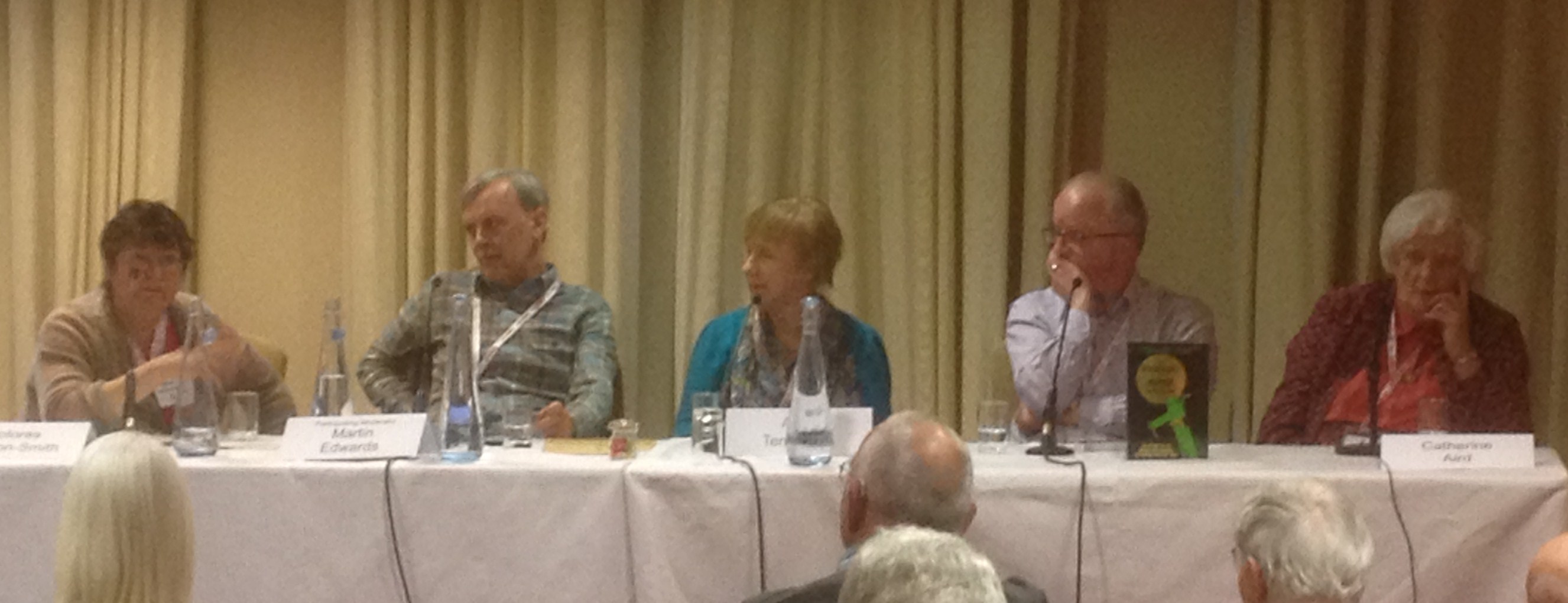
Looking forward to CrimeFest 2015

I am looking forward to CrimeFest 2015 which is taking place in Bristol this week from Thursday 14th to Sunday 17th May.

In particular I want to catch up with John Curran, Martin Edwards, Dolores Gordon-Smith, Jake Kerridge and L C Tyler who will be there and who will all be speaking at The Bodies From The Library conference on 20th June.

For more information about CrimeFest go to:

CrimeFest

Ruth Rendell

We are sad to hear of the death of Ruth Rendell, aged 85. The author of more than 60 books,she published her first novel From Doon With Death in 1964.  It featured her series character Chief Inspector Reginald Wexford who featured in 24 novels. She also wrote under the pen-name Barbara Vine and in this guise particularly explored the psychological aspects of criminals and those on the edge of society.

Rendell had a deep interest in social issues and as a Labour Peer was instrumental in bringing to the House of Lords a bill which came into law as the Female Genital Mutilation Act 2003.

She often said that Wexford reflected her view of the world though, interestingly, she characterised him as a Liberal Democrat in her fiction.

Along with the PD James, who died last year, Rendell was acclaimed as one of the two new Queens of Crime, inheriting the mantle from Agatha Christie, Dorothy L. Sayers, Margery Allingham and Ngaio Marsh.  Together the two writers transformed the crime thriller, moving it on from the Golden Age and achieved critical literary acclaim as well as popular sales.

Her final novel, Dark Corners, is scheduled for publication in October 2015.

Golden Age part of Modernist literary movement

When you think of Modernism in literature the names that come to mind might include James Joyce, Virginia Woolf, D.H. Lawrence, Ezra Pound, T.S. Elliot, Franz Kafka or Marcel Proust, depending on your preferences and native language. The names Anthony Berkeley, Edmund Crispin, Freeman Wills Crofts and Michael Innes may not be at the forefront of your mind. Yet I have just finished books on the Bodies From The Library recommended reading list by each of these authors and think there is at least a case to answer.

The evidence I put forward for inclusion of these, and other authors of the Golden Age, in the modernist literature movement alongside the more academically and critically acclaimed authors listed above is that they display a characteristic trait of modernist novels – namely a conscious playing with form, an acknowledgement of the artifice in their art, and a willingness to break down what in the theatre is known as the fourth wall, the “window” through which the audience sees the action but is separated from it.

In Berkeley’s Jumping Jenny, the scene is a party given by a writer of detective stories and Berkeley’s series protagonist, Roger Sheringham, in a deliberate and playful inversion of the genre’s expected form, engages in wilful attempts to obstruct the police investigation and prevent them discovering the identity of the person whom he believes has committed a murder on the morally somewhat dubious grounds that they are a nice person whereas the victim was not.

Crispin goes further in The Moving Toyshop and has a character, who happens to be a poet currently suffering from writer’s block, cry out during a car chase:

“‘Let’s go left,’ Cadogan suggested. ‘After all, Gollancz is publishing this book.”

It could be argued that as far back as 1924, Freeman Wills Crofts invented the police procedural though his Inspector French’s Greatest Case at times reads like a travelogue of some of the finest holiday destinations in Europe (I can vouch for the accuracy of the description of Murren in Switzerland which appears to have changed little in the intervening 90 years). He too refers to the world within the novel as:

“In this world the ordinary, natural and obvious thing happened. A man who secretly visited the scene of the crime at about the hour at which it was known to have been committed,…such a man, in ordinary, prosaic, everyday life was the criminal.”

Furthermore, he refers to the fictional world of Conan Doyle when the detective’s wife says to him:

“‘…Why, a child could guess that, Watson!’ When Mrs French called her husband by the name of the companion of the great Holmes, it signified two things…” Notably that Freeman Wills Crofts expected the reader to cheerfully blur real world in which they as readers were themselves likely to have read Conan Doyle and the world inhabited by the characters of the novel where fictional characters have a fictional place in that fiction. I hope you’re still with me on this one.

And finally Michael Innes in Death At The President’s Lodgings has one of the suspects, an Oxford Professor, moonlight under a pseudonym as the author of detective fiction, of which he is slightly ashamed. The book conludes with the Inspector Appleby telling the professor:

“‘I have a parting present for you… A title for the book you may never be able to write: Seven Suspects.” Which, of course, is the alternate title under which the book was published (and Innes was the pseudonym of Professor John Innes Mackintosh Stewart of Christ Church College, Oxford).

Make of that what you will.

I should also point out that I got hold of these titles, not available through my local library service (cries of shame go up but, in fairness, they are pretty old and obscure even if classics of the genre), through the wonders of Amazon Marketplace. I am indebted to Karl Eynon Books, Tree Savers, World of Books and Brit Books whose online stores were where I found the books discussed this week and so give them a shameless plug here.


Recommended Reading – No Spoiler Alert Required

I have now exhausted the resources of the South West Libraries (well, all bar one final book which is still on order). The Golden Age has been reasonably well-served with 11 of the 34 recommended titles (if we exclude the ones I have already on my own bookshelves) in stock – either on the shelves or stashed away in some vault somewhere to be retrieved on request.

The last three I have read – Traitor’s Purse and Hide My Eyes, both by Margery Allingham and The Water Room by Christopher Fowler are all published later than the traditionally accepted Golden Age of between the wars and all show developments from the classics of the genre.

Traitor’s Purse has the detective, Albert Campion, suffering from amnesia which places him in the same situation as the reader – not knowing what is going on and having to figure it out for himself as he goes along.  An interesting twist to see him struggle rather than exhibit the more usual omniscient brilliance of the insightful detective.

If Traitor’s Purse has Campion cast in the role of central protagonist in an almost 39 Steps like nod to the heroes of the thriller genre, given it was a wartime publication,  then in Hide My Eyes, he is almost relegated to the background as others carry the bulk of the action (arguably the book need not have been a Campion novel at all and could have been managed without his presence).

It is possible to read The Water Room as a critique of the police procedural which superseded the Golden Age style. The Peculiar Crimes Unit (the title says it all) which carries out the investigation is placed neatly outside the control of the Metropolitan Police and follows the accepted modern procedures or not, more or less as the author fancies. In this way it almost harks back to the earlier era.

Yet all three still adhere, more or less, to the rules expounded by Ronald Knox in his introduction to Best Detective Stories 1928-29, which I paraphrase below:

  1. The criminal must be a person introduced near the start of the story and be someone whose full thoughts the reader has not been allowed to follow.
  2. No supernatural solutions are allowed.
  3. No more than one secret room/passage is allowed.
  4. No hitherto unknown poisons are to be used (nor any complex scientific gadget requiring tedious explanations).
  5. No stereotypical (my italicised insertion) Chinese person should feature (see previous article on implicit racism pervading the genre because it reflected contemporary society norms).
  6. No accident must help the detective to solve the crime, nor may he reach the solution by unsupported intuitive (i.e. guessing it correctly) rather than deductive methods.
  7. The detective must not commit the crime.
  8. The detective must not rely on clues that are concealed from the reader.
  9. The detective’s sidekick, if present, should be ever so slightly dimmer than the readership.
  10. Identical twins shall not feature in the solution unless clearly flagged beforehand.

Of course all the great authors of the Golden Age felt free to break one or more of these rules when it suited them – we can all think of examples that are classics of the genre which do so – but when they did, it was very deliberately and for a good reason.

British Library Crime Classics

I am delighted to provide a link to the Past Offences site featuring an interview with Rob Davies who is responsible for the British Library Crime Classics series which is re-publishing some of the great forgotten classics of the golden age of detective fiction.  We are delighted that Rob will be speaking at the Bodies From The Library Conference as will Martin Edwards who has provided the erudite introductions to many of the books in the British Library series.

Crime publishing at the British Library – an interview with Rob Davies

As a brief postscript, I am also delighted that one of the books I received for my birthday over the weekend was the British Library Crime Classic edition of Antidote to Venom by Freeman Wills Crofts which is one of the books on the recommended reading list provided by Dolores Gordon-Smith, who will be speaking at the conference on the novels of Freeman Wills Crofts.

Recommended Reading – No Spoiler Alert Required

I am continuing to work my way through the Bodies From The Library conference speakers’ recommendations. Thanks to the continuing wonder of the library service, I am able to get hold of all but the more obscure titles (sorry Martin Edwards – that means several of your recommendations!)

Without going into the plots – so no spoiler alert required – the historian in me has been piqued by the possibilities for studying the society which produced the Golden Age of Detective Fiction: Britain (for the most part) between the wars. What evidence do these novels, products of popular culture, written with no real thought for posterity but simply as entertainment, offer about the people, society and culture of those times?

Reading Dorothy L. Sayers’ Gaudy NightUnnatural Death, and Have His Carcase, Edmund Crispin’s Love Lies Bleeding and G.K. Chesterton’s The Innocence of Father Brown, I am struck by the concern to avoid scandal and the inherent deference in the culture. Both Sayers’ and Crispin’s plots feature academic institutions – an Oxford College and a private school – whose primary concern when faced with crimes on their premises is to avoid the embarrassment of publicity rather than catching the perpetrator. The distinctly proletarian police seem more than willing to go along with this prioritisation by these upper-middle class establishments.

Indeed the class deference is taken further with the working-class police even allowing the aristocratic amateur Lord Peter Wimsey and the intellectual-elite Professor Gervase Fen not only to take an active part in the criminal investigation but at times to lead it.

That such plot devices were accepted without comment by the contemporary readers is indicative of a vastly more class-hierarchical society than modern Britain. It might be argued that readers then were less sophisticated than the modern reader and were more ready to suspend dis-belief in the interests of allowing the author to further the plot in a way that a modern audience would not because the modern audience requires the author to maintain precise accuracy in their adherence to procedures to establish their verisimilitude.

However, I suspect that such a line does a dis-service to contemporary readers between the wars. There is no reason to suppose that they were less demanding than readers now and a more plausible explanation is that the contemporary reader would find nothing comment-worthy in the deference to the elite because it reflected their own expectations of the society in which they lived.

The same could be said of the casual racism and anti-Semitism that pervades many of the novels. That a plot could hinge on a person being blackmailed over mixed-race parentage in their family, or that the idea of a white woman being abducted is more horrific because the abductor is believed to be black, indicates a level of racism inherent in the society that would be intolerable today. Indeed, notoriously, Agatha Christie’s novel Ten Little Niggers is now bowdlerised as And Then There Were None to reflect changing sensitivity in the use of the word, which is now treated by society as deeply offensive.  Yet, the use of “nigger” occurs many times in books of this era, both in the speech of characters and, perhaps more tellingly, in the author’s own voice as narrator, without arousing comment at the time of publication.

The same can be said of the treatment of Jewish characters. Often they are portrayed stereotypically, as avaricious or money-grabbing. Characters are sometimes described as being a Jew without further elaboration, as if that suffices to portray them in the reader’s mind. This cannot be put down to lazy writing on the part of the authors. For them to use this form of shorthand, the readers must have had a common understanding and set of beliefs which to the modern audience appears disturbing.

It is not, I must stress, that the authors were themselves specifically racist or anti-Semitic.  It is rather that they reflect the deep-rooted racism and anti-Semitism of their times in their writing.

I must, however, single out G.K. Chesterton for a specific prejudice which says more about him than about the society in which he lived. When reading his short stories about the Roman Catholic priest cum detective Father Brown, it soon becomes apparent that if a person is described as “atheist”, “Presbyterian” or “Calvinist” then you can safely assume that the character will be irrational, arrogant, stupid, or unhappy, and is likely to be involved in the crime as either the killer or his victim.

His conversion to Roman Catholicism is eminently predictable as a result,


Academic Conference on European Crime Fiction

We are very pleased to let you know about an intriguing conference which is taking place shortly at the British Library on Friday 10th April.

The conference is entitled Towards a Digital Atlas of European Crime Fiction?

Here’s what the organisers have said to describe the event:

“In the last decades the astonishing speed in the global circulation of cultural works and the unprecedented opportunities to gather and analyse large amount of data through electronic resources have opened up new possibilities for researchers in all disciplines. At the same time, the spatial turn in the Humanities has prompted scholars to consider the benefits of using with maps and graphs to investigate the transnational history of cultural phenomena. However, while scholars working on quite traditional literary subjects have been quick to discuss and carry out the provocative claims made by Franco Moretti in The Atlas of the European Novel (1998), an ideal case study for such an approach, i.e. popular fiction, had been largely neglected.

The AHRC-funded project Visualising European Crime Fiction: New Digital Tools and Approaches to the Study of the Transnational Popular Culture has represented a first attempt to adopt this approach in the field of crime fiction studies, starting to collect data from different sources and exploring use of an online database and various visualisation tools. This exploratory project aimed at testing a number of strategies and possibilities in order to envision a larger, longer-term initiative to conduct extensive studies on the transnational circulation of popular fiction on a continental level. Researchers from a group of universities in the UK, France, Hungary, Sweden and Czech Republic have collaborated to create sample datasets, the prototype database and a series of visualisations.

At the symposium to be held at the British Library on April 10, 2015 the scholars involved in the project will present the work carried out so far and will talk about future perspectives, reflecting on how they might address their research questions, take advantage of the most useful technological resources as well as disseminate their results in innovative ways. The strengths and the weakness of quantitative and digital approaches, the ideas to take this challenge to a new level, and the potential of new partnerships will be discussed with a group of other scholars invited to present their own experience in the study of crime fiction.

Please register using the following link: http://www.eventbrite.co.uk/e/towards-a-digital-atlas-of-european-crime-fiction-tickets-16199136052

Programme of the day

10:00-10:20 Coffee and registration

10:20-10:30 Welcome and Introduction: Dominique Jeannerod & Federico Pagello

10:30-12:00 Papers from the project members:

Dr. Dominique Jeannerod (Queen’s University Belfast) – “European Crime Fiction : A Big Data Story”

Dr. Federico Pagello (Queen’s University Belfast) – “Metadata, Cover Art & Data Viz: Creating an Online Archive of European Crime Fiction”

Dr. Loic Artiaga (University of Limoges) – Title tbc

12:00-12:15 Coffee Break

12:15-13:30 Papers from the project members:

Dr. Natacha Levet (University of Limoges) – Title tbc

Dr. Sandor Kalai (University of Debrecen) – “The Hungarian Translation of Crime Novels under Socialism: Analyse of Two Specialised Series”

Dr. Andrew Pepper (Queen’s University Belfast) – “Quantifying the Internationalization of Crime Fiction: Les Crimes De L’Annee (1989-2004) and the Significance of Place”

13:30-14:30 Lunch Break

14:30-15:30 Lightning Talks: Studying European Crime Fiction, Sources and Methods

Dr. Ellen Carter (University of Paris 1) – “Killing by numbers: quantitative methods in crime fiction research”

Dr. Katharina Hall (Swansea University) – Title tbc

Dr. Andrea Hynynen (University of Turku) – “Gender studies and crime fiction – pros and cons of quantitative methods”

Dr. Marcel Poučová (Masaryk University) – Title tbc

15:30-16:00 Coffee break

16:00-17:00 Keynote address, Ian Sansom (Author of the Mobile Library Mystery Series; Professor in English and Comparative Literary Studies, University of Warwick)

16:30-17:30 Roundtable: Towards a Digital Atlas of European Crime Fiction? (Chair: Prof. Jacques Migozzi, University of Limoges)

Deal Noir

Deal_Noir_logo_change_1

The Bodies From The Library team is very pleased to be supporting the Deal Noir conference which takes place next Saturday 28th March at the Landmark Centre in Deal.

This promises to be an interesting and entertaining day featuring:

  • Best-selling authors speaking on crime fiction in all its forms from dark psychological thrillers through historical fiction to light-hearted romps
  • Interactive sessions where you have chance to put your questions to the panel and join in the debate
  • The announcement of the Winner of the Deal Noir Flash Fiction Award 2015

To find out more and to book your tickets go to the Deal Noir website:

A Conference on Crime Fiction

Eclipse trivia

in view of today’s eclipse I thought it worth mentioning the final paragraphs of Dorothy L. Sayers’ Unnatural Death (one of the recommended reads for the conference) which concludes with Lord Peter Wimsey emerging into the  June morning to witness an eclipse. This makes the date 29th June 1927 as this was the date on which a total eclipse could  be observed in London. 

For details of all the books recommended by our speakers go to The Bodies From The Library website. 

The Seven Types of Locked Room Mystery

According to John Dickson Carr, there are no less than seven distinct types of locked room mystery. At least that is what his character Dr Fell tells the readers in chapter seventeen of his 1935 classic The Hollow Man (widely regarded as one of the masterpieces of that genre). Having mentioned this last week, I have been prevailed upon to summarise Dr Fell’s categorisations as a reminder for those who have read the book some time ago or to enable those who have yet to do so to benefit from Dr Fell’s elucidation while skipping over the relevant chapter (as Dickson Carr invites them to do) so they can get on with the plot.

1 The murder is not a murder but is, in fact, an accident. The circumstances are such that it appears there has been a murder but this is not the case. Instead there has been a fatal accident within the locked room. Hence no murderer was present or has made his escape without leaving any trace. Often the accident will involve a fall with the victim striking their head a blow on the fender. This method is becoming more difficult to carry off now with open fireplaces being replaced by central heating.

2 The murder is achieved by means of a poison gas which overcomes the victim (perhaps driving him into a frenzied paroxysm which causes damage to the furniture leading to investigators mistakenly believing a desperate fight has taken place between the victim and the murderer).

3 The murder is done by a mechanical trap planted in the room, which is set off by the victim while the murderer is safely elsewhere. The trick here is to make the method by which the trap is sprung undetectable and, if the trap is concealed, for the weapon to return to (or else remain in) its place of concealment after being triggered – such as a gun hidden in the workings of a clock which fires when the clock is being wound (a method which surely is falling out of fashion due to the inexorable rise of battery or mains electricity powered clocks).

4 It is suicide which is rigged up to look like murder, frequently with the intention of incriminating an innocent party against whom the suicide holds a grudge. The weapon might be an icicle with which the victim stabs himself.  The icicle then melts, speeded no doubt by the fading body heat of the “victim”. In the absence of a weapon in the body, murder is presumed with the supposed murderer having made his escape with the the weapon.

5 The murderer impersonates the victim after having first killed him. The murderer is later observed to enter the room disguised as the victim.  He emerges immediately afterward having slipped out of the disguise thereby giving himself the alibi of having been seen to leave the room without having had sufficient time to commit the murder. The timing of the death is critical in this category; the elapsed time between actual and supposed later time of death must be sufficiently short for the body to be in an appropriate state of rigor mortis and at the correct post-mortem temperature.

6 The murderer manages to carry out the murder from outside the room in a manner which suggests that the murderer was inside the room to carry out the killing. Bullets made of ice, or even frozen blood, have been fired in through windows and subsequently melted leaving no trace to detect the method used.

7 This is the reverse of category 5. Here, the murderer has merely stunned or otherwise rendered the victim unconscious. They leave the room and after a suitable interval, during which no-one enters or leaves the now locked room, ensure they are on hand as efforts to break down the door are made. They ensure they are first into the room and in the initial confusion after entry is gained, they killed the unconscious victim swiftly – a stiletto is a favoured method – while misdirecting the others who have crashed into the room with them. This gives the impression that the victim has been lying dead in the hitherto locked room for some time.

If any of you are currently reading a book where it turns out that one of these tricks has been used, please don’t blame me for having outlined the method here. I’m only repeating Dr Fell’s 80 year old lecture which anyone can read for themselves if they follow the suggested reading recommended by our conference speakers at:

https://thebodiesfromthelibrary.wordpress.com/suggested-reading/