Last Few Days Before The Conference

I have been away for a few days and after I finished packing my bag, I downloaded four novels from the speakers’ recommended lists: The May Week Murders by Douglas Brown, Death’s Bright Dart by V C Clinton-Baddeley, The Case With Nine Solutions by J J Connington and Inspector French and the Starvel Tragedy by Freeman Wills Crofts. 

I think it is just marvellous that I can buy these books in seconds and pack them for holiday reading without taking up any space in my bag. 

It is also fantastic to see so much Golden Age detective fiction available again through e-publication after years of obscurity and being out of print. 

Looking forward to discussing these and other related topics at the British Library on Saturday. 

A Three Pipe Problem

This week I have read The Norwich Victims by Francis Beeding, Fire Burn! by John Dickson Carr (which I picked up for just £1 the previous week at the Book Barn – what a bargain) and The Greene Murder Case by S S Van Dine. I found the historic setting of Fire Burn! gave it a very different feel. I am not sure I go for the bang on the head/time travel book-ending of the story but then it worked for the TV series Life on Mars though that only went back to the 1970’s rather than 1829 as Dickson Carr chose to do.

One of the peculiarities of manner which emerged about the pre-Victorians was their prudish reaction to the excesses of the earlier Regency era.  So along with keeping one’s hat on indoors, and always wearing gloves (useful for those of a criminal disposition), there was the treatment of smoking which is not a million miles from the modern almost blanket ban anywhere civilised. A female charcter notes to a male character that she can tell he has been smoking but doesn’t mind even though she ought to do so.

This makes such a change from the usual Golden Age novel set 100 years later. Then everybody smokes, the only question is what? Of course, pipes are favoured by some of the cerebral detectives (following Holmes we see Wimsey and Campion both indulging in pipes at one time or another). Others go for cigars (Gervase Fen, Roger Sheringham  et al – as well as Wimsey and Campion when social occasions require it). Cigarettes are more the preserve of the police detectives (Inspector Martin) or Americans (Philo Vance – though, to confuse the issue, he speaks with an effete, laconic drawl in the finest Wimsey or Campion tradition).

Women tend to smoke less, however, and this can be a pointer to their moral and hence criminal tendencies – I won’t give examples to avoid spoilers but you have been warned! Note to self – must check if Harriet Vane smoked in Strong Poison – now that would have been a red herring though it could be a marker laid down by Dorothy Sayers that Vane is in the feminist vanguard.

Do You Write Under Your Own Name?

With apologies to one of our speakers, Martin Edwards, for shamelessly pinching the name of his Blog as a title for this post, I have been struck while going through the recommended reading list from our speakers how many of the Golden Age authors wrote under one or more pseudonyms.

Over the last week I have read The Monogram Murders by Sophie Hannah, The Poisoned Chocolates Case by Anthony Berkeley and Antidote to Venom by Freeman Wills Crofts.

But Berkeley also wrote under the name Francis Iles and A. Monmouth Platts. The Francis Iles pseudonym appears to have been his preferred choice for books that attempted to subvert the conventions of the genre, such as Malice Aforethought, but he also used it when serving as a book reviewer for The Daily Telegraph – read into that what you will.

Berkeley is even less trust-worthy when you consider that The Poisoned Chocolates Case is a full length novel that reworks the plot from an earlier short story The Avenging Chance, which gets name-checked in the novel as a play attended by a possible suspect. So even the book is appearing under a pseudonym. Indeed the short story solution is one of those proposed by one of the detectives in the novel but proved to be incorrect.

Likewise, John Dickson Carr is represented in the list under both his own name (The Hollow Man and Fire Burn!) and his Carter Dickson pseudonym used primarily for his Merivale detective fiction (He Wouldn’t Kill Patience). He also used Carr Dickson and Roger Fairburn.

Francis Beeding (author of recommended book The Norwich Victims which I am currently reading) is the pseudonym of not one but two authors collaborating – John Palmer and Hilary St George Saunders.

S.S. Van Dine (author of The Greene Murder Case) is the pseudonym of Willard Huntington Wright who was too embarrassed at writing what he regarded as pulp fiction that he preferred to do so under an assumed name.

Even Agatha Christie was at it. She wrote several romantic novels under the pseudonym Mary Westmacott.

So if you’re coming to the Bodies From The Library conference -you might want to consider attending under a false name. You never know who you might meet.

Yours,

Mickey Mouse

So many maps

One of the great delights of golden age detective fiction is the plethora of maps that appear.

As I read through the recommended list of books from our conference speakers, three of the books I have just completed, Overture To Death by Ngaio Marsh, Look to The Lady by Margery Allingham and The Nine Tailors by Dorothy L. Sayers feature maps (and sometimes more than one such map) of the locations where the crimes take place. And one need look no further than Agatha Christie’s first Poirot novel The Mysterious Affair at Styles to complete your full house of all four Queens of Crime including a plan of the setting for the action. They are, of course, not alone in having this feature.  Fully half of the books I have been reading in preparation for the conference, by almost any of the golden age authors, have something of the kind.

This fascination with pictorial representations of the scene in no way indicates shortcomings in the descriptive powers of the writers. This is far from the case. It appears more to be adherence to a convention and bowing, therefore, to their audiences expectations.

It does make for an interesting diversion from the main business of reading the story to check the maps to follow routes taken by characters – do they seem to be sensible ways to get from A to B in the time available? Will the alibis stand up?

But sometimes, the layout is not significant to the plot. In that case, is the presence of the map in itself a giant red herring, implying that character’s movements around the setting for the events is of greater importance to the solution of whodunnit than is in fact necessary?

Perhaps this is why two other books I have also read recently, X v Rex by Philip Macdonald (writing as Martin Porlock) and Malice Aforethought by Frances Iles (aka Anthony Berkeley) do not use maps. Each is, in its way, consciously breaking with the traditions and conventions of the genre.  Neither is a classic whodunnit puzzle to be solved. The former is arguably the first attempt to portray a serial killer and reveal something of the killer’s psychology that drives them to commit the crimes; the latter is an inverted tale where you know the identity of the killer and the question is whether or not he will get away with the murder or be caught (wherein lies the suspense).

Golden Age at CrimeFest 2015

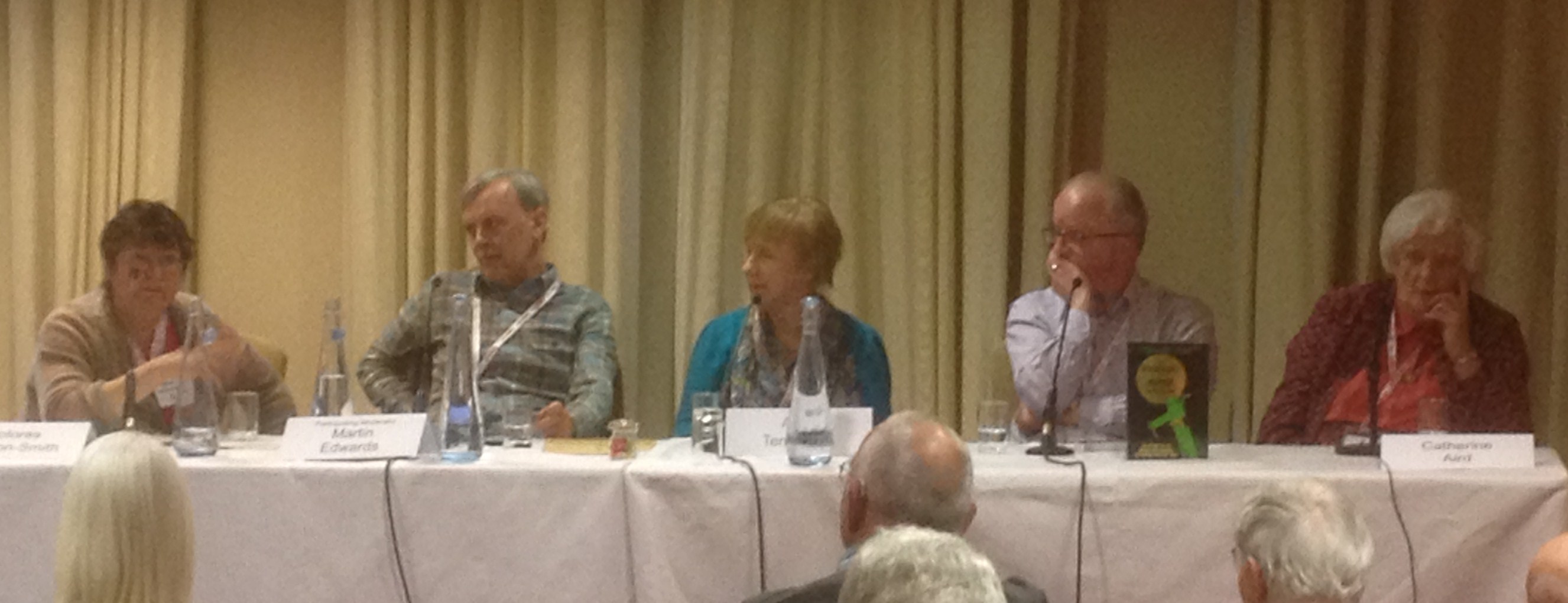
CrimeFest Golden Age Panel

One of the best attended sessions at CrimeFest 2015 was the panel “Forgotten Authors: The Golden Age of Murder”. Five leading authors and experts on the Golden Age took turns to urge readers to rediscover their favourite authors whose books are unjustly neglected.

Dolores Gordon Smith advocated Freeman Wills Crofts and G K Chesterton.

Martin Edwards spoke up on behalf of G D H and Margaret Cole; and Milward Kennedy.

Aline Templeton recommended Margery Allingham and Ronald Knox.

John Curran put forward J J Connington and Henry Wade.

Catherine Aird proposed Josephine Tey.

Three of the panel, Dolores, Martin and John will be speaking in more detail about Golden Age Detective Fiction at The Bodies From The Library conference.  Dolores will be talking in more detail about Freeman Wills Crofts, while Martin will be expanding on the theme of Forgotten Golden Age authors and John will be speaking on Agatha Christie.

Martin’s new book The Golden Age of Murder about the authors of that era is out now and provides the most comprehensive review of the genre yet to appear. It is a must read for anyone who wants to get to grips with the sheer volume and variety of crime fiction from the golden age. For more information and to buy a copy follow the link below:

Looking forward to CrimeFest 2015

I am looking forward to CrimeFest 2015 which is taking place in Bristol this week from Thursday 14th to Sunday 17th May.

In particular I want to catch up with John Curran, Martin Edwards, Dolores Gordon-Smith, Jake Kerridge and L C Tyler who will be there and who will all be speaking at The Bodies From The Library conference on 20th June.

For more information about CrimeFest go to:

CrimeFest

Ruth Rendell

We are sad to hear of the death of Ruth Rendell, aged 85. The author of more than 60 books,she published her first novel From Doon With Death in 1964.  It featured her series character Chief Inspector Reginald Wexford who featured in 24 novels. She also wrote under the pen-name Barbara Vine and in this guise particularly explored the psychological aspects of criminals and those on the edge of society.

Rendell had a deep interest in social issues and as a Labour Peer was instrumental in bringing to the House of Lords a bill which came into law as the Female Genital Mutilation Act 2003.

She often said that Wexford reflected her view of the world though, interestingly, she characterised him as a Liberal Democrat in her fiction.

Along with the PD James, who died last year, Rendell was acclaimed as one of the two new Queens of Crime, inheriting the mantle from Agatha Christie, Dorothy L. Sayers, Margery Allingham and Ngaio Marsh.  Together the two writers transformed the crime thriller, moving it on from the Golden Age and achieved critical literary acclaim as well as popular sales.

Her final novel, Dark Corners, is scheduled for publication in October 2015.

Golden Age part of Modernist literary movement

When you think of Modernism in literature the names that come to mind might include James Joyce, Virginia Woolf, D.H. Lawrence, Ezra Pound, T.S. Elliot, Franz Kafka or Marcel Proust, depending on your preferences and native language. The names Anthony Berkeley, Edmund Crispin, Freeman Wills Crofts and Michael Innes may not be at the forefront of your mind. Yet I have just finished books on the Bodies From The Library recommended reading list by each of these authors and think there is at least a case to answer.

The evidence I put forward for inclusion of these, and other authors of the Golden Age, in the modernist literature movement alongside the more academically and critically acclaimed authors listed above is that they display a characteristic trait of modernist novels – namely a conscious playing with form, an acknowledgement of the artifice in their art, and a willingness to break down what in the theatre is known as the fourth wall, the “window” through which the audience sees the action but is separated from it.

In Berkeley’s Jumping Jenny, the scene is a party given by a writer of detective stories and Berkeley’s series protagonist, Roger Sheringham, in a deliberate and playful inversion of the genre’s expected form, engages in wilful attempts to obstruct the police investigation and prevent them discovering the identity of the person whom he believes has committed a murder on the morally somewhat dubious grounds that they are a nice person whereas the victim was not.

Crispin goes further in The Moving Toyshop and has a character, who happens to be a poet currently suffering from writer’s block, cry out during a car chase:

“‘Let’s go left,’ Cadogan suggested. ‘After all, Gollancz is publishing this book.”

It could be argued that as far back as 1924, Freeman Wills Crofts invented the police procedural though his Inspector French’s Greatest Case at times reads like a travelogue of some of the finest holiday destinations in Europe (I can vouch for the accuracy of the description of Murren in Switzerland which appears to have changed little in the intervening 90 years). He too refers to the world within the novel as:

“In this world the ordinary, natural and obvious thing happened. A man who secretly visited the scene of the crime at about the hour at which it was known to have been committed,…such a man, in ordinary, prosaic, everyday life was the criminal.”

Furthermore, he refers to the fictional world of Conan Doyle when the detective’s wife says to him:

“‘…Why, a child could guess that, Watson!’ When Mrs French called her husband by the name of the companion of the great Holmes, it signified two things…” Notably that Freeman Wills Crofts expected the reader to cheerfully blur real world in which they as readers were themselves likely to have read Conan Doyle and the world inhabited by the characters of the novel where fictional characters have a fictional place in that fiction. I hope you’re still with me on this one.

And finally Michael Innes in Death At The President’s Lodgings has one of the suspects, an Oxford Professor, moonlight under a pseudonym as the author of detective fiction, of which he is slightly ashamed. The book conludes with the Inspector Appleby telling the professor:

“‘I have a parting present for you… A title for the book you may never be able to write: Seven Suspects.” Which, of course, is the alternate title under which the book was published (and Innes was the pseudonym of Professor John Innes Mackintosh Stewart of Christ Church College, Oxford).

Make of that what you will.

I should also point out that I got hold of these titles, not available through my local library service (cries of shame go up but, in fairness, they are pretty old and obscure even if classics of the genre), through the wonders of Amazon Marketplace. I am indebted to Karl Eynon Books, Tree Savers, World of Books and Brit Books whose online stores were where I found the books discussed this week and so give them a shameless plug here.


Recommended Reading – No Spoiler Alert Required

I have now exhausted the resources of the South West Libraries (well, all bar one final book which is still on order). The Golden Age has been reasonably well-served with 11 of the 34 recommended titles (if we exclude the ones I have already on my own bookshelves) in stock – either on the shelves or stashed away in some vault somewhere to be retrieved on request.

The last three I have read – Traitor’s Purse and Hide My Eyes, both by Margery Allingham and The Water Room by Christopher Fowler are all published later than the traditionally accepted Golden Age of between the wars and all show developments from the classics of the genre.

Traitor’s Purse has the detective, Albert Campion, suffering from amnesia which places him in the same situation as the reader – not knowing what is going on and having to figure it out for himself as he goes along.  An interesting twist to see him struggle rather than exhibit the more usual omniscient brilliance of the insightful detective.

If Traitor’s Purse has Campion cast in the role of central protagonist in an almost 39 Steps like nod to the heroes of the thriller genre, given it was a wartime publication,  then in Hide My Eyes, he is almost relegated to the background as others carry the bulk of the action (arguably the book need not have been a Campion novel at all and could have been managed without his presence).

It is possible to read The Water Room as a critique of the police procedural which superseded the Golden Age style. The Peculiar Crimes Unit (the title says it all) which carries out the investigation is placed neatly outside the control of the Metropolitan Police and follows the accepted modern procedures or not, more or less as the author fancies. In this way it almost harks back to the earlier era.

Yet all three still adhere, more or less, to the rules expounded by Ronald Knox in his introduction to Best Detective Stories 1928-29, which I paraphrase below:

  1. The criminal must be a person introduced near the start of the story and be someone whose full thoughts the reader has not been allowed to follow.
  2. No supernatural solutions are allowed.
  3. No more than one secret room/passage is allowed.
  4. No hitherto unknown poisons are to be used (nor any complex scientific gadget requiring tedious explanations).
  5. No stereotypical (my italicised insertion) Chinese person should feature (see previous article on implicit racism pervading the genre because it reflected contemporary society norms).
  6. No accident must help the detective to solve the crime, nor may he reach the solution by unsupported intuitive (i.e. guessing it correctly) rather than deductive methods.
  7. The detective must not commit the crime.
  8. The detective must not rely on clues that are concealed from the reader.
  9. The detective’s sidekick, if present, should be ever so slightly dimmer than the readership.
  10. Identical twins shall not feature in the solution unless clearly flagged beforehand.

Of course all the great authors of the Golden Age felt free to break one or more of these rules when it suited them – we can all think of examples that are classics of the genre which do so – but when they did, it was very deliberately and for a good reason.

British Library Crime Classics

I am delighted to provide a link to the Past Offences site featuring an interview with Rob Davies who is responsible for the British Library Crime Classics series which is re-publishing some of the great forgotten classics of the golden age of detective fiction.  We are delighted that Rob will be speaking at the Bodies From The Library Conference as will Martin Edwards who has provided the erudite introductions to many of the books in the British Library series.

Crime publishing at the British Library – an interview with Rob Davies

As a brief postscript, I am also delighted that one of the books I received for my birthday over the weekend was the British Library Crime Classic edition of Antidote to Venom by Freeman Wills Crofts which is one of the books on the recommended reading list provided by Dolores Gordon-Smith, who will be speaking at the conference on the novels of Freeman Wills Crofts.