The Detection Club’s Fogginess

IMG_2673

I know, I know. Fogginess is part of what we look for in a Golden Age detective novel, if, by “Fogginess”, we mean the ability to cast a swirling haze of mystery over a labyrinthine plot so that we can be taken by surprise when the denouement looms shockingly out of the mist and upsets our every preconception of what has been going on up to that point.

But that’s not the type of “Fogginess” to which I refer.

Instead, I am concerned with the received wisdom that Agatha Christie wrote, for want of a better expression, “pulp fiction” but others, notably Dorothy L.Sayers, wrote, according to some at least, “literature”. I want to test whether that is true, and, if so, to what extent.

Measuring quality is surely an oxymoron. But that is what I am setting out to do. Quality of writing is, you might argue, a matter of style, of how the content is presented to the reader, and, of course, some ineffable something about the actual content itself. One can imagine Oscar Wilde or P. G. Wodehouse concocting aphorisms which positively ooze style but which on closer examination are found to be quite deliberately empty.

Yet there is a measure which might serve my purpose: the Gunning Fog Index. This elegant device neatly sidesteps questions of quality and considers matters purely from the perspective of the reading age it requires of the reader to enable them to make head nor tail of what is written.

My hypothesis is that a work of “literature” is more demanding to read than is a work of “pulp fiction”.

Put another way: a work of pulp fiction will be easier to read than a work of literature. The former might be read by a person with a reading age of 12 whereas the latter might require a person with a reading age of 18 or more.

For those who are interested, I include at the end a note on how the Gunning Fog Index is calculated but it is sufficient for our purposes to observe that writing which uses long sentences and long words is more demanding than writing which uses short sentences and short words. It is not for no reason that our earliest childhood books are filled with sentences like, “The cat sat on the mat.”

The rather brilliant Robert Gunning devised the Index in the early 1950s (so it’s not strictly a Golden Age creation) and it estimates how many years of schooling a given text demands of its readers to make sense of it. Thus a text with a Gunning Fog Index of 8 demands some eight years of schooling for its readers to make sense of it – i.e. it can generally be understood by a high school teenager. This is regarded as the benchmark for a piece to be “universally accessible”. A piece with a Gunning Fog Index of 12 or above, on the other hand, assumes a level of reading equivalent to university education.

On which basis, one might expect that Agatha Christie would have a lower Gunning Fox Index score for her writing than more supposedly literary contemporaries such as Dorothy L. Sayers or Anthony Berkeley.

The difficulty, of course, is that writers will tend to adapt their style, to a greater or lesser extent, to fit their supposed market. Think Roald Dahl. His style for his children’s book Charlie and the Chocolate Factory would be very different from that he employed in Kiss, Kiss, his collection of adult short stories.

Which is where the Detection Club comes into its own. During the 1930s, members of the Detective Club wrote a number of collaborative novels. Therefore, anything included in any one of these novels is, perforce, aimed at the same intended target audience. So a head to head comparison of the various sections of the five books written collectively by the different authors gives a direct and valid comparison of the complexity of their writing given each is writing for the same audience with the same purpose in mind.

The first collaboration by members of the Detection Club was Behind The Screen, published in 1930. This was written by E. C. Bentley, Anthony Berkeley, Agatha Christie, Ronald Knox, Dorothy L. Sayers and Hugh Walpole.

The chart below shows the Fog Index of each of the authors measured from a sample page selected at random from each of their contributions.

Behind the screen fog

It is notable that Agatha Christie and Ronald Knox use a markedly simpler style than do Anthony Berkeley, Dorothy L. Sayers and Hugh Walpole. The contributions by Christie and Knox might be read and understood by an 11 year old (assuming 5-6 years of schooling starting at age 5). Note however, that even the most complex style of Anthony Berkeley, demands a reading age of less than 14.

From which we conclude that Behind The Screen was intended for a universal audience and we see evidence to support the theory that Agatha Christie’s style was less demanding (and therefore arguably, less self-consciously literary) than that of her contemporaries Berkeley, Sayers and Walpole.

But is this pattern repeated in the next collaboration, The Scoop, published in 1931?

Inevitably, of course, we are faced with a different collection of writers in this second story: E. C. Bentley, Anthony Berkeley, Agatha Christie and Dorothy L. Sayers remain but Knox and Walpole are replaced by Freeman Wills Crofts and Clemence Dane.
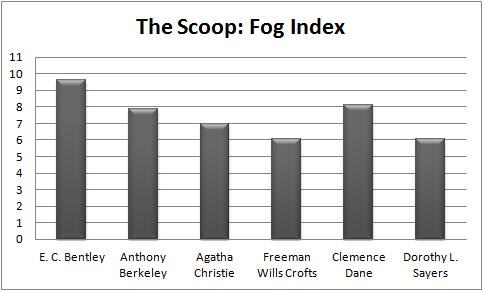
Scoop fog

Here we see that there has been a distinct upward shift in the demands placed with all contributors aiming at a reading age of 12 and above.  Bentley has seen a marked shift upward to a Fog Index of 9.6, implying a reading age of over 14.  More surprisingly, for our theory that Sayers’ writing is more demanding of its readers than Christie’s we find that Sayers has a Fog Index of 6.0 (down from 8.0 in Behind The Screen) whereas Christie has a Fog Index of 6.9 (up from 5.6 in Behind The Screen).  The evidence of this second book, therefore, contradicts the theory that Sayers is a more demanding, and hence by implication, more literary writer than Christie.

Which brings us to the third, and arguably most famous collaborative effort: The Floating Admiral, also published in 1931. Once again we see Berkeley, Christie and Sayers amongst the usual suspects, penning sections of the novel. This time they are joined by a host of others: G. K. Chesterton, G. D. H. And M. Cole, Freeman Wills Crofts (again), Clemence Dane (once again), Edgar Jepson, Milward Kennedy, Ronald Knox (another return), John Rhode, Henry Wade and Victor L. Whitechurch.

Floating Admiral Fog

Now here things, as they say, start to get really interesting. Firstly we see a far greater inconsistency in style (in terms of the reading age at which each writer pitches his or her chapter). We have Clemence Dane, for example, “upping his game” (or should that be “her game” given this is the pseudonym of playwright Winifred Ashton) and writing a chapter with a Fog Index of 11.8 (demanding a reading age of about 17) while G. D. H. and M. Cole have a Fog Index of a mere 4.8 (making it readable by the typical 10 year old).

It is perhaps unsurprising that G. K. Chesterton’s prologue is demanding on its readers but we also see Dorothy L. Sayers rise to a more demanding Fog Index of 11.0 (reading age 16 or over) after the easing off for The Scoop. This leapfrogs Christie whose chapter once again has a Fog Index of 6.9. Perhaps we see here evidence of Christie having perfected a style which is pitched at precisely the level which is readily accessible to and matches her audience’s expectations.

A noteworthy feature though is Berkeley’s contribution which this time has a Fog Index of a mere 6.5 (reading age of less than 12). It appears that he has been making his style less demanding over the course of these three books.

Sadly for us in our efforts at making an ongoing comparison, this is the last collaboration in which Christie participated (don’t be fooled by her name featuring prominently on the covers, Harper Collins, wise to her bank-ability, have included in each volume essays by her which are unrelated to the main titles and not necessarily even written  contemporaneously with them) but as we move on to Ask A Policeman, published in 1933, we still see both Berkeley and Sayers involved. They are joined this time by: Milward Kennedy (again), Gladys Mitchell, John Rhode (again) and Helen Simpson.

Things are more complicated here as the authors involved were writing pastiches using each others’ detectives and so their personal styles may be overlaid with an exaggerated impersonation of their peers’ own styles.

Ask A Policeman Fog

The most remarkable feature of this collaboration is the contribution by Gladys Mitchell (borrowing Helen Simpson’s detective Sir John Saumarez -actually co-created by Simpson and Clemence Dane) which has a Fog Index of 15.2 (implying a reading age of a third year under-graduate student). This may, in fact, reflect the Clemence Dane influence on the style appropriate to that character rather than Simpson’s own, given Dane’s Fog Index of 11.8 in The Floating Admiral). So far out of line with the rest of her collaborators was this chapter that I actually selected a second page at random to double-check the Index score and, in fact, recorded an even higher Index the second time.

It is notable also that Berkeley has returned to a Fog Index of 8.7 which is more consistent with his contributions to Behind The Screen and The Scoop than his simplified style in The Floating Admiral. Mitchell’s contribution aside, his is the most demanding chapter. Sayers has returned to a less demanding style with a Fog Index of 7.6, making her the least consistent (or is that most erratic) of the regular contributors in terms of the fluctuating demands she places on her readers.

And so we come to the final fictional collaboration from the Golden Age Detection Club members, Six Against The Yard, published in 1936.  This features in addition to Berkeley and Sayers – the only authors to appear in all five titles: Margery Allingham (making her debut as a collaborator), Freeman Wills Crofts (making a welcome return), Ronald Knox (likewise) and Russell Thorndike.

I should perhaps mention that I am avoiding contaminating this analysis of the works of fiction with the potentially confusing element that might be introduced should I also bring into consideration the non-fiction true crime essay collection The Anatomy of Murder.
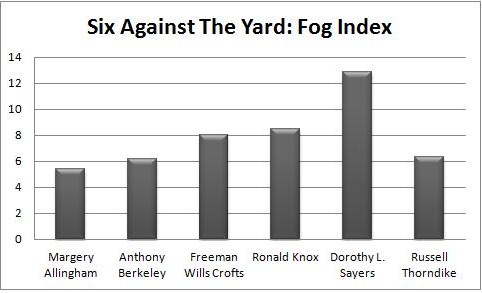
six against the yard fog

Here Sayers chapter is markedly more demanding than that of any of her collaborators with a Fog Index of 12.9 (requiring a reading age of 18) which is definitely not within the bounds regarded as “universally accessible”.

This is in marked contrast to the other contributors whose chapters range from a Fog Index of 5.4 (Allingham) to 8.5 (Knox) which would make them all accessible to the average reader. Indeed, Berkeley’s chapter has a Fog Index of 6.1, his simplest yet.

Indeed, if each book is considered as a whole, the overall trend has been one of increasingly demanding reading prior to this last book.  However, this upward trend is in part attributable to the high outliers in each of the preceding books (Sayers and Clemence Dane in the 12 author The Floating Admiral and Mitchell in Ask A Policeman).  Indeed, Sayers contribution to Six Against The Yard inflates its overall Fog Index which would otherwise be marginally the lowest of all five books. Overall though, all of the books fall within the reading capabilities of the typical teenager and so might be regarded as “universally accessible” – albeit with difficult chapters!

Average Fog

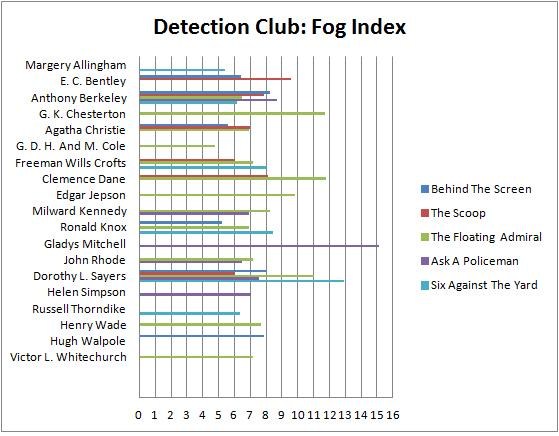
In all nineteen authors contributed to the five collaborative books published by The Detection Club in the 1930s. The following chart captures the Fog Index for all of their contributions. It is perhaps worth highlighting some key findings of the analysis.

There are certain authors (Chesterton, Dane, Mitchell and Sayers) whose contributions are markedly more “Foggy”. This finding is not inconsistent with the hypothesis that Fogginess is a reasonable proxy for measuring the literary quality of the writing, based on the premise that a more demanding read is likely to be a more satisfying literary experience (I would not venture to put it any more strongly than that).

It also provides evidence to support the assertion that Sayers (and Chesterton) were more literary writers (or at least more demanding of their readers) than was Christie. Indeed, Christie might be said to have found almost the “golden mean” with a consistent Fog Index in a narrow band between 5.6 and 6.9 making her “universally accessible” to potential readers. Sayers on the other hand is less consistent, sometimes writing simply but often, and particularly later when she was becoming more self-consciously literary and contemplating moving away from the prosaic world of Golden Age Detective Fiction, her work was to become significantly more demanding.

Berkeley is perhaps most interesting in that his Fog Index varies quite widely (his lowest Fog Index is 6.1 in Six Against The Yard which follows on immediately from his highest 8.7 in Ask A Policeman giving a variability  almost exactly twice that of Christie). On closer examination this may be an indication of him deliberately adopting different approaches for each piece. His chapter in Six Against The Yard, for example, is written in the tone of American pulp fiction of the time – a hard-boiled/noir voice with simplified delivery in short, sharp sentences and punchy vocabulary which naturally tends to lower the Fog Index.
Detection Club Authors Fog

For those who wish to understand more about the calculations used to derive the Gunning Fog Index, the formula takes into consideration the length of sentences (longer sentences raise the index) and the use of longer words (taken to be those with more than three syllables ignoring any names or other proper nouns).

Fog Index = 0.4 x ((Number of words in sample / Number of sentences in sample ) plus ((Number of words with more than three syllables in sample / Number of words in sample) x 100) )

For example: a sample page of 300 words, in 20 sentences, with 10 words of three or more syllables would have a Fog Index calculated as follows:

Fog Index = 0.4 x ((300/20) + ((10/300)*100))

                   = 0.4 x (15+3.333)

                   = 7.333

The 0.4 used in the calculation is the factor that Gunning decided was appropriate to derive a number that was meaningful in terms of years of education undergone (and hence reading age).

It is an arbitrary measure but, as can be seen from the above analysis of the Detection Club books, it is one that can produce meaningful results.

I should also point out that when carrying out the analysis, I found that several of the authors had a penchant for using semi-colons in their writing where now we would use full-stops. Thus they might have a huge, long sentence with several clauses, punctuated by semi-colons, with each clause capable of standing on its own as a grammatically acceptable sentence. Where I encountered this, I treated these clauses as if they were indeed sentences separated by full-stops for the purposes of calculating the Index. This ensured an approach consistent with current methods of punctuation, which have more or less eradicated the semi-colon from use in the way these Golden Age authors sometimes chose to use it. This approach is, I believe, justified, since readers in the Golden Age would have been habituated to this method of punctuation and would not have struggled with the resulting immense sentences in the way that a modern reader might.

Mark

Sleeping Murder

 Illustration by Andrew Davidson, taken from the Folio Society edition of the novel.

It is often said that Agatha Christie’s novels lack characterisation or that she employs two-dimensional stock characters to populate her village settings. If a reader wants psychological depth then he or she should look elsewhere – perhaps to Anthony Berkeley or Dorothy L. Sayers amongst her contemporaries of the Golden Age.

Whatever the truth behind such generalisations, there is no doubt that Christie did employ great psychological insight in more than one of her novels. Let’s face it, if she didn’t and the plots were always psychologically implausible she’d have gone out of fashion years ago. One such example of her penetration into the workings of the mind is to be found in the “last” Miss Marple case, Sleeping Murder. I say “last” because although it was published in 1976, shortly after her death, it was actually written in 1940*. Indeed the book is set in the late 1930s, mentioning His Majesty’s Theatre and the princesses Elizabeth and Margaret Rose, and appears to pre-date the story of Nemesis since in that novel she has given up gardening on doctor’s orders but is evidently still an active gardener in the course of this novel.

It is in fact at His Majesty’s Theatre that a pivotal moment in the plot takes place. Gwenda, the young heroine of the book, is shocked by the lines from the play The Duchess of Malfi and recalls a traumatic incident from her childhood in which she saw a murdered woman with a person standing over the body speaking the self-same lines.

The plot revolves around this partial recollection from childhood and it is in describing this that Christie is so psychologically accurate. She notes that children are very peculiar in what they do and don’t remember from their childhood. These repressed memories of trauma became very much more widely known during the 1980s and 1990s when suppressed memories of childhood abuse were widely discussed in the context of trials of abusers based on the testimony of victims recalled many years after the event.

The reliability of such memories has been the subject of much debate in legal and medical circles. There is evidence to support the concern that such memories may be inaccurate, even false, being reconstructed by the people under conditions where they may be very suggestible. The process of trying to aid the recollection of repressed memories may in fact result in wholly artificial memories being created in the truth of which the person is wholly convinced.

Subsequent experiments have been conducted which replicate the conditions for recalling lost childhood memories and memories have been “recalled” based on the deliberate false stories included amongst true stories.

The way in which the memory works is still becoming understood with differences in short term memory and long term memory retention or loss being found to be quite different and occuring in different parts of the brain.

Christie’s novel is consistent with the current thinking on the operation of memory, quite ahead of academic thinking at the time, and so would appear to have been based on careful and close observation of the phenomenon – perhaps in her daughter Rosalind and other children she came across. In many ways, the empathy with the victim of the memory loss, Gwenda, is almost maternal and so the more understandable.

It is also possible that Christie drew on her own troubled psychological experiences when writing of the memory loss or repression. Her temporary disappearance in 1926 was marked by many of the hallmarks of a “fugue” episode under dissociative disorders. She was suffering stress through overwork and traumatised by the death of her mother and by the breakdown of her marriage to Archie Christie. She displayed classic symptons when she disappeared, travelling to unfamiliar surroundings, assuming a different name and identity (taking the surname of her husband’s new lover) and suffered from amnesia relating to the period of her disappearance. Certainly these events would have given her a personal understanding of the confusion and state of mind of a person under such circumstances. Maybe she was echoing her own personal experience when she had her character Gwenda cry out that she must surely be going mad.

*There is some debate about the actual date of writing. Christie indicated in her Autobiography that it was written during the blitz when she feared she might be killed in the bombing as she was living and working in London at the time. Correspondence between Christie and her literary agent also discusses the book in 1940 and she executed a deed transferring the anticipated publishing royalties to her husband Max that year, which would seem an odd thing to do if the book was not already written.  There is however evidence from her notebooks uncovered by John Curran that she was planning work on it as late as 1947 and 1948. Certainly the title was changed from the original. The first draft was called Murder in Retrospect but that had to be dropped when her US publishers used that title for the novel Five Little Pigs. The title was then changed to Cover Her Face, the line from the play The Duchess of Malfi which trigger Gwenda’s memories of the traumatic event from her childhood, but that too had to be changed when P. D. James used that title for her first novel.

Poirot: The Bodycount Rises

Recent academic study has apparently been able to reduce Agatha Christie’s plots down to an formula which enables the reader to predict, within statistically tolerable boundaries, who has done the murder. That the formula is complex is inevitable – there are so many variables for Agatha to play with. That it relies on the reader spotting the relevant factors and is unreliable where these are missed is an equally inevitable constraint on its successful application. That is completely misses the point of reading Christie is surely also abundantly clear. For me, at least, its use is akin to tackling yesterday’s Times crossword with the solution open beside you. Reading Christie is about solving the puzzle she sets, differentiating the clues from the red herrings and reaching a conclusion based on the evidence presented – assuming you have not missed a vital clue through her masterly misdirection.

So it is with some trepidation that I offer the following analysis.

Its purpose is to explore features and patterns in Christie. And in this at least it shares some common ground with the research described above. But it does so not for the purpose of helping the would-be solver of the mystery – for that he or she must read the tales themselves. Its scope is broader than merely examining the murderer, but gives equal consideration to the victims and to the nature, location and method of the crimes. In this it shares some common ground with the studies of Kathryn Harkup, who has examined in minute detail the uses of poison in Christie’s work, in her book A is for Arsenic.

However, it considers solely the Poirot cases and, in order that it is not disproportionately concerned with murder – which is invariably the case with the novels – it does so only in respect of the 51 short stories which feature Poirot. For the record the stories include only the longer versions where two different versions exist (eg The Mystery of The Spanish Chest is used rather than the shorter The Mystery of the Baghdad Chest) and the Poirot version of stories which are also available in different form with another detective such as Parker Pyne.

Of the 51 short stories, three feature no actual crime. To avoid spoilers, in this, as in every other feature discussed, I shall not identify the specific stories (since there being no crime may, but may not, be the twist in the tale for a crime story). So we are reduced to 48 stories, featuring murders, thefts, blackmail and so on – some stories, of course, featuring more than one type of crime or, indeed, more than one instance of the same type of crime (though serial killers are a little thin on the ground, not that the term had been coined during the Golden Age). The actual breakdown is:

crime

It may also be interesting to note in passing that fully half of the thefts are of jewels or jewellery worth fabulous sums.  I suppose that just lends more colour to the story than anything so sordid as stealing bags of notes.

But who are the victims? What are they like?

In total there are 55 victims. Of these, the majority are men – 36, compared to 18 women. That ratio holds true for the murder victims – 25 male compared to 12 female.

Gender of victims

The age of the victims is more difficult to ascertain.  Rarely does Christie give a specific age of a person in her short stories although often a person will be described, for example, as “a few years over thirty”. The reader therefore has to infer from other information, such as having adult children who are working but do not themselves have children that they are perhaps in their forties or fifties rather than in their thirties. On the basis of such information, the age profile of the victims is as follows (in necessarily broad age bands).

Age Profile Murder Victims

Age profile of victoms

I have separated out the murder victims from the victims of other crimes (theft, blackmail etc) because there is a distinct difference in the profiles. The majority (64%) of Christie’s murder victims are under 50 whereas less than half (44%) of the victims of other types of crime are under 50. Indeed, the difference is most marked in the 20s and 40s age bands where there are significantly fewer victims of crimes other than murder. Interestingly, there are very similar proportions of murder victims and victims of other types of crime who are in their 30s, which was the age-band Agatha had reached at the time most of the Poirot short stories were written. Perhaps she simply felt comfortable writing about people of a similar age to herself.

It is a widely held view that Christie wrote mostly about the upper- and upper-middle classes. England at the time she was writing these stories, between the two world wars, was indeed a very class-conscious society and there were nuances of class which are blurred or lost today. I have, therefore, attempted to reflect these differentiations in the analysis.

Class profile murder victims

class profile of victims

The data confirms Christie’s bias towards the victim being drawn from the upper- or middle-class. The interesting difference between the murder victims and the victims of other crimes is that socialites (celebrities??) are only ever victims of murder but not other crimes, whereas the rich businessman is more likely to be the victim of a crime other than murder.

So can we draw up a profile of the typical victim in a Poirot short story? We might suggest that the murder victim was most frequently male, middle class and in his 40s. The typical victim of other crimes might most frequently be male, slightly older, perhaps in his 50s and more likely to be a rich businessman.

A quick check reveals, almost inevitably, that there is in fact no example of a middle class, male murder victim in his 40s (though there 8 of the 37 murder victims – more than 20% – display two out of those three characteristics).

There is in fact one example of a victim of other crimes who fits the profile of a rich, male businessman in his 50s and there are five others who satisfy two of the three criteria (so that’s fully one-third of the 18 victims, which is starting to look more impressive).

But what of the murderer? Or the perpetrator of other crimes?

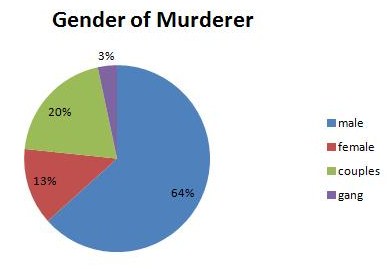
There is a marked difference in the gender of the murderers compared with the gender of perpetrators of other crimes. As can be seen below, murderers are overwhelmingly more likely to be male (87% if you add in the males who are halves of murderous couples or gang members), whereas there is an even split for perpetrators of other crimes. I have separated out murders carried out by couples as this is a distinctive feature of murder stories – there are no other crimes committed by husband and wife “teams”.

Murderer Gender

Criminal gender

On the face of it this might be attributable to the theory that men have greater physical strength and so are more capable of carrying out a murder, but that pre-supposes that the method used requires an element of brute force. Given that Christie is supposed to have a preference for poisons – which make no such physical demands on the perpetrator – it will be interesting to examine the methods used in the Poirot stories to see if this has any bearing on the gender bias in Christie’s murderers.

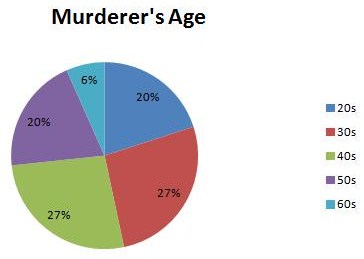
However, before we look at that, we must consider the age of the perpetrators to build up our criminal profile. As with the victims, so too are the perpetrators’ ages rarely specifically mentioned so once again, it is necessary to infer the likely age band from the ancillary information about the characters – a father of teenagers is unlikely to be younger than his mid-thirties and may be somewhat older still, for example.

Murderers age

Criminals age

There are, it transpires, subtle differences in the age profiles of Christie’s murderers and other criminals. The murderers tend to be slightly older – we see them going on into their 60s in a way that doesn’t seem to arise in other areas of crime (maybe criminals retire like the rest of us?).  And fewer murderers are in their 20s than commit other types of crime. Though it has to be said that age seems to be no bar to any type of criminal activity in Christie’s book – they are at it at all ages in very similar numbers.

Which brings us back to that archetypal English question of class. Does Christie have a better class of murderer?

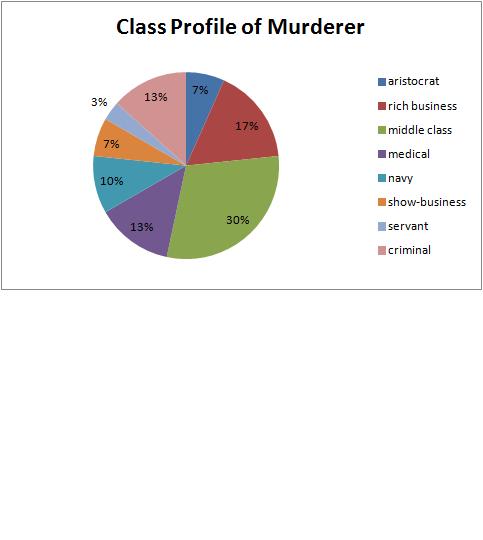
murderer class

criminal class

To which the answer would appear to be yes. The vast majority of crimes are committed by upper- and middle classes.  In the case of murders this is 77%; and 72% of other crimes. There are some notable peculiarities.  Members of the medical professions (doctors and nurses) are disproportionately more likely to be involved with murders.  Maybe it is the easy access to poisons? But there is an amusing discrepancy between the penchant for murder – an exclusively naval urge – and the willingness to commit other crimes where members of both Army and Navy are equally likely to be involved. Intriguingly show-business types appear as both murderers and other criminals. Did Agatha have something against the stage? Maybe that accounts for her reluctance to attend performances of The Mousetrap?

And what of the nature of the relationship between the criminal and his (and as we have seen in the case of murder it is more likely to be “his”) victim?

Here there is a very marked difference between the murders and other crimes. There is almost invariably a long-standing, and frequently close relationship between the murderer and victim.  In the case of other crimes, however, there is almost always none – or at best acquaintance only.  Although listed below as friends for the purposes of comparison, it frequently emerges that these “friendships” have often been struck up by the criminal expressly for the purpose of committing the crime.

Relationship

It can be seen that the most likely culprit in the case of a murder is the spouse. Whereas for other crimes, in 61% of cases, there is no relationship beyond an apparent friendship or acquaintance. (“Criminal” in the chart above indicates there is no relationship other than that of criminal and victim of that crime.)

So our prime suspect in a murder story is a middle-class male, in his 30s or 40s, married to the victim. (Let’s forget that the typical victim is male – the Golden Age pre-dates same sex marriage by several decades!) Miraculously there is indeed one such example satisfying all four criteria. There are however, three other murderers who are middle class male in their 30s or 40s and a further three if we allow members of the medical profession and officers in the armed forces (both of which categories would be middle class in the period). Thus our profile (ignoring the relationship) fits nearly one in five cases.

In the case of other crimes, there is no clear profile as the the criminal is equally likely to be either gender and any age.  They are more likely to be middle class but then the social setting for the majority of the stories is middle class. So that doesn’t help much. Perhaps the only guidance that can be taken from the data is to beware of military men and those in show-business with whom you have a slight acquaintance. And vet your servants carefully!

Another aspect to consider is the criminal’s motive.

The murderers’ motives vary. The most common is to speed up an inheritance. This is also a complicating factor in two of the murders “for love” – in an almost Trollopian regard for the need to finance whatever subsequent love-nest is desired. No doubt insurers will be relieved to note that murder for the insurance money is a rare occurrence (even in respect of spouses to be bumped off so that the way is clear for another).

Motives

Other crimes are, sadly, almost invariably motivated by money. Theft, blackmail, kidnapping: the end object is pretty much always the same. So nothing much in the way of interesting analysis of motives emerges there. The only exceptions are two later stories which feature attempts to frame someone as a drug dealer. One is left wondering what provoked Christie to use this plot device not once but twice in a relatively short space of time.

Now it has already been mentioned that Christie is said to favour poison as a method for her murderers to use. This, of course, draws on her own training in the hospital pharmacy when serving as a nurse for wounded soldiers during the First World War. Nevertheless, it is instructive to look at the means employed in her Poirot stories to see that this expectation is borne out.

Means

It is perhaps worth considering that the poisons used included three uses of cyanide and two of arsenic at a time when such chemicals were more freely available to purchase than they are now. Pest control between the wars left a much scope for abuse! As did the prevalence of firearms, especially as a result of bringing home “trophy” weapons from the War. It is hard to imagine such conditions in the UK now with our much stricter gun controls. In her choice of methods, Christie simply allowed her murderers to use what was readily to hand in many upper- and middle-class households.

The “other” methods include being pushed from a train, being pushed downstairs and two unspecified methods.

Having proved that Christie did indeed prefer poison, did she also prefer that archetypal Golden Age setting for her crimes: the country house? On the face of it, the answer is no.

 scene of crime

The location Christie used most often was somewhere in London, usually central London, though also sometimes in the suburbs. And for the record, where she has specified a suburb at all – or where it may be inferred from other information such as references to the nearest county outside the city (such as Essex or Surrey) – she shows no preference for either north or south of the river!

That said, lumping all London locations in together does sidestep rather than face head on the fact that the commonest type of location Christie uses is the country manor house. So perhaps there is quite a bit of truth in the stereotype.

She does, however, for a quintessentially English form, use foreign settings surprisingly often.

She is also fond of transport for her settings. As well as the two murders on trains, one of the murders and one of the other crimes “abroad” take place on a cruise ship and a train respectively while a further crime takes place in a moving car in a UK country (village) location.

Which brings me to a potentially controversial concluding section on Poirot’s own involvement in the stories.

You see it has always struck me – perhaps sacrilegiously – that being around Poirot is a pretty damn dangerous, nay even fatal perhaps, place to be. He may, like the Mounties, always get his man (or woman), but he doesn’t always succeed before another murder has been committed. So I thought it would be interesting to look at when he is called in relative to when the crime takes place. In short, how many times does someone request his help only to get themselves murdered before he has got himself around to investigating what is going on.

What I found, somewhat shockingly, was that out of the 37 murders he investigated, he was involved before they took place on 10 occasions. And he only foiled 3 of the possible murders. Okay, in fairness, some of the time he was merely a bystander before the murder took place and then investigated after the event but still… If I saw Hercule coming I’d run.

Of course, this being an analysis of crimes – albeit fictional crimes.  It is impossible to end without considering the solving of those crimes.

Here, this being Poirot, his clean up rate is 100%.  He always solves the case but, interestingly, he is concerned with justice in its broadest sense. So the criminal doesn’t always face the justice of the legal system. Two killers are allowed to go free – one because it was an accidental killing of a blackmailer and the other because the killing was done to prevent the “victim”, who was himself a murderer, from killing again. And 5 of the 18 criminals, other than murderers, were also allowed to walk away, either on the grounds that they had learned their lesson or their crimes were not too serious.

This is more important than it might appear. At the time these stories were written, the penalty for murder was death. So Poirot’s success in identifying the murderer was, in effect, a death sentence. Christie was of a generation that had no problems with this (though interestingly Dorothy L. Sayers’ amateur detective Lord Peter Wimsey, perhaps as a result of his experiences in the War, appeared to suffer agonies over this fact – not that it stopped him solving crimes at the time, you understand, but afterwards he was often seen to be deeply conflicted by the results of his actions). Yet she allows Poirot occasionally the latitude to extend his mercy to those for whom he (and therefore Christie, we may speculate) felt that the full rigours of the law would be an injustice.

 Mark

A Pocket Full of Rye

Christie frequently used quotations from nursery rhymes as titles for her novels and short stories. Sometimes the reference is a clue to the solution but, infuriatingly for those who treat her novels as puzzles to be solved, at least as often it is a red herring.

The most frequently quoted rhyme is “Sing a Song of Sixpence”, whose words give the titles to the Miss Marple novel A Pocketful of Rye (from the Folio Society edition of which, the Andrew Davidson illustration above is taken) and to two short stories Sing a Song of Sixpence and Four and Twenty Blackbirds.

In the novel, Inspector Neele seeks obsessively for the reason why the murder victim should have “a pocketful of rye” in his jacket when he is killed. It would give too much away if I were to disclose the reason here and its connection, if any, with his death.

In the first of the two short stories, there is indeed a sixpence, possibly forged, which has come into the possession of the woman who is murdered. It’s place in the solution suddenly occurs to the investigating lawyer by chance when he sees the name of a restaurant called “Four and Twenty Blackbirds” – the association with the rhyme triggering a line of thought which leads to the unmasking of the culprit.

The second of the short stories turns on the effects of eating blackberry pie, which reveals a surprising sequence of events by which a murder was contrived. Needless to say, Poirot, sees through the concealed plot and springs the surprise conclusion.

Of course, it is Christie’s intention to spring such surprises and it is no surprise, therefore, that she should use this nursery rhyme more than any other as a source for her titles. The rhyme relates the 16th century practice of concealing live birds in a baked pie served up between courses in a banquet. When the pie is cut open, the birds emerge and fly off (or begin to sing, as the rhyme has it), making an entertaining surprise for the guests. Surely this is only appropriate for Christie as the Queen of springing such surprising denouements on her readers.

The nursery rhyme “Three Blind Mice” also appears in three Christie works.  It serves as the title for a short story and a radio play. It is also used as a musical motif in the long-running production of her play The Mousetrap. However, I would argue that since all three are inter-related – the short story is based on the half hour radio play and the long play is an expansion of the ideas first contained in the shorter original, albeit with crucial differences – this constitutes a single actual use with three different takes rather than three separate and unrelated stories.

Other rhymes which have been used by Christie are many and varied in how she has applied them.

“Goosey Goosey Gander” is used in the Tommy and Tuppence adventure N or M?.

“Hickory Dickory Dock” gives its name to a Poirot novel although the link is thin – the name of a road in the book, indeed, the US title of the book is Hickory Dickory Death, which makes the link even more obscure.

“Mary, Mary Quite Contrary” is used in the short story How Does Your Garden Grow?, the rhyme being quoted by Poirot as he explains how he arrived at the solution.

“One, Two Buckle My Shoe” gives its name to the title of a Poirot novel, though again the US title differs. It was first known as The Patriotic Murders and subsequently re-titled An Overdose of Death. Perhaps the rhyme is less well known in the US than the UK, or perhaps the publishers thought the references were too obscure for the American market. However, the chapter titles in this book are derived from the lines of the rhyme, so it does provide valuable signposting to the reader who is alive to the possible connotations of the rhyme, to help solve the mystery.

“There Was A Crooked Man” serves as an inspiration for one of Christie’s favourite of her novels, The Crooked House, for which she allowed the idea a period of several years gestation before she finally wrote it. The rhyme has everything crooked and this is applied to the psychological states of the family members living at the house who have all grown up “twisted and twining” as a result of an unnatural dependence on the family patriarch.

“This Little Piggy” provides plot ideas for the novel Five Little Pigs. The five suspects are each noted by Poirot to have characteristics that might be (loosely) associated with those of the five pigs listed in the nursery rhyme. Again the US publishers eschewed this conceit and retitled the book Murder in Retrospect.

But of course the most famous (infamous?) use of a nursery rhyme by Christie was her riff on “Ten Little Indians” or, in its more politically incorrect original form “Ten Little Niggers”, now more suitably titled And Then There Were None, taking the final line of the rhyme. Here the rhyme serves as a blueprint for the deaths which befall each of the characters in the startling plot. It is a masterly use of this device which both ratchets up the tension and provides the mis-direction to take readers’ eyes off the ball at the crucial moments so that they are shocked by the final revelation of who is behind the deaths. It is little wonder that this book was recently voted her most popular with readers – it has sold more than 100 million copies, making it the seventh ranked in the all time best-sellers by any author and contributing significantly to her position as the best selling author of all time.

TICKETS GO ON SALE FOR 2016 BODIES FROM THE LIBRARY CONFERENCE

DSCF4832

Tickets are now on sale for the 2016 Bodies From The Library Conference taking place on 11 June 2016 at the British Library.

We are very pleased that we have been able to keep the cost to the same amount as for the 2015 conference for those who take advantage of our Early Bird offer. So don’t delay – book now to secure your place at the 2016 conference at this year’s price.

You can buy tickets through our website:

Bodies From The Library 1 June 2024 Tickets On Sale

Or you can buy them through the Eventbrite site:

http://www.eventbrite.co.uk/e/bodies-from-the-library-tickets-18713458458?aff=es2

We do hope you will be able to join us.

Bodies From The Library 2016

DSCF4832

We are very pleased to announce the date of our second annual conference at the British Library.

The conference will be taking place on 11 June 2016 and, once again, we intend it to be an all day event.

We are putting together what we hope will be a fantastic collection of speakers and interesting topics focussing on the Golden Age of Detective Fiction. Tickets will go on sale shortly at a special discounted rate for early booking.

We will update our website continually as the details are finalised.

Death on The Nile


I am reading this in a cheap Spanish paperback edition, where it goes under the title Poirot in Egypt. In order that I do not miss too much in the translation, I am checking my understanding by reading in parallel the much more elegantly presented Folio Society edition.

One thing which has quite surprised me is that just like the lovingly illustrated Folio Society edition, my cheap Spanish paperback also features original illustrations – albeit line drawings which, therefore, do not require colour printing.

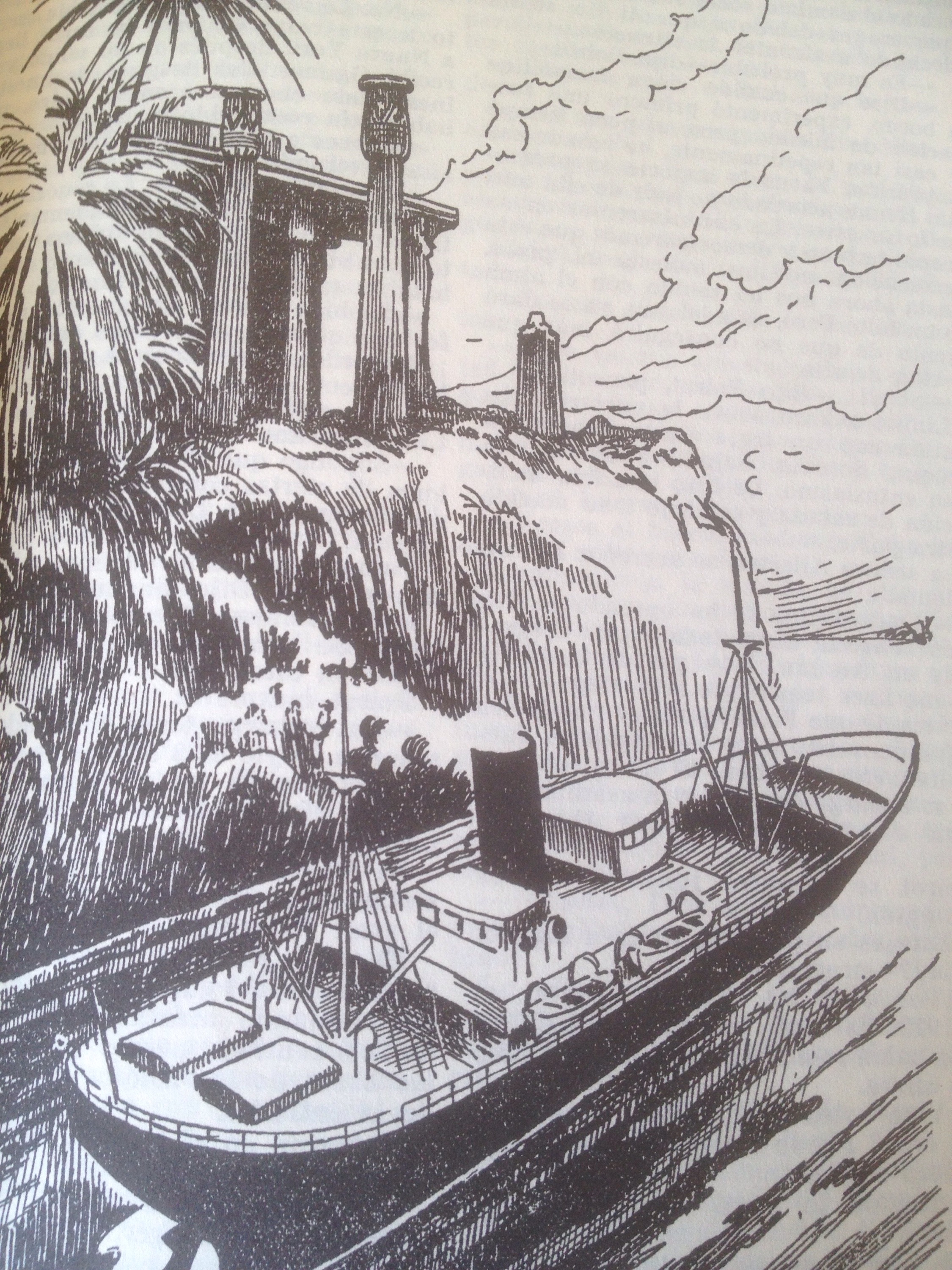
Interestingly, both editions select seven scenes from the novel to feature but only one scene is illustrated in both editions. This is when the Karnak on which the party is travelling along the Nile moors at the temple of Abu Simbel. This is such an iconic view which is, with the pyramids, a sight that absolutely captures the mysterious atmosphere of the ancient ruins of Egypt in the desert.  It is therefore no surprise that both books should choose to use it.

Except they don’t quite.

The text from the novel reads: “The steamer was moored to the bank and a few hundred yards away, the morning sun just striking it, was a great temple carved out of the face of the rock.  Four colossal figures, hewn out of the cliff, look out eternally over the Nile and face the rising sun.” And this is indeed what we see in the Folio Society edition illustration below.

But in the Spanish translated version, the second sentence is omitted.  The four figures are not mentioned. And the illustration, in consequence, drawn from the Spanish text, shows a wholly conventional free standing temple with columns such as might be seen at Luxor but not at Abu Simbel. Bizarrely, the temple at Abu Simbel does feature in the cover illustration of this version (see top image).

Indeed, one might speculate that the lower production values in the cheaper Spanish paperback meant that the illustrator was simply given a few lines from the novel and told to illustrate the caption. This may account for the layout of the Karnak in the picture which, of course, does not correspond to the deck plan included in both versions of the novel in a later chapter.

There are two other pairs of images which, although not depicting the same scenes, depict the same characters at critical moments in the plot. The Folio Society edition choses to show Jacqueline de Bellefort and Simon Doyle at the moment when he is clutching his leg after she has shot at him in a drunken rage.

The Spanish edition choses to show the two of them in the aftermath when Simon Doyle is recuperating in Dr Bessner’s cabin and Jacqueline de Bellefort in a moment of high melodrama begs for forgiveness. We also see here Hercules (note the different spelling) Poirot looking on. That moustache is certainly extra-ordinary but I think we have become so used to the tightly styled, trim, waxed moustache of David Suchet and Albert Finney that it does strike as odd when confronted for the first time.

Indeed, Poirot appears a much slimmer character in the illustrations for the Spanish edition than we are used to seeing. There is no “embonpoint” for him to rejoice in, as we can see again in this illustration of the two detectives, Poirot and Colonel Race, examining the letter “J” scrawled on the wall of Linnet Doyle’s cabin in a blatant attempt to incriminate Jacquline de Bellefort. Indeed, Colonel Race is not how many English readers would imagine him in this illustration.

The Folio Society edition seems to represent Colonel Race more in line with English expectations (as indeed is Poirot) in this later scene when the two detectives find the murder weapon bearing Jacqueline’s de Bellefort’s initials.

I think it is fair to say that the illustrations in the two editions are in keeping with the expectations of their respective markets. The Folio Society hardback has beautifully reproduced colour images in muted pastel colours which ooze nostalgia and glamour in a way that will appeal to their more affluent readers; the cheap Spanish paperback – true to its pulp fiction aesthetics – focuses on the melodrama and, dare I say it, paints an altogether more black and white picture of the world.

Indeed, to avoid spoilers I have not shown here an illustration from the Spanish edition which depicts a murder with the murderer’s face showing an expression of such demonic fury and hatred that it would be worthy of the type of gurning that was shown in old silent movies accompanied by the captions like “No one calls me that and gets away with it. You’ll pay for that insult. I’ll get even with you if it’s the last thing I ever do.”

Mark


Agatha Christie: unfinished portrait

  
This exhibition of rarely seen photographs has been on display at the Bankside Museum in London and will move to Torre Abbey during the Torquay Festival starting next week to commemorate the 125th Anniversary of her birth. 

The photographs span her entire life from childhood to shortly before her death and are displayed in chronological order. The timeline is marked on the wall below esch photograph and very helpfully for the fans of her books, indicates which novels coincide with the photographs. 

Also included, in its correct place in the sequence, is the 1969 portrait of Agatha by painter Oscar Kokoshka. This, in contrast to the muted tones of the photographs, is full of vivid reds and yellows. It gives the impression of a woman very much alive and bursting with ideas even at 80. 

There are many quotations, taken largely from Agatha’s posthumously published autobiography, interspersed between the photographs which often shed more light on the woman pictured than the captions which are purely factual records of the where, when, who variety. The excerpts from her letters to second husband Max are full of joy and almost surprise at having had this second chance at love. 

The photos are black and white though there is a charming short silent film – about 2 minutes long – which is drawn from home movies of the author with husband Max Mallowan, her daughter Rosalind and grandson Matthew   These include some later colour footage. The sequences include typical family messing about in the garden material revealing a fun-loving and warm home-life completely at odds with the subject matter of her novels. There are also clips of Agatha swimming on holiday and with Max on archaeological digs in the middle east, which provided her with material for several novels. 

Easy to overlook amongst the visual display were a couple of headphones through which you could listen to Agatha talking about the experience of writer’s block. Her voice is characteristically upper middle class of the period – received pronunciation so to speak. She clearly does not take herself or her work seriously and speaks deprecatingly of the agonies she goes through before each novel and the displacement activities she tries every time before the germ of the idea comes, after which all is plain sailing. She tells how husband Max never takes seriously her moans that she fears she this time the block will be permanent and she will never write another book. “You’ve said that for 80 books and I’ve no doubt you’ll say it again next year for the 81st” 

For me the home movies and the short audio clips brought Agatha to life in a way that still photographs rarely can. However there is much to be revealed of the private Agatha from these candid snaps by friends and family. 

Overall the exhibition leaves you with the impression of a fun-loving woman who enjoyed life and her family – in spite of personal tragedies along the way (the suffering of her mother before her death, her divorce from Archie Christie, and the loss of her daughter’s husband in the second world war only shortly after they were married) – far-removed from the rather severe looking elderly author so often featured in photos of her. 

Mark

The Body In The Library

IMG_2517

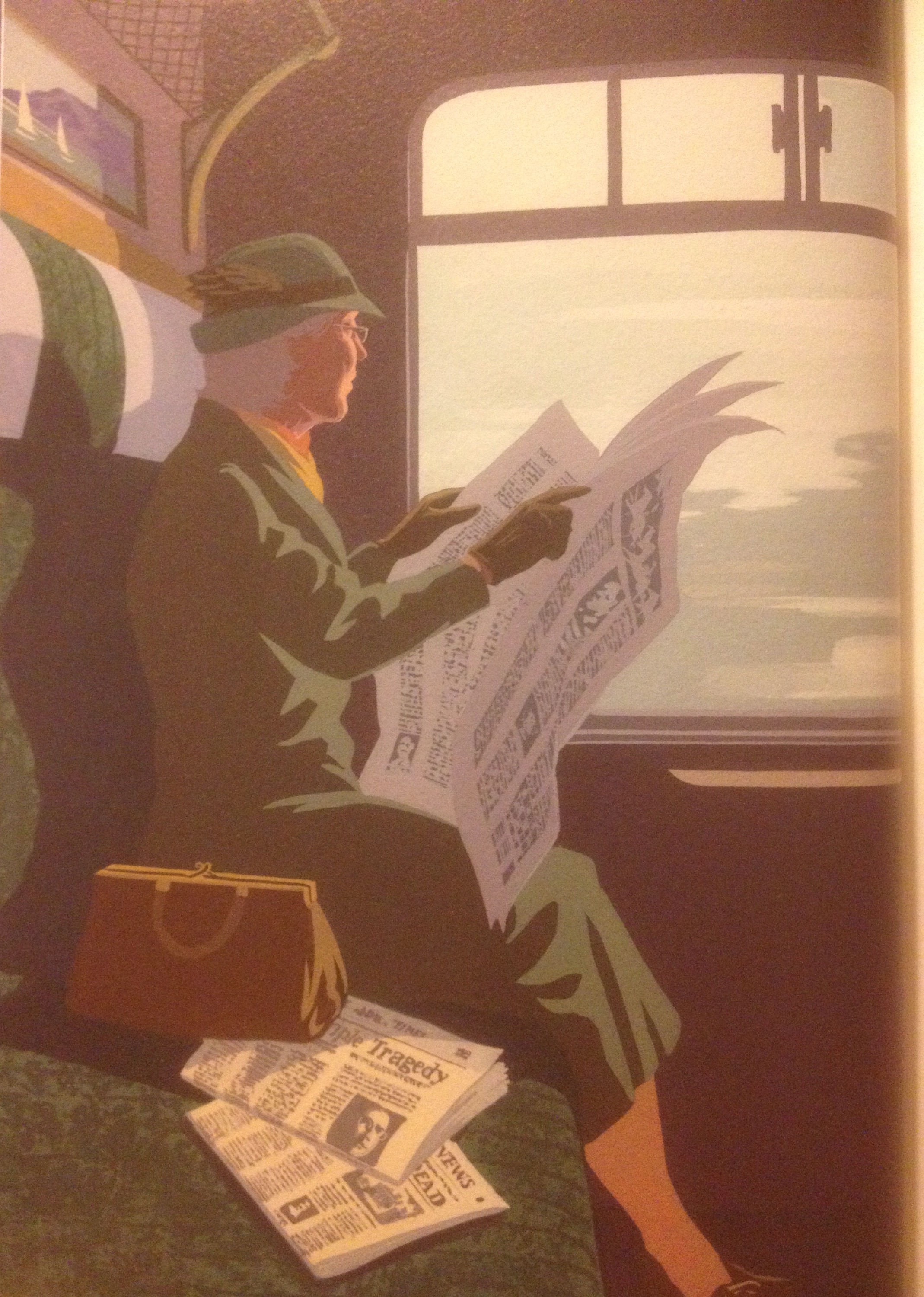
The above image, by Andrew Davidson in The Folio Society edition of The Body In The Library, for me epitomises the “cozy” in Agatha Christie – a palm court in a hotel with Miss Marple observing crucial developments. The resemblance in the illustration’s style to the railway posters of the 1920s and 1930s – a retro feel also exploited by The British Library Crime Classics series – is marked. So the reader is very clearly steered into the appropriate vintage feel and atmosphere.

The cast of characters in The Body In The Library includes the professional dancers who were a feature of such genteel hotels in resorts such as Torquay with which Agatha would be very familiar. Dorothy L. Sayers included a similar setting and captured too the slightly shabby truth behind the glamourous facade of the dancers’ lives in Have His Carcase.

Miss Marple is frequently viewed, by both readers of the books and by protagonists within the books, as an interfering old busy-body. Murderers, to their cost, have been known to dismiss her in such terms. Even her fellow gossips in St Mary Mead often snipe behind her back about her nosiness.

However, in this instance, contrary to such sniping, she is brought into the case by Mrs Bantry, the mistress of the house in which the body is discovered. Mrs Bantry recognises the insidious power of malicious gossip in a small village and understands all too well that there will be a presumption among their neighbours that her husband, in spite of all his protestations to the contrary, will be judged by them to have been carrying on with the young woman whose body turned up overnight in their library. She foresees that he will inevitably respond to the subsequent snubs he will suffer by withdrawing into his shell. This eventuality will ruin both their lives. Mrs Bantry therefore, trusting her husband’s statement that he has never seen the girl before in his life, brings in the only person she feels can get to the bottom of the mystery and save her husband, and her, from the fate she sees awaiting them. Miss Marple is, therefore, involved from the outset of the investigation, not as a nosy bystander but as a trusted friend.

Christie’s understanding of the dynamics of relationships in a small country village and the nasty undercurrents that swirl beneath the picture book exterior makes this apparently stereotypical “cozy”, in fact, anything but cozy. It is insightful and merciless in its exposure of the unpleasant truths about human nature that are normally hidden behind the genteel facade. Layers of this facade are peeled away to reveal the seamier reality beneath.

This ability to portray so accurately the English middle class of the inter-war years, both as they wish to appear and as they actually are – identifying their fine qualities and skewering their nastiness – is frequently overlooked in Christie. It is too easy for the modern reader to dismiss her depiction of this “cozy” world as a collection of lazy, stereotypes recycled endlessly in the service of fantastic plots. In fact, like so many stereotypes, they represented an all too recognisable collection of characters, many of whom would have been recognised by her contemporary readers as portraits, albeit at times perhaps caricatured, of people they actually knew. The modern reader who fails to appreciate this important point misses a vital aspect of Christie’s brilliance and relevance to the student of the social and cultural norms of that era.

Mark

Nostalgia by Design

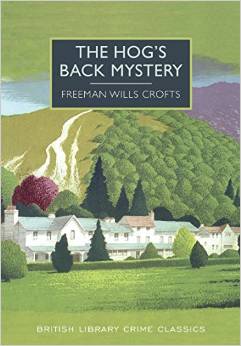
hogs-back

A feature of the cover design of the British Library’s Crime Classics series is the use of illustrations taken from old railway posters. This, no doubt, is tapping into a feeling of nostalgia for a bygone era when for most people travelling on holiday meant a train journey to the seaside.

Rob Davies of the British Library explained in his session at The Bodies From The Library conference in June that the adoption of this new retro look for their Crime Classics series saw a quantum leap in sales. With the series featuring John Bude novels such as The Cornish Coast Murder and The Lake District Murder, the connection between the locations and entertaining holiday reading was too good to miss so the 1920s and 1930s railway poster designs became an intrinsic part of the brand.

The evolution of such posters is intriguing in itself. Initially, when the railways first sought to encourage passenger travel they were torn between conflicting approaches – to load the posters with information about the destinations or to let the picture replace a thousand words and rely on strong images to attract attention. Gradually the latter approach prevailed with minimal text and often a strong “strapline”.  Who can forget “Skegness is so bracing”?

For a quick journey through the timeline of the evolution of railway posters go to:

http://www.bbc.com/culture/story/20150817-vintage-tourism-posters-railways-britain

Mark