Huge thanks to delegates at the conference


We were delighted to see you all. 

If we didn’t get opportunity to speak to all of you we just wanted you to know that we were thrilled so many people came and we hope you had a great day. 

We will be sending you feedback forms so you can tell us what you liked, what we could do better, and, most importantly, what you would like to see at future Bodies From The Library conferences. 

See you all again!

Off to the British Library

…to complete the final preparations for tomorrow’s Bodies From The Library Conference. 

The whole team is so excited and looking forward to welcoming the delegates. 

We hope, after all the preparation, that the hard work pays off and everybody has a fabulous day. 

See you there!

Trollope pops up for The Bodies From The Library Conference


You might be forgiven for thinking that there can be little in common between one of the great Victorian authors and golden age detective fiction other than his prolific output which bears comparison with Agatha Christie (47 novels from Trollope against 66 for Christie with 6 more as Mary Westmacott).

Indeed Trollope thought nothing of reassuring his readers almost from the outset of a novel that the hero and heroine will get together in the end whatever trials and tribulations they might go through during the course of the novel, whereas the detective fiction genre by its very nature seeks to conceal and misdirect the readers about the ending. However, closer reading reveals some interesting points in common.

There is a prevailing sense that there is a rightness and orderliness to which life should conform. Trollope was by nature conservative and liked the social order to be maintained. He may show internal struggles between high and low church camps in the Church of England but does not like to see this struggle spill over into the public domain disturbing the population of Barchester at large. The same desire for order to be restored after it has been disturbed by the events related in the crime novel is a core part of the appeal of golden age detective stories – the killer is caught and justice is done (though not always through the formal judicial system).

There is an understanding of money as a key motivator in human events. Whether it is the agonising of Mark Robarts over the debts he has brought upon himself in Framley Parsonage or in the colossal swindling of Melmotte in The Way We Live Now, Trollope shows how money, the greed for more of it, and the painful exigencies to which the lack of it drives people is behind so many of our actions. Often there is dependence of one generation on the prospective inheritance from the previous generation that drives people to act as they do.

So what type of detective fiction might Trollope write. Some might suggest he would be into “cozies”. Few would consider him “hard-boiled” or “noir”. And though his plots might not be as tightly wrought as “golden age” authors, his psychological insights, especially into women, would place him alongside the finest writers of the genre such as Ruth Rendell or P D James. 

“Discuss!” As they used to say on exam papers. 

Last Few Days Before The Conference

I have been away for a few days and after I finished packing my bag, I downloaded four novels from the speakers’ recommended lists: The May Week Murders by Douglas Brown, Death’s Bright Dart by V C Clinton-Baddeley, The Case With Nine Solutions by J J Connington and Inspector French and the Starvel Tragedy by Freeman Wills Crofts. 

I think it is just marvellous that I can buy these books in seconds and pack them for holiday reading without taking up any space in my bag. 

It is also fantastic to see so much Golden Age detective fiction available again through e-publication after years of obscurity and being out of print. 

Looking forward to discussing these and other related topics at the British Library on Saturday. 

A Three Pipe Problem

This week I have read The Norwich Victims by Francis Beeding, Fire Burn! by John Dickson Carr (which I picked up for just £1 the previous week at the Book Barn – what a bargain) and The Greene Murder Case by S S Van Dine. I found the historic setting of Fire Burn! gave it a very different feel. I am not sure I go for the bang on the head/time travel book-ending of the story but then it worked for the TV series Life on Mars though that only went back to the 1970’s rather than 1829 as Dickson Carr chose to do.

One of the peculiarities of manner which emerged about the pre-Victorians was their prudish reaction to the excesses of the earlier Regency era.  So along with keeping one’s hat on indoors, and always wearing gloves (useful for those of a criminal disposition), there was the treatment of smoking which is not a million miles from the modern almost blanket ban anywhere civilised. A female charcter notes to a male character that she can tell he has been smoking but doesn’t mind even though she ought to do so.

This makes such a change from the usual Golden Age novel set 100 years later. Then everybody smokes, the only question is what? Of course, pipes are favoured by some of the cerebral detectives (following Holmes we see Wimsey and Campion both indulging in pipes at one time or another). Others go for cigars (Gervase Fen, Roger Sheringham  et al – as well as Wimsey and Campion when social occasions require it). Cigarettes are more the preserve of the police detectives (Inspector Martin) or Americans (Philo Vance – though, to confuse the issue, he speaks with an effete, laconic drawl in the finest Wimsey or Campion tradition).

Women tend to smoke less, however, and this can be a pointer to their moral and hence criminal tendencies – I won’t give examples to avoid spoilers but you have been warned! Note to self – must check if Harriet Vane smoked in Strong Poison – now that would have been a red herring though it could be a marker laid down by Dorothy Sayers that Vane is in the feminist vanguard.

Do You Write Under Your Own Name?

With apologies to one of our speakers, Martin Edwards, for shamelessly pinching the name of his Blog as a title for this post, I have been struck while going through the recommended reading list from our speakers how many of the Golden Age authors wrote under one or more pseudonyms.

Over the last week I have read The Monogram Murders by Sophie Hannah, The Poisoned Chocolates Case by Anthony Berkeley and Antidote to Venom by Freeman Wills Crofts.

But Berkeley also wrote under the name Francis Iles and A. Monmouth Platts. The Francis Iles pseudonym appears to have been his preferred choice for books that attempted to subvert the conventions of the genre, such as Malice Aforethought, but he also used it when serving as a book reviewer for The Daily Telegraph – read into that what you will.

Berkeley is even less trust-worthy when you consider that The Poisoned Chocolates Case is a full length novel that reworks the plot from an earlier short story The Avenging Chance, which gets name-checked in the novel as a play attended by a possible suspect. So even the book is appearing under a pseudonym. Indeed the short story solution is one of those proposed by one of the detectives in the novel but proved to be incorrect.

Likewise, John Dickson Carr is represented in the list under both his own name (The Hollow Man and Fire Burn!) and his Carter Dickson pseudonym used primarily for his Merivale detective fiction (He Wouldn’t Kill Patience). He also used Carr Dickson and Roger Fairburn.

Francis Beeding (author of recommended book The Norwich Victims which I am currently reading) is the pseudonym of not one but two authors collaborating – John Palmer and Hilary St George Saunders.

S.S. Van Dine (author of The Greene Murder Case) is the pseudonym of Willard Huntington Wright who was too embarrassed at writing what he regarded as pulp fiction that he preferred to do so under an assumed name.

Even Agatha Christie was at it. She wrote several romantic novels under the pseudonym Mary Westmacott.

So if you’re coming to the Bodies From The Library conference -you might want to consider attending under a false name. You never know who you might meet.

Yours,

Mickey Mouse

So many maps

One of the great delights of golden age detective fiction is the plethora of maps that appear.

As I read through the recommended list of books from our conference speakers, three of the books I have just completed, Overture To Death by Ngaio Marsh, Look to The Lady by Margery Allingham and The Nine Tailors by Dorothy L. Sayers feature maps (and sometimes more than one such map) of the locations where the crimes take place. And one need look no further than Agatha Christie’s first Poirot novel The Mysterious Affair at Styles to complete your full house of all four Queens of Crime including a plan of the setting for the action. They are, of course, not alone in having this feature.  Fully half of the books I have been reading in preparation for the conference, by almost any of the golden age authors, have something of the kind.

This fascination with pictorial representations of the scene in no way indicates shortcomings in the descriptive powers of the writers. This is far from the case. It appears more to be adherence to a convention and bowing, therefore, to their audiences expectations.

It does make for an interesting diversion from the main business of reading the story to check the maps to follow routes taken by characters – do they seem to be sensible ways to get from A to B in the time available? Will the alibis stand up?

But sometimes, the layout is not significant to the plot. In that case, is the presence of the map in itself a giant red herring, implying that character’s movements around the setting for the events is of greater importance to the solution of whodunnit than is in fact necessary?

Perhaps this is why two other books I have also read recently, X v Rex by Philip Macdonald (writing as Martin Porlock) and Malice Aforethought by Frances Iles (aka Anthony Berkeley) do not use maps. Each is, in its way, consciously breaking with the traditions and conventions of the genre.  Neither is a classic whodunnit puzzle to be solved. The former is arguably the first attempt to portray a serial killer and reveal something of the killer’s psychology that drives them to commit the crimes; the latter is an inverted tale where you know the identity of the killer and the question is whether or not he will get away with the murder or be caught (wherein lies the suspense).

Golden Age at CrimeFest 2015

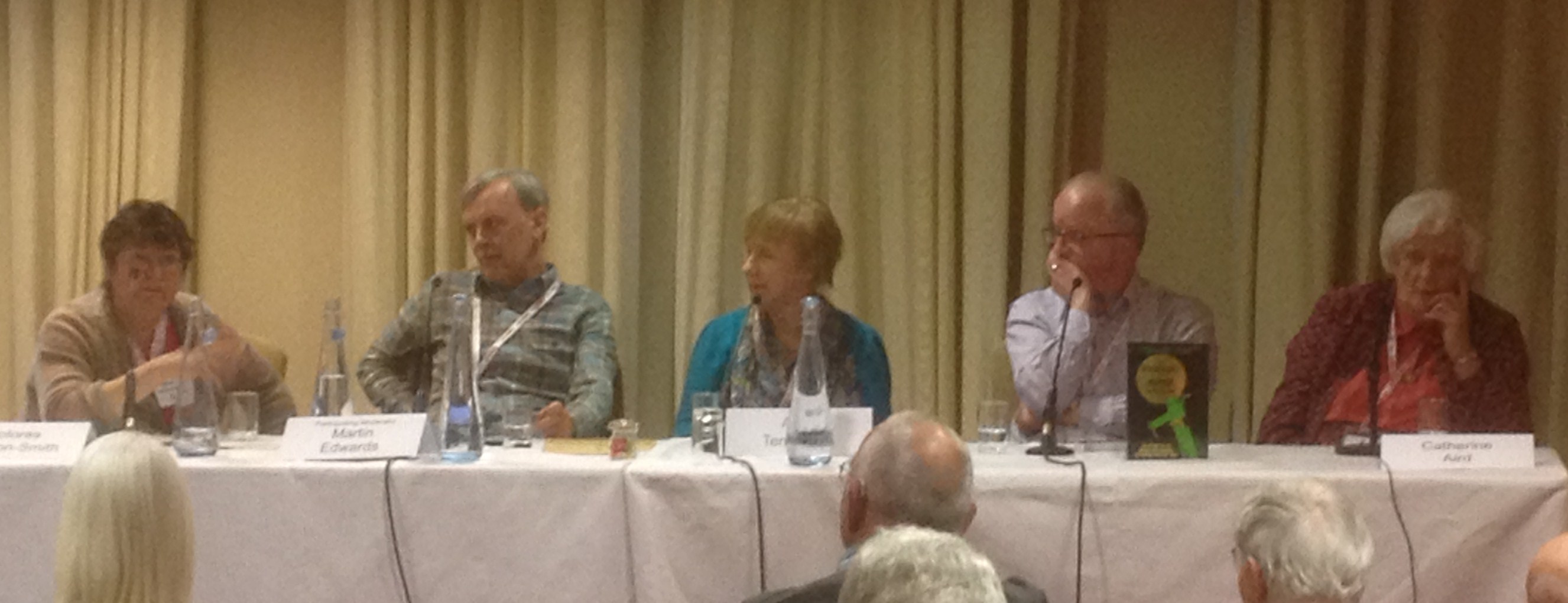
CrimeFest Golden Age Panel

One of the best attended sessions at CrimeFest 2015 was the panel “Forgotten Authors: The Golden Age of Murder”. Five leading authors and experts on the Golden Age took turns to urge readers to rediscover their favourite authors whose books are unjustly neglected.

Dolores Gordon Smith advocated Freeman Wills Crofts and G K Chesterton.

Martin Edwards spoke up on behalf of G D H and Margaret Cole; and Milward Kennedy.

Aline Templeton recommended Margery Allingham and Ronald Knox.

John Curran put forward J J Connington and Henry Wade.

Catherine Aird proposed Josephine Tey.

Three of the panel, Dolores, Martin and John will be speaking in more detail about Golden Age Detective Fiction at The Bodies From The Library conference.  Dolores will be talking in more detail about Freeman Wills Crofts, while Martin will be expanding on the theme of Forgotten Golden Age authors and John will be speaking on Agatha Christie.

Martin’s new book The Golden Age of Murder about the authors of that era is out now and provides the most comprehensive review of the genre yet to appear. It is a must read for anyone who wants to get to grips with the sheer volume and variety of crime fiction from the golden age. For more information and to buy a copy follow the link below: